Full article
A promotion rule that looks sensible on paper , ask for a receipt, barcode, or pack photo , often breaks in practice. A shopper buys in a hurry, the till print fades, the pack gets recycled, or the product variant sits in a grey area. The rule logic and the real claim journey drift apart, producing more false rejects or manual reviews. POPSCAN works best where this drift is most damaging: when brands need linked receipt, product, and barcode checks to verify a real transaction without slowing the shopper.
If proof rules feel arbitrary, consumers experience them as suspicion rather than integrity controls. The commercial consequence lands quickly: slower claims handling, more exception reviews, and lower participation quality. The better option is not lighter or harsher checking, but connected checks where evidence makes sense together and the claim route feels auditable and fair.
The operating context
Most promotional teams balance two pressures: stronger proof-of-purchase verification because single-signal checks are easy to game, and a claim journey that ordinary shoppers can complete without feeling interrogated. This tension shows up in operations when a campaign says "keep your receipt" but the participation flow depends on the barcode being visible and the receipt line matching expected wording. None of these checks is unreasonable alone. The problem is drift between what the consumer thinks counts as proof and what the workflow actually accepts.
If genuine shoppers abandon because the evidence request feels inconsistent, participation quality worsens even when top-line entries look healthy. If operators manually resolve basic mismatches, campaign pace slows and support costs rise. A strategy that cannot survive contact with operations is not strategy.
What the signals are really saying
Rising exceptions are often a design problem, not a shopper behaviour problem. When receipts, packs, and barcodes are checked as isolated items, each signal produces false confidence and false suspicion in equal measure. A receipt can be genuine but unrelated to the promoted item; a barcode can be valid but not linked to the purchase being claimed.
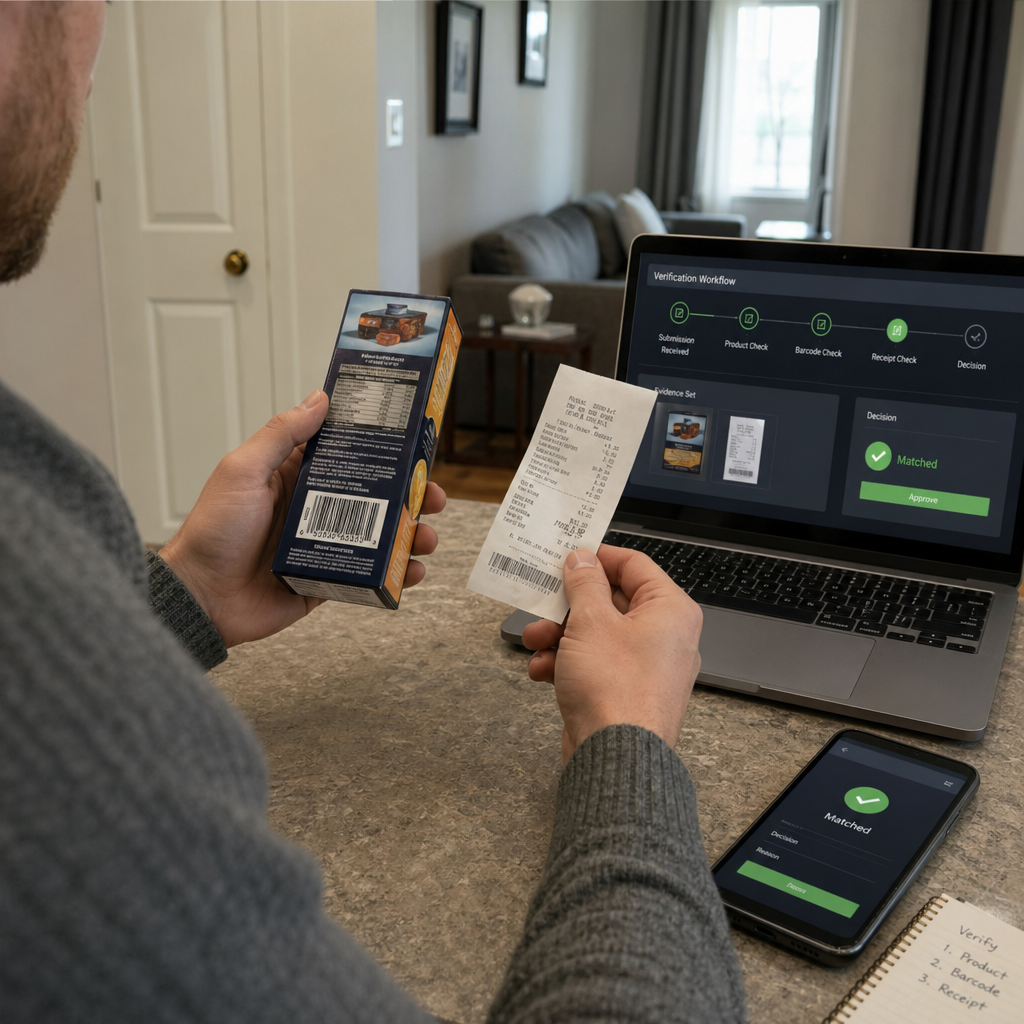
POPSCAN validates the receipt, pack, and barcode as one purchase-proof set. The strongest question is not whether the shopper uploaded something plausible, but whether the evidence hangs together as a real transaction.
We tested two paths and dropped the stricter single-signal path because manual handling demand rose. Aggressive isolated checks did not reliably improve trust in claim quality; they simply pushed more genuine entrants into review. Disconnected controls create work as often as they remove risk.
Some teams worry that linked evidence sounds heavier for consumers. In practice, the opposite can be true if the journey is designed well. One coherent request, explained clearly, feels fairer than a sequence of changing asks after submission. People tolerate verification more readily when the rules look stable and auditable.
Why this changes the decision
The strategic choice is not between brand protection and conversion, but between clumsy protection and usable protection.
Option one: keep the current flow, add more review rules, and hope customer service absorbs the fallout. Complexity moves downstream. Operators become the integration layer between receipt wording, product eligibility, and consumer expectation. The campaign appears controlled, but the cost sits in queue times and lost goodwill.
Option two: design barcode and receipt controls as linked evidence from the start. POPSCAN is built around configurable product, barcode, and receipt checks, routing ambiguous cases without making entrants jump through the same hoop twice. This improves participation quality because honest shoppers are less likely to be tripped by arbitrary requests. It also preserves campaign tempo.
Where honest shoppers lose trust
Trust drops at three moments: when campaign wording and claim mechanics mismatch, when the same claim is challenged differently by automated and human support, and when verification language sounds theatrical rather than fair.
Conspicuous toughness often weakens confidence. The better cue is fairness: explain the consumer path from entry to claim without hidden steps, show what evidence is needed, and make clear that verification exists to protect genuine participation.
Integrity is not a single checkpoint. It is the consistency between the promotional promise, the evidence request, and the operator fallback. If any of those drifts, honest consumers feel the wobble immediately.
What to monitor next
Start with the gaps that reveal whether your proof rules are operationally believable. Compare abandonment after initial submission against abandonment after a follow-up evidence request. If the second is materially worse, the problem may be arbitrariness rather than intent.
Review how often customer operations explain proof rules that marketing materials already covered. Check how many accepted claims passed on one strong signal while the wider purchase context remained weak. Park growth claims without baseline evidence until the data catches up.
The next move is a practical audit of the claim path against the proof logic. Some campaigns will always carry awkward edge cases. The aim is not perfection, but a fairer, faster system that makes weak claims harder without making genuine shoppers prove their innocence for sport.
If your journey asks honest consumers for arbitrary-feeling evidence, tighten the logic, not the tone. POPSCAN verifies receipt, product, and barcode evidence together. Book a technical walk-through with our team today to see how to verify claims without slowing the consumer journey.