Full article
Why do high-volume text-to-win campaigns so often trade entry speed for claim quality? The initial SMS entry route feels tidy, yet code entry on its own leaves gaps in purchase verification that matter when claim quality starts to slip. That gap becomes costly when digital channels amplify weak participation before the dashboard even registers a problem.
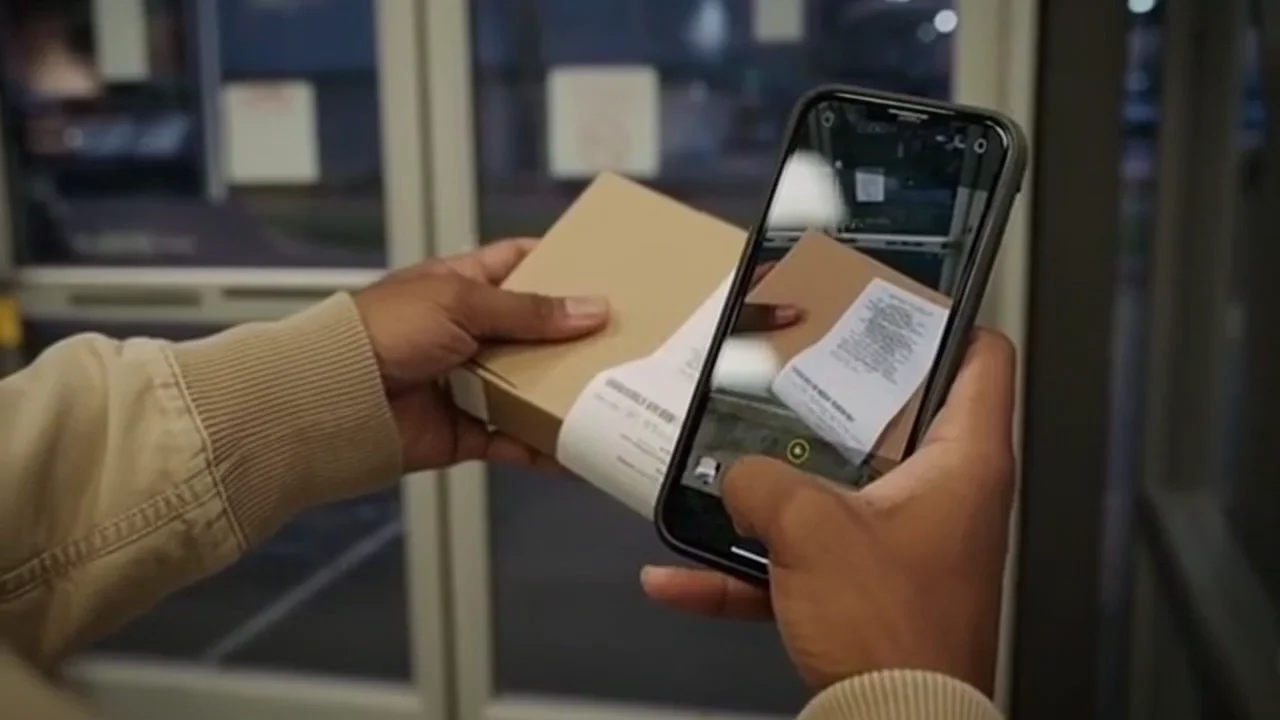
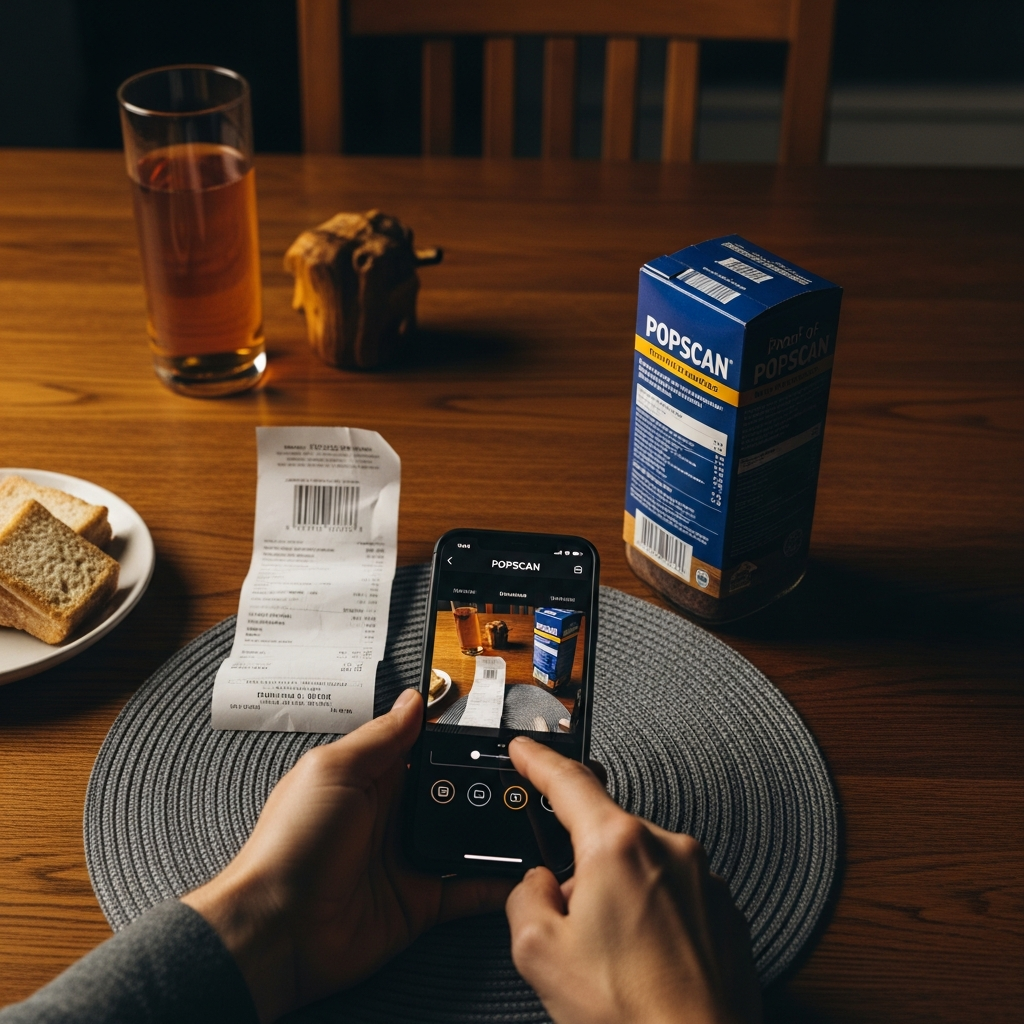
Design proof of purchase verification in the right sequence. POPSCAN validates the receipt, pack, and barcode as one purchase-proof set. By combining these signals, brands can filter weak entries without overbuilding the consumer journey and avoid settling disputes through manual guesswork.
Why teams trip here
Most campaigns fail not from ignoring controls, but from applying the wrong ones at the wrong moment. A text-to-win mechanic is attractive precisely because it lowers entry barriers and can lift response volume fast. But when a campaign requires a genuine purchase, operations need an evidence layer that actually confirms the transaction context, rather than just an entry attempt.
That is where weak design choices reveal themselves. Receipt-only proof can look convincing on a slide deck, yet receipts submitted by participants are often incomplete, poorly photographed, or circulated repeatedly if there is no matching product signal. Barcode-only checks improve product specificity but still leave uncertainty around when and how the item was bought. Teams usually discover this late, watching support queues fill with exceptions or duplicate patterns that are technically possible but operationally expensive to verify.
A strategy that cannot survive contact with operations is not strategy, it is branding copy.
| Control approach | What it can confirm | Main weakness | Operational consequence |
|---|---|---|---|
| Text code only | Entry attempt and timing | Leaves gaps in purchase verification | Weak claims surface later, often at claim review |
| Receipt only | Transaction context | Harder to prove the exact qualifying product without product matching | More exceptions and manual handling |
| Barcode only | Product identity | No direct proof of transaction on its own | Eligibility disputes remain open |
| Barcode plus receipt | Product identity and transaction evidence | Needs careful journey design to avoid friction | Stronger participation quality and faster exception handling |
The sequence worth following
The useful comparison is evidence-led proof of purchase versus single-signal checks that are easy to abuse. The best sequence removes avoidable ambiguity early. For most purchase-required text-to-win offers, that means a simple entry point followed by a proportionate request for purchase proof.
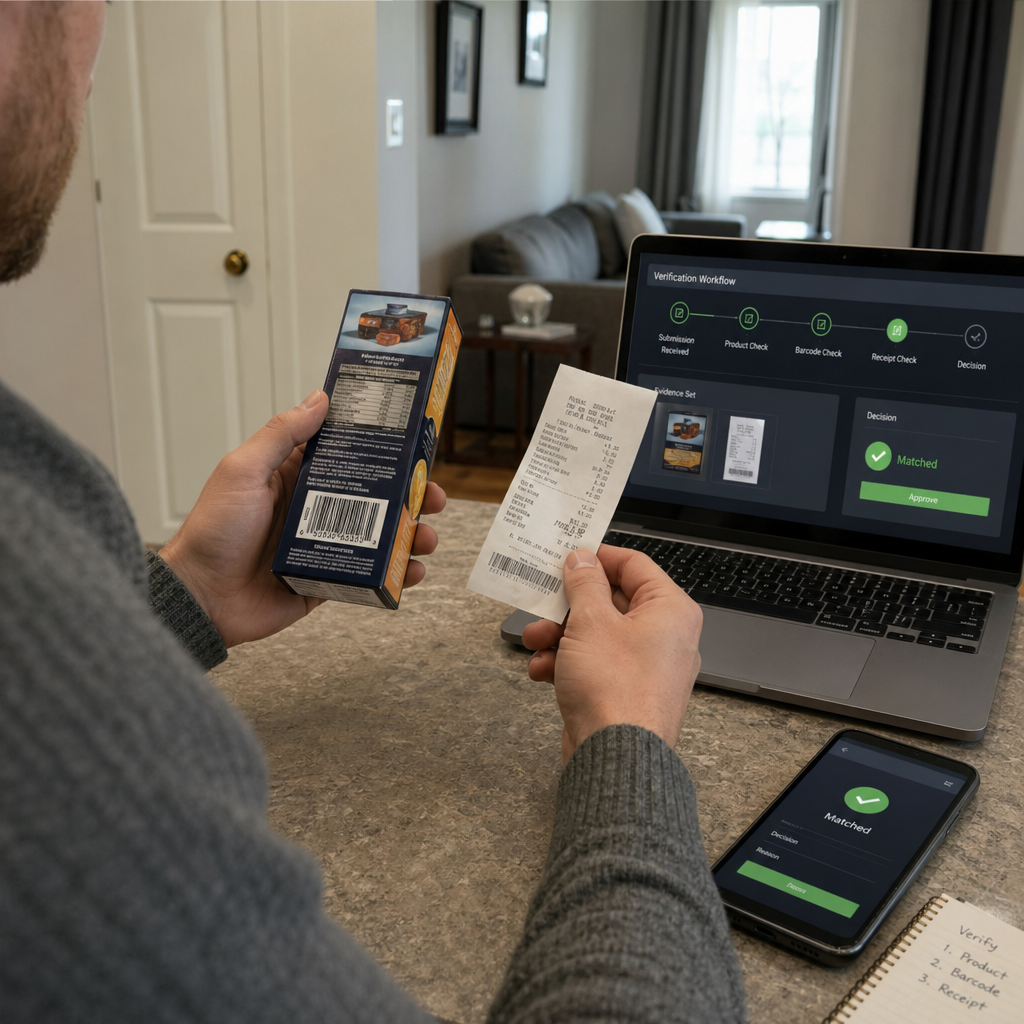
The POPSCAN workflow is built around exactly that joined-up logic. Product, barcode, and receipt signals are assessed as one decision path, rather than three disconnected hurdles.
In practice, capturing the barcode alongside the receipt image upfront prevents a large exception bottleneck at the claim stage. This sequence has been tested against single-signal routes and consistently reduces manual review volume. The public journey must remain completely transparent. Best practice is to show the consumer path from entry to claim without hidden steps. Prize and claim mechanics should feel auditable. The consumer should understand the rules and see exactly what counts as valid proof. Behind the scenes, the internal logic must avoid theatre. If a control step cannot affect a decision, remove it. Extra data points that feel serious but do not materially improve eligibility decisions only slow response time and give operations useless data to process, without improving promotion participation quality.
Where judgement still matters
No automated system removes human review entirely. Pretending otherwise creates brittle processes. The real question is where that judgement adds commercial value. In barcode and receipt controls, judgement matters most at the edges. Think partial receipts, damaged barcodes, unusual store formats, or promotional packs that differ slightly from the main run. These are not fringe concerns. They are the exact cases that turn a promising control model into a backlog.
The proof question is whether the claim stays consumer-friendly while the brand still gets strong verification.
When a dependency shifts, for example, a change in promotional pack design, the verification sequence may need re-ordering to maintain momentum. Applying maximum strictness at the front end is too blunt; genuine customers drop away before the campaign can perform. Selective strictness works better: let obvious valid entries pass cleanly, route doubtful ones to review, and keep rule language transparent so support can explain decisions without improvising.
The trade-off is always timing. Looser controls accelerate launch. If claim quality drops in week two, the catch-up cost lands squarely in customer operations. That distinction is worth a closer look when balancing budget against risk.
What the clean version looks like
A clean design for a text-to-win offer treats evidence as a primary concern, not a bolt-on. It makes the claim path visible upfront and keeps the review logic proportionate to the prize value.
Best practice dictates that we use language that communicates fairness and verification, not theatre. If purchase evidence is needed, say so early. If the barcode must match a specific pack family, make that explicitly clear in the primary copy. Fairness is much easier to defend when the path is obvious before participation starts.
For teams handling live volume, the strongest setup includes a defined barcode capture requirement, a receipt image standard that customer operations can actually read, and smart routing rather than blanket rejection. Poor-quality evidence can be flagged for review instead of being discarded automatically when the promotion economics justify a closer look.
- Confirm whether purchase proof is required at entry, at shortlist, or at claim stage, and pick one deliberately.
- State which products qualify, including exactly how barcode evidence will be used to confirm eligibility.
- Define what a usable receipt image looks like, covering date, retailer detail, and line-item visibility.
- Decide how duplicate receipts and incomplete images will be handled operationally.
- Set a review route for edge cases rather than forcing all uncertainty into immediate rejection.
- Test the support script against real examples so fairness can be explained consistently.
- Check that each requested data point actively affects a decision. If not, remove it entirely.
A short checklist to keep nearby
If the team only keeps one reference page to hand, keep this one. It catches the avoidable slips before they turn into operational noise.
- Match the control to the offer value. Higher-value prizes justify earlier proof checks.
- Use joined evidence. Receipt and barcode signals are stronger together than apart.
- Keep the customer path explicit. Hidden validation steps damage trust and increase complaint risk.
- Route uncertainty intelligently. Review queues should handle genuine ambiguity, not mop up weak rule design.
- Measure where friction lands. Watch drop-off rates and claim exception volumes in the first live period.
POPSCAN brings these elements together, giving brands a secure verification layer that evaluates product, barcode, and receipt evidence as one cohesive decision. By filtering out weak claims early, the system protects your promotional budget without adding unnecessary friction to the shopper's journey. Contact our commercial team to map out an evidence path that actually survives contact with real-world operations. The useful question now is whether POPSCAN should be trialled on one route first, with the threshold and stop point made explicit.
The useful question now is whether POPSCAN should be trialled on one route first, with the threshold and stop point made explicit.