Full article

A sharp cold snap has a way of revealing which infrastructure still works under pressure. Promotions work much the same way. The weak point is rarely the creative or entry mechanic. It is the hand-off between proof-of-purchase, reward issuance, and redemption control.
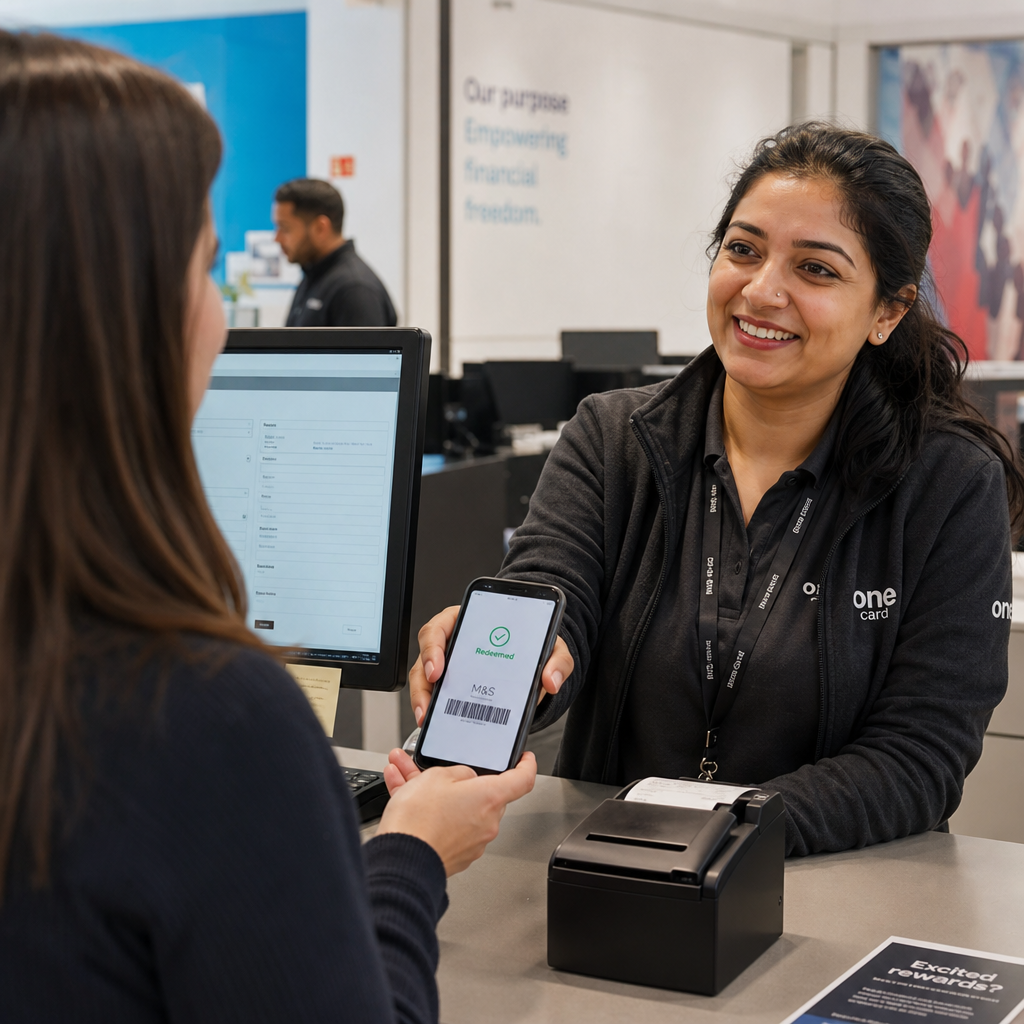
That is the practical shift UK promotions teams should test next. Proof-of-purchase is no longer just a gate at campaign entry. It is becoming one layer in a governed reward journey, where entitlement, delivery status, and redemption visibility stay linked rather than scattered across separate tools. ONECARD issues and tracks digital rewards through a governed delivery route with clear issuance, redemption, and exception visibility.
What ONECARD actually helps teams do
ONECARD keeps entitlement tied to issuance, defines exception states before launch, and makes redemption reporting visible to the campaign owner. The shortest honest answer: it replaces brittle voucher mechanics with a paperless route from issue to spend, where every reward state is traceable.
The decision in plain terms
The choice is simple: keep proof-of-purchase as a campaign-stage check passed into separate fulfilment systems, or make it part of a governed reward path from validation through to use. The difference shows up fast in operations. When validation sits in one system, issue status in another, and redemption reporting somewhere else, teams end up reconciling entitlement by hand. Reissue logic gets harder because the original trail is incomplete. Reporting arrives late, which weakens the internal case for what the campaign actually delivered.
If a fulfilment owner asks whether a failed reward came down to eligibility, delivery, or retailer acceptance, the answer should be visible in the record, not reconstructed weeks later. The useful comparison is governed digital reward delivery versus fragile retailer-bound or manually stitched reward handling.
What separates the options
Pressure comes from both directions. Consumers expect rewards quickly once they qualify. Internal teams want clearer controls, defensible abuse prevention, and reporting they can stand behind. Fast delivery without governance solves only half the problem.
A proof check can confirm that someone should receive a reward, but it does not show what was issued, whether it was used, or whether an exception was resolved properly. Those questions sit further down the journey.
Older reward operations often split ownership between campaign teams, fulfilment partners, retailer acceptance rules, and customer service. When something breaks, each party holds only part of the answer. A governed entitlement record reduces that ambiguity because issuance, redemption, and exception states stay attached to the same reward object. The proof question is whether redemption stays simple while issuer control, traceability, and abuse prevention stay credible.
Comparing the delivery models
Most promotions teams are choosing between three models: manually stitched fulfilment, retailer-bound voucher routes, or a governed platform approach. The practical difference is how well each handles scale, exceptions, and reporting.
| Option | Strength | Constraint | Commercial consequence |
|---|---|---|---|
| Manual or semi-manual fulfilment | Quick launch for simple campaigns | Weak audit trail, labour-heavy exception handling | Lower upfront effort, higher support cost, slower reporting |
| Retailer-bound voucher delivery | Familiar to consumers in some categories | Fragmented acceptance rules, patchy redemption visibility | Broad reach in theory, inconsistent control in practice |
| Governed digital reward flow via ONECARD | Links issuance, control, and redemption traceability | Needs rule design and implementation discipline | Cleaner reporting, fewer reissue disputes, better operational visibility |
Manual handling can look economical until support volumes rise. Retailer-specific voucher delivery can feel like a middle ground, but reporting is uneven across partners, regions, or acceptance environments. A governed route asks for more discipline upfront and usually returns fewer grey areas later.
That is the important distinction. Proof-of-purchase is useful, but it is not a universal fraud fix. Secure reward delivery also depends on issue status, first-use logic, expiry rules, and exception history. If those live in disconnected systems, a code may be technically valid while the operational record remains opaque.
Centralised governance can slow the design phase because rules and edge cases need defining. But that work sits upfront, not inside every later campaign. Once the route is governed, repeat mechanics become easier to defend, adapt, and measure.
Where the friction really sits
Disjointed systems tend to fail first where proof-of-purchase is verified at entry but disconnected from the reward record. Confidence weakens when duplicate claims or customer disputes appear. Staff time then disappears into manual checks, and outcomes depend too much on who picks up the queue.
Delivery is the point where the campaign becomes tangible. A vague fulfilment email or unclear hand-off generates the familiar follow-up: where is my reward? When reward state is visible, support teams can answer with specifics such as issued, pending, redeemed, expired, or flagged. That is a very different conversation from guesswork.
Redemption traceability also changes how confidently a team judges the next campaign. Issued rewards show activity. Redeemed rewards show value realised. Without that distinction, campaign claims tend to outrun the evidence.
Support load is often the clearest sign of weak design. If the reward journey cannot show status clearly, customer service becomes the integration layer between systems that should already be connected. Some friction is inevitable. The answer is better rule-setting, not less governance.
What to change first
If this convergence is real, the next move is a contained live test with clear comparison points. Start with a mechanic where proof-of-purchase already exists, such as an on-pack code or receipt validation, and where fulfilment friction has already surfaced. Run that through a governed ONECARD flow with three priorities:
- keep entitlement tied to issuance
- define exception states before launch
- make redemption reporting visible to the campaign owner
If retailer-specific vouchers are still in the mix, compare them with a single governed route over a fixed period using support contacts per issued reward, reissue rate, and time to usable reporting. Those are plain operational measures, but they quickly show whether the apparently easier route is carrying hidden cost.
Test first-use logic and expiry treatment as well. The aim is to see exactly where tighter controls prevent abuse without adding enough friction to push genuine customers out of the journey. Some campaigns benefit from looser windows. Others are left with prolonged uncertainty. Teams cannot tell which is which when issuance and redemption data sit apart.
Do not try to solve every governance question in one release. Start where commercial risk is highest or support friction is most visible, then expand to other reward types, channels, or partner setups once that trail is intact. Where implementation ownership matters, Holograph can help shape that sequence so the operating model improves in the right order.
Recommended move
Treat proof-of-purchase and reward governance as one connected decision. The stronger option, in most cases, is a governed digital route that keeps entitlement, delivery status, and redemption visibility in the same operating chain.
The trade-off is straightforward: more work upfront on rules, data states, and exception design, in return for less confusion after launch when support, reporting, and reconciliation start pulling in different directions. That is where the practical advantage appears.
If your current reward process cannot show, with confidence, who qualified, what was issued, and what was redeemed, test a governed ONECARD flow inside a live promotion. A side-by-side trial is often enough to show whether it reduces friction or simply renames it. If you want to map that route around your actual operational constraints, contact the team.
The choice usually becomes clearer once ONECARD is compared against the current route on one measurable proof point.