Full article
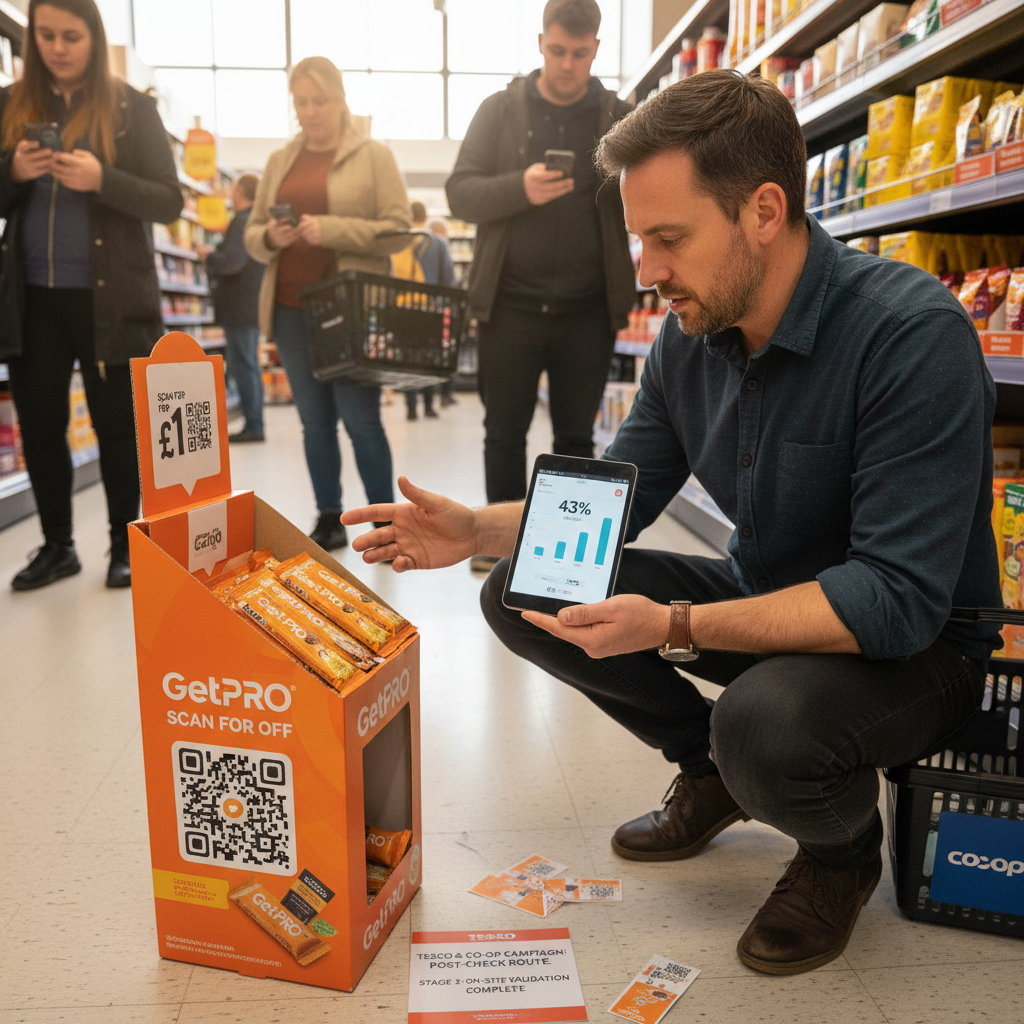
The short answer: for Tesco and Co-op coupon mechanics, push towards proof-of-purchase checks that can be automated, then prove the route in a controlled pilot before wider rollout. The public GetPRO Campaigns case study reports a 43% uplift in email sign-ups across Tesco and Co-op, tied to an on-pack coupon mechanic offering £1.50 off. That number does not answer the validation question on its own. It does change the operating conditions. More response means more coupon activity, more exposure to invalid claims, and less tolerance for slow or inconsistent checking. See the original case-study context here: Holograph case studies and Holograph.
The trade-off is plain. Manual checking is easy to start and awkward to sustain at volume. Full automation usually produces the cleaner model, but only if retailer data feeds, policy checks and exception handling are agreed early. The useful test is not which route sounds smarter. It is which route has an owner, a date, acceptance criteria and a fallback when a dependency slips.
What is being decided
The decision is how Tesco and Co-op coupon mechanics should confirm proof of purchase after a high-response activation. The trigger is concrete enough: if the GetPRO Campaigns mechanic can deliver a reported 43% uplift in email sign-ups, the redemption layer has to absorb higher activity without letting invalid claims through or dragging fulfilment to the point where the experience starts to fray.
That is where proof-of-purchase checks earn their place. They protect redemption data, reduce the number of invalid claims entering the system and give loyalty and retail teams a firmer base for the performance wrap. If your plan has no named owners and dates, it is not a plan, fix it.
The evidence is narrower than the headline result. The GetPRO Campaigns outcome supports the case that the coupon mechanic can drive response. It does not, on its own, settle the best validation model, the likely fraud rate or the service level a retailer can hold under pressure. Those are delivery questions. They need direct answers.
For this brief, the decision owner sits with the retailer-side loyalty or promotional programme lead, working with Holograph and the retailer's technical and compliance teams.
What the evidence actually shows
Start with the one figure that is public and specific: GetPRO Campaigns' Tesco and Co-op case study reports a 43% uplift in email sign-ups. That is the proof anchor. It is enough to justify a tougher look at validation depth, because a mechanic that pulls more response also adds operational load behind redemption.
The more useful reading is to separate what this case proves from what it only points towards.
- What it proves: the named coupon mechanic generated a measurable response outcome in a live retail setting.
- What it suggests: if the mechanic is repeated or scaled, weak proof-of-purchase checks could become a bottleneck or distort reporting.
- What it does not prove: that one validation model is automatically right for every Tesco or Co-op rollout.
That distinction matters. Teams routinely over-read uplift metrics. Stronger top-line response is useful, but it is not a stand-in for receipt validation rules, duplicate detection, service windows or compliance review.
Comparative view
There are three credible routes here: manual checking, automated validation, or a hybrid model where automation handles the majority and spot audits catch the edges. The risk profile changes with each option, so the choice should be made in those terms rather than by habit.
| Option | Primary owner | Indicative timing | Main risk | Useful checkpoint |
|---|---|---|---|---|
| Manual proof-of-purchase checks | Retail operations lead | Fastest to launch | Queue build-up, inconsistent judgement, higher staffing load | Redemption turnaround and exception backlog reviewed weekly |
| Automated validation via POPSCAN or equivalent | Data engineering lead with compliance sign-off | Longer setup, cleaner once live | API dependency, policy volatility, integration effort | Pass/fail against test receipts, duplicate detection and redemption within agreed service window |
| Hybrid model with spot audits | Programme manager | Moderate setup | Governance complexity, gaps between rules and manual review | Audit sample accuracy and exception rate tracked by retailer |
Manual checking often feels sensible in the first planning pass because it looks controllable and quick to deploy. That comfort rarely lasts once volume turns up. Costs climb, turnaround stretches, and valid submissions end up sitting behind suspect ones.
Automation demands more in the build phase, but it usually gives the better day-two model once rules and integrations settle down. The public Google Pixel launch work, described as faster, leaner and fully brand-compliant across multiple regions, is useful here as a delivery comparison rather than a retail equivalent. Different brief, same operational lesson: sort the underlying process early and the team spends less time rescuing avoidable exceptions later.
Where the mechanic fits best
This kind of proof-of-purchase model suits activations with three traits: a response mechanic strong enough to generate real redemption volume, a retailer environment that can support clean validation rules, and stakeholders who need reported outcomes that will stand up to scrutiny rather than simply look flattering.
It fits less well where the programme is small, one-off and simple enough that limited manual review will not distort service levels or reporting. That is the easier alternative. The mistake is sticking with it after response volume has moved beyond what a small manual team can clear without delay.
For Tesco and Co-op coupon mechanics, four controls matter most:
- receipt or purchase-data validation
- duplicate detection
- clear consent handling where data is captured
- promotion policy checks before launch and at each release gate
On data capture, the published guidance is specific: if teams collect email addresses or other data, give entrants a clear opt-out and keep forms short. Full terms can sit elsewhere if embedded space is tight. That is not a legal flourish. It keeps the journey usable and reduces ambiguity around consent handling.
On compliance, promotion and platform rules should be treated as volatile. Re-check retailer and platform requirements close to launch. An earlier review is not enough if the wording, proof flow or retention logic has changed underneath it.
Operational impacts
The real question is whether the mechanism can be run, measured and defended without turning the activation into a service problem. Fraud control matters, but it is not the whole story.
The pressure points are familiar enough. Receipt matching rules fail on edge cases. Duplicate logic can be too loose or too strict. Consent capture gets messy when the form tries to do too much. Compliance issues found late force rework after creative, build and QA are already committed.
That is why acceptance criteria need to be set before build starts. Teams should define what counts as valid proof, what triggers manual review, what duplicate thresholds apply, what turnaround time is acceptable and how provisional versus validated redemption figures will appear in the performance wrap. Miss those decisions and the mechanic may still launch, but it will be harder to trust and harder to defend.
Where the answer widens into product choice, the fit is practical. POPSCAN is the clearest route for automated proof-of-purchase validation. ONECARD or DNA matter more once the brief shifts towards identity, loyalty continuity or audience management across channels. MAIA comes into play when the challenge is orchestration and decisioning around the mechanic rather than the receipt check itself.
Risks and mitigations
The main risks are not subtle. They are the same ones that turn a neat activation plan into a messy launch week.
- Integration dependency risk: retailer APIs or data exports are delayed or incomplete. Mitigation: agree a fallback route before build starts, ideally a limited manual review path for defined exception types only.
- Policy and compliance risk: platform or promotional rules shift close to launch. Mitigation: set a final compliance review gate immediately before release and keep a change log.
- Volume risk: participation exceeds forecast and manual handling becomes the bottleneck. Mitigation: cap manual review categories, monitor backlog daily during launch week and trigger extra support if thresholds are breached.
- Reporting risk: unverified claims inflate redemption or loyalty reporting. Mitigation: separate provisional from validated figures in the performance wrap.
The consequence is straightforward. Checks that are too loose can make redemption look stronger than it is. Checks that are too heavy can leave a valid audience waiting too long. Neither result survives much scrutiny once stakeholders start asking harder questions.
Recommendation and next step
The recommended route is phased. Pilot automated proof-of-purchase validation where the data landscape is simplest, then extend once the exception logic, reporting treatment and compliance checks have held up under live conditions.
Begin with acceptance criteria. Agree what valid proof looks like, what moves to manual review, what service window is acceptable and how validated figures will be separated from provisional ones. Then assign the next move to the retailer-side programme lead, with support from Holograph's delivery lead and the relevant compliance contact.
A sensible pilot checkpoint should cover four measures: validation pass rate, duplicate-detection accuracy, average redemption turnaround and manual exception volume. If those stay within agreed tolerance, the case for wider rollout is credible. If they do not, the answer is not more optimism. It is tighter rules, clearer ownership or a narrower starting scope.
If you want to get this sorted without turning it into a six-week email chain, bring Holograph in for a delivery workshop and we will map the options, owners, risks and acceptance criteria with your team. We can pressure-test the Tesco and Co-op mechanics against real delivery constraints, call out what is likely to block progress, and leave you with a plan that is usable rather than decorative. Book a chemistry session with the Holograph studio team.