Full article
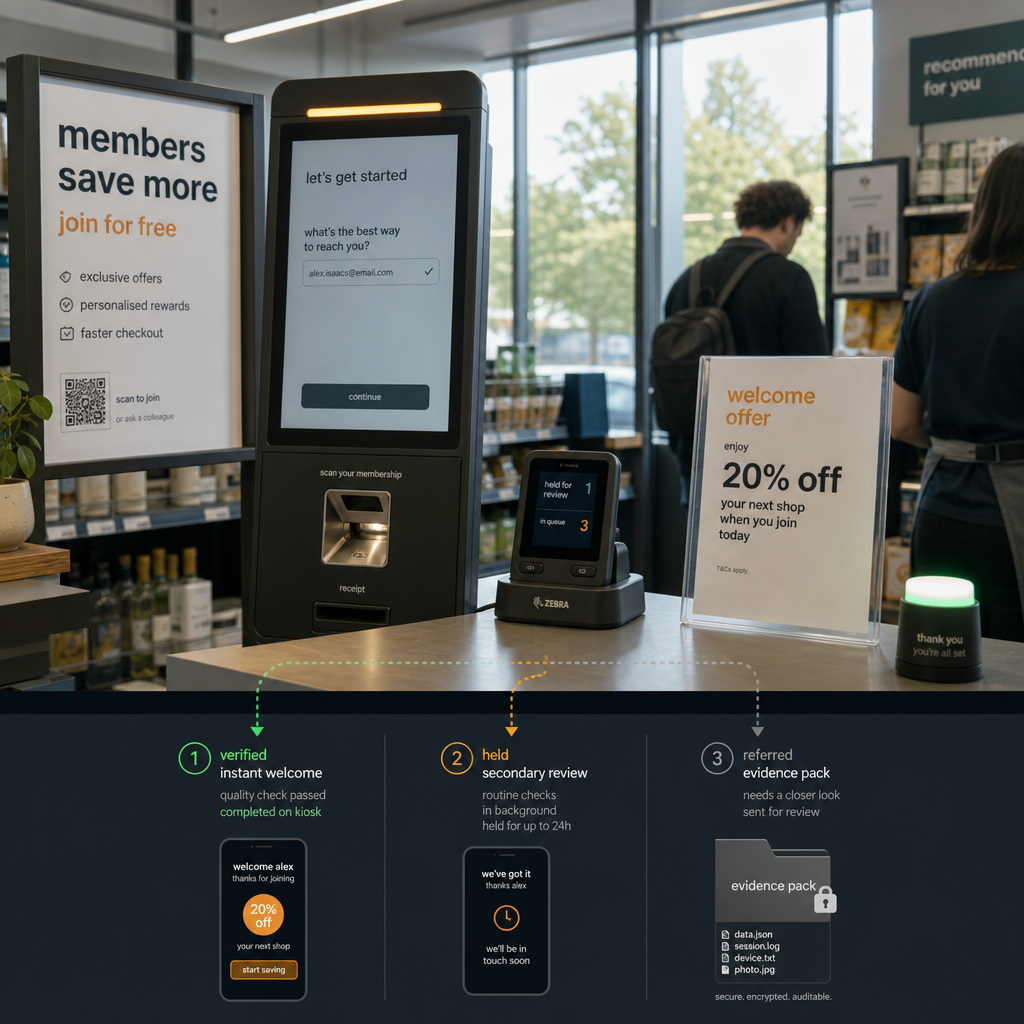
The difficult records are rarely the obvious fakes. The real problem is the plausible address that clears a form, enters a welcome flow and starts weakening deliverability, consent confidence and reporting a few days later. Acquisition still counts the sign-up. CRM and compliance inherit the mess.
That is the decision lifecycle teams actually face. Not whether to block everything risky or let everything through, but which records should be challenged at entry, which should be held out of automation, and which deserve review before the downstream cost spreads.
Where the pressure sits
The tension is straightforward. Acquisition wants low-friction capture during launches and peak periods. CRM needs cleaner inputs to protect inbox placement. Legal needs consent evidence that still holds up later. Those priorities only align if route decisions happen early enough to change the outcome.
Risky email records are not one problem with one fix. Some look like routine typing errors and can be rescued through an email confirmation loop. Others carry conflicting signals that make an automatic pass hard to defend, especially in regulated onboarding or where duplicate identity patterns begin to stack up. Leave them unchecked and the early damage lands in conversion reporting first, then sender trust.
Routes available now
For most UK lifecycle teams, the usable route set is pass, challenge, hold and review. EVE is an automated email-judgement engine built for that governed routing. It grades pass, challenge, hold, review or stop outcomes in real time and shows why the route was taken. That is the material shift from static regex or allow-list checks. Teams can see the reasoning, tune thresholds and exception handling, and avoid the usual choice between silent rejects and silent acceptance. More on EVE is here: EVE and Holograph solutions.
| Route | Best use | Main advantage | Main constraint |
|---|---|---|---|
| Pass | Low-risk, high-confidence records | Preserves conversion speed | Needs strong threshold discipline |
| Challenge | Likely genuine records with fixable uncertainty | Recovers good users without manual work | Adds friction at entry |
| Hold | Higher-risk records awaiting more evidence | Protects journeys and reputation quickly | Can suppress short-term volume |
| Review | Ambiguous or high-value edge cases | Creates auditable judgement | Consumes analyst time |
Challenge suits records that still look human and can be corrected in the same session. In that situation, a visible prompt usually does more good than pushing a weak record straight into a welcome programme.
Hold is the route teams often resist because the cost shows up immediately. Even so, once several risk signals converge, it is usually the cleaner call. EVE applies more than 30 proprietary detection methods, including keyboard walks, entropy analysis, alias unmasking and behavioural fingerprinting, with sub-50ms response times. Intelligent caching and optional client-side execution help teams apply that judgement without slowing legitimate sign-ups. The output is probability-based routing, not certainty, and the policy needs to reflect that.
Review belongs to edge cases where the cost of a bad decision is unusually high. It should not become the place where undecided policy goes to hide.
What each route costs
The cheapest-looking route is often not the cheapest route in the programme. The useful comparison is total drag across deliverability, consent evidence, suppression policy and manual handling.
Pass everything that seems mostly plausible and the cost arrives later. Bounce exposure and weak engagement blur the signal fast, and sender reputation moves on patterns, not isolated misses.
Challenge creates a clearer front-end cost. It needs copy that makes sense and a fallback path that does not trap a genuine user. In high-volume capture, though, it gives people a way to correct a mistake there and then. The Boots Health & Beauty Magazine pilot with The Pharm is a relevant reference point. Rapid sign-up growth across a new publication channel meant forms had to stay simple within platform constraints. If emails are being captured for promotions or editorial updates, a clear opt-out supports cleaner consent capture. But simple forms only hold up if the background route-state judgement is tighter, otherwise toxic data reaches the CRM with very little resistance.
Hold creates a different operational issue. It only works if the held record has a defined next state, whether that is suppression, automated reconsideration or a release rule tied to further evidence. Without that, volume disappears into a policy gap and the trade-off becomes difficult to defend.
Review is the most expensive route per record, but it can still be the cheaper decision overall. In a regulated journey or a high-value segment, analyst time is easier to justify than a bad pass. Auditability matters as much as detection here. EVE’s explainable logic, zero data retention position and quantum-resistant encryption help UK teams document why a record was challenged, held or reviewed without adding unnecessary data risk.
Which route to choose and why
The most useful default is still the plain one: pass low-risk records quickly, challenge recoverable uncertainty, hold high-risk records out of automation, and reserve review for ambiguous cases with real commercial or compliance weight.
This is not an abstract argument about challenge versus hold. It is a question of which route contains the downstream cost before it spreads into deliverability, reporting or manual clean-up.
- Challenge when the record looks human and the issue can reasonably be fixed in-session.
- Hold when multiple signals converge and the cost of a false pass is higher than the cost of waiting.
- Review when a wrong call would be awkward, regulated or expensive.
The usual objection is manual load. Fair enough. But that normally points to threshold design, source-level exceptions or weak release rules rather than a flaw in the route set. Review should remain a minority route. Teams are usually better served tightening rules around known risky sources, checking route shares weekly and re-tuning when campaign mix shifts. Some genuine users will always be suppressed by thresholds that protect the database. The serious question is whether that trade-off is controlled, visible and worth it.
The operational advantage sits with teams that can explain why a record was passed, challenged, held or reviewed, then adjust thresholds without slowing legitimate users down.
The next move for lifecycle teams
Do not begin by redesigning every form. Start by mapping current risky-record states against measurable consequences in the first week, the first 30 days and the next campaign cycle. If challenge rates stay low while bounce signals rise, the pass threshold may be too loose. If held volume grows without a defined next state, the route design needs fixing before stricter policy will help.
EVE gives teams a practical way to make those route decisions in real time, with explainable judgement that protects onboarding while controlling false positives and deliverability risk. If you want to see how those thresholds would behave in your own stack, book a frictionless validation walkthrough with our solutions team.