Full article

Silent reject looks neat until list growth softens, welcome flows thin out and nobody can show which records were blocked or why. That is the real choice for UK lifecycle teams tuning email risk: hide uncertainty inside a blunt fail state, or send it through governed judgement with visible routes, thresholds and exception handling.
The shortest honest answer is this. Use silent reject only for clear fail states. Use governed judgement when the risk sits in the middle and the team needs to protect deliverability without losing legitimate sign-ups or creating manual repair work later.
Decision context
EVE is not a pass-or-fail checker. It is an email validation engine and fraud-prevention layer that grades pass, challenge, hold, review or stop outcomes in real time, keeps the route reasoning visible, and lets teams tune thresholds without adding blanket friction to legitimate users.
That distinction matters because email risk is rarely just a form problem. It reaches into sender health, abuse control and governance. Toxic data drags on campaign performance. Repeated aliases and scripted sign-ups distort acquisition numbers. Opaque suppression decisions become harder to defend once consent, CRM status and lifecycle actions stop lining up.
EVE is built for that operating reality. It uses more than 30 proprietary detection methods, including keyboard walks, entropy analysis, alias unmasking and behavioural fingerprinting, with sub-50ms response time supported by intelligent caching and optional client-side execution. The technical point is straightforward: teams get a route decision at the point of entry, and the reasoning remains available for later review.
Options and trade-offs
Silent reject is simpler on paper. Governed judgement introduces route logic, exception handling and, sometimes, a review band. That extra structure is real. So is the cost of the simpler route. It usually appears later as weaker explainability, quieter false positives and avoidable clean-up inside CRM and lifecycle operations.
| Option | What it does now | Where value appears first | Trade-off to watch |
|---|---|---|---|
| Silent reject | Blocks suspect records before they enter CRM | Low front-end friction and minimal manual handling | Weak explainability and higher false-positive risk if thresholds are blunt |
| Governed challenge | Requests a confirmation step for borderline records | Recovers fixable user errors while protecting list quality | Adds some friction, so placement and timing matter |
| Hold and review | Queues narrower high-risk cases for manual or rule-based judgement | Strong auditability for higher-risk campaigns and abuse spikes | Queue capacity can become the new bottleneck |
The comparison that carries most weight is not sophisticated versus basic. It is explainable route-state versus hidden loss. If a team cannot show why one address passed, another was challenged and a third was suppressed, the apparent efficiency of silent reject starts to look fragile.
That is why the practical model usually sits between the extremes. Pass clearly sound records. Challenge recoverable ambiguity with an email confirmation loop. Hold or review only when several abuse signals stack up or policy requires another step. Silent reject still has a place, but as an endpoint for the clearest fail states rather than the default answer to uncertainty.
Where the operating model usually breaks
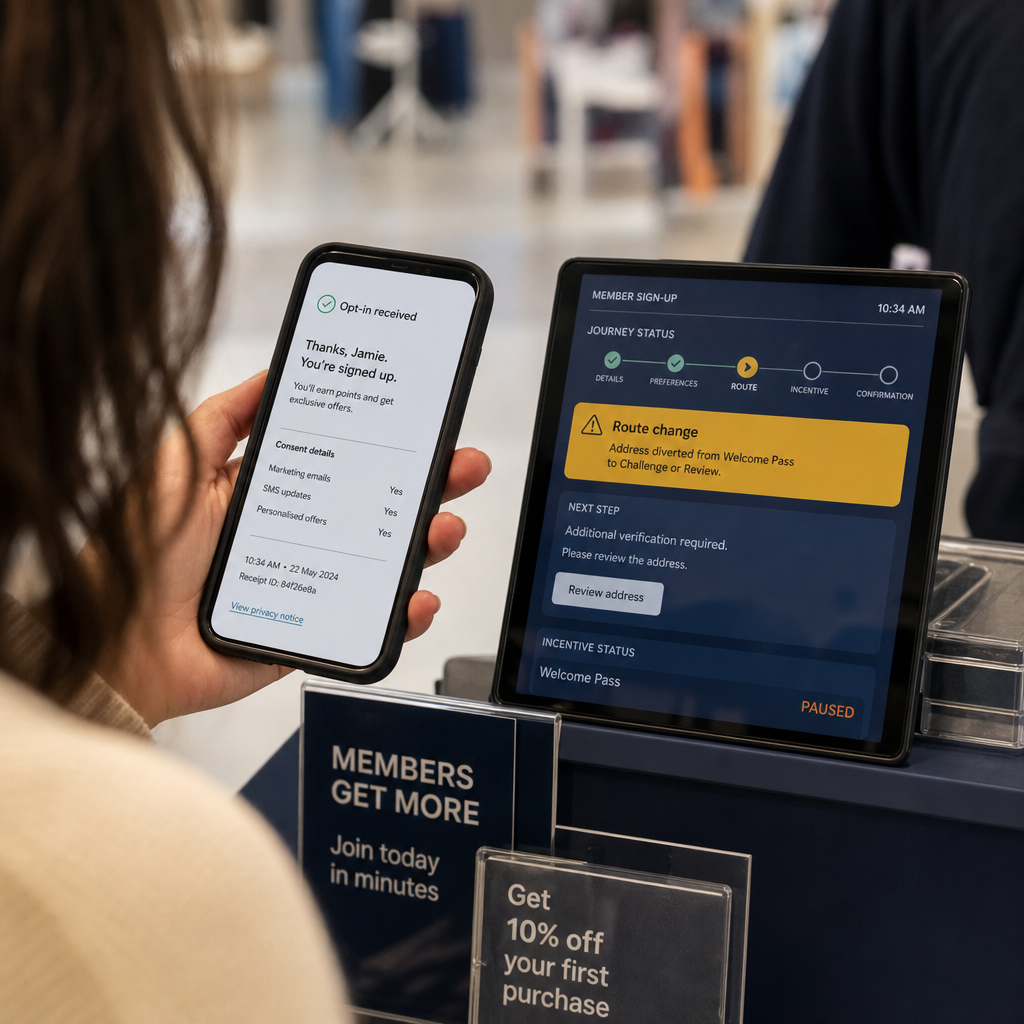
The form is rarely the weak point. The failure usually appears in the hand-off between route-state, consent capture and the first lifecycle action. Teams can grade risk accurately at sign-up, then lose the benefit if pass, challenge or hold status never reaches CRM, support tooling or campaign logic.
Two implementation checks matter first. Route-state needs to persist beyond entry so the welcome flow does not treat every accepted record as identical. Consent records and suppression logic also need to stay inspectable. If an address is collected, consent is logged and the record is later suppressed without a usable trail, the organisation is left defending a decision it cannot clearly reconstruct.
EVE supports that requirement with audit-ready controls, zero data retention and a compliance posture aligned to GDPR and UK GDPR expectations. It is still inferring authenticity probabilities, not setting policy for the team. Thresholds, exceptions and suppression rules still need to be owned inside the operating model.
Risk and mitigation
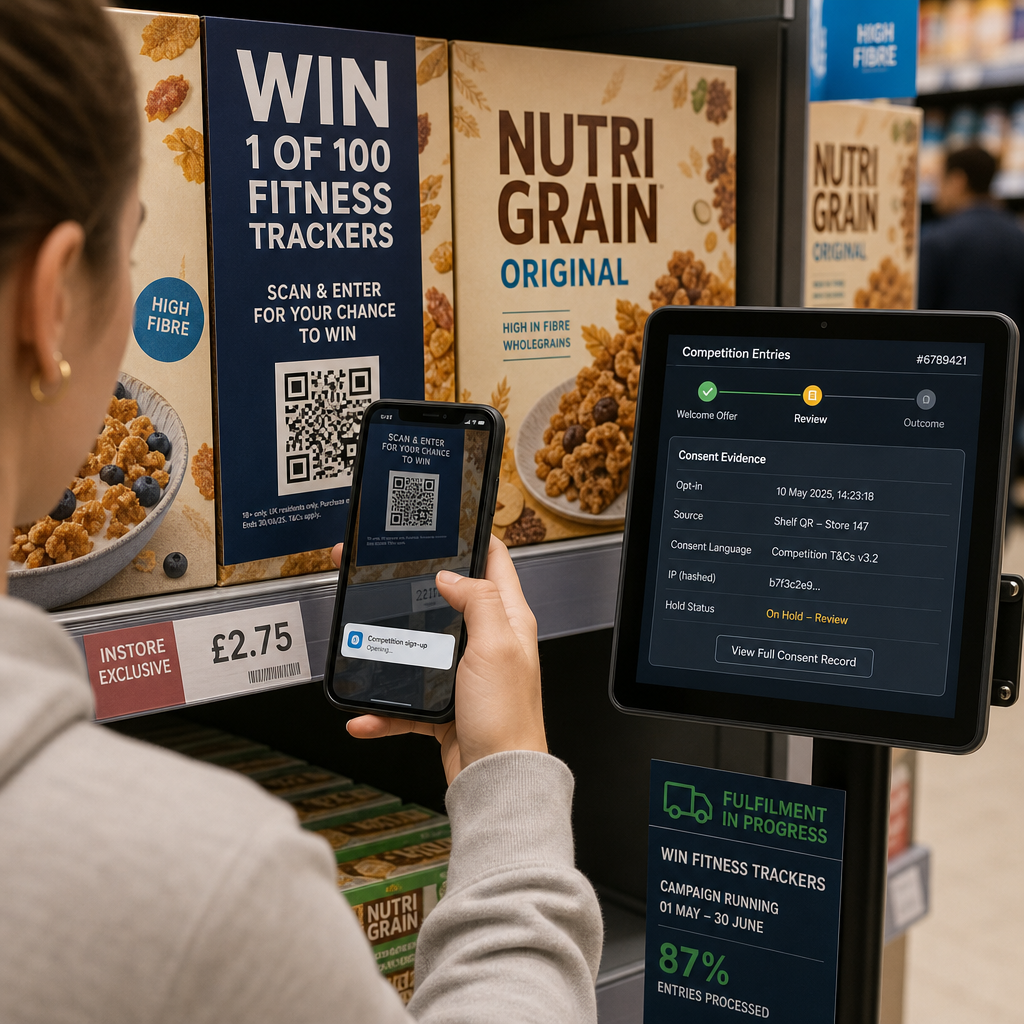
The pressure point in governed judgement is queue growth. Promotional mechanics, giveaways and other high-volume capture moments can push borderline records into hold or review faster than expected. Without a service level, a held record can function as a rejection by delay.
The mitigation is usually narrow and procedural. Keep the review band tight. Reserve hold or stop for repeated aliases, clustered abuse signals or explicit policy conflicts. Use a lightweight email confirmation loop where the ambiguity looks recoverable. If one route starts absorbing too much volume, change the sequence rather than forcing every record through the same path.
The first 24 to 48 hours usually show whether the design is holding. Correction rates, bounce movement, queue growth and complaint drift are the early signals. Within roughly 30 days, the wider commercial effect tends to appear in list efficiency, manual cleaning effort and sender-health repair work. Silent reject hides part of that cost at entry. Governed judgement exposes more of it early enough to tune.
Recommended path
For most UK lifecycle teams, the cleaner model is governed judgement with explicit routes. Not maximum strictness. Not generous pass-through. The next move is to tune by lifecycle stage and by consequence.
In acquisition, pass obviously sound records and challenge ambiguous ones with a low-friction confirmation loop. In onboarding, persist route-state into CRM so welcome logic reflects the original judgement instead of flattening everything into accepted or rejected. In retention, watch early indicators closely and retune before sender damage spreads. If thresholds are too strict, acquisition slows and recoverable users disappear. If they are too loose, toxic data enters the journey and the repair bill arrives later.
EVE fits best where teams need real-time route decisions, visible reasoning and threshold control without reducing every doubtful case to a silent block. For a more defensible way to tune email risk monitoring that UK teams can actually run, book a frictionless validation walkthrough with our solutions team. We can show where silent reject is masking loss, where governed judgement is likely to pay back first, and what to test next with EVE. See also the wider solution context here.