Full article

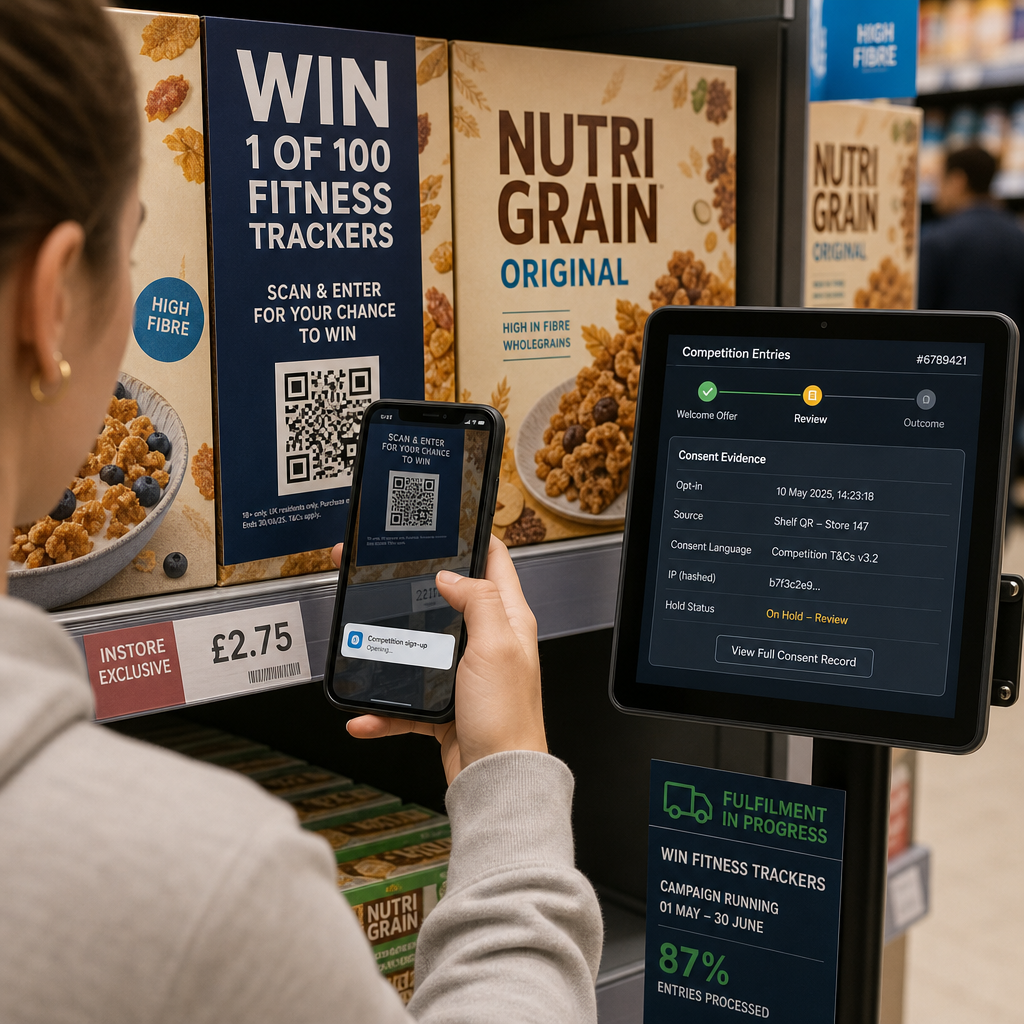
A reported 43 per cent uplift in sign-ups from a GetPRO Campaigns launch across Tesco and Co-op looks like a win. The contradiction: capturing an email address at scale is not the same as capturing a usable customer. Growth claims without baseline evidence need the data to catch up. This case study traces how coupon-led email growth impacts welcome-flow routing: where toxic data enters fastest, why legacy barriers fail under volume pressure, and how EVE’s real-time judgement separates genuine demand from noise.
The gap between capture and usable growth
Coupon-led capture works because it lowers hesitation. The same mechanic also attracts opportunistic noise. GetPRO Campaigns reporting pointed to a 43 per cent uplift in email sign-ups across their multi-retailer activation, but capture volume often masks CRM degradation. A digital coupon can draw in genuine shopper demand alongside mistyped addresses, one-off redemption aliases, and automated entries that complete the form while weakening what follows.
This pattern appears frequently in retail activation. The weak point is rarely the form field itself. It is the immediate hand-off into the welcome journey, where too many operations teams still rely on a simple accept-or-reject rule even though offer-led acquisition usually requires nuanced exception handling.
Real-time email judgement versus static regex or allow-list checks
Legacy barriers were not built for promotional surges. The live tension for a brand manager evaluating coupon-led acquisition is real-time email judgement versus static regex or allow-list checks. Static rules are a blunt instrument. They either block a potentially good customer who happens to use a privacy-first mailbox, or they let through sophisticated fake entries that look structurally valid but lack genuine behavioural intent.
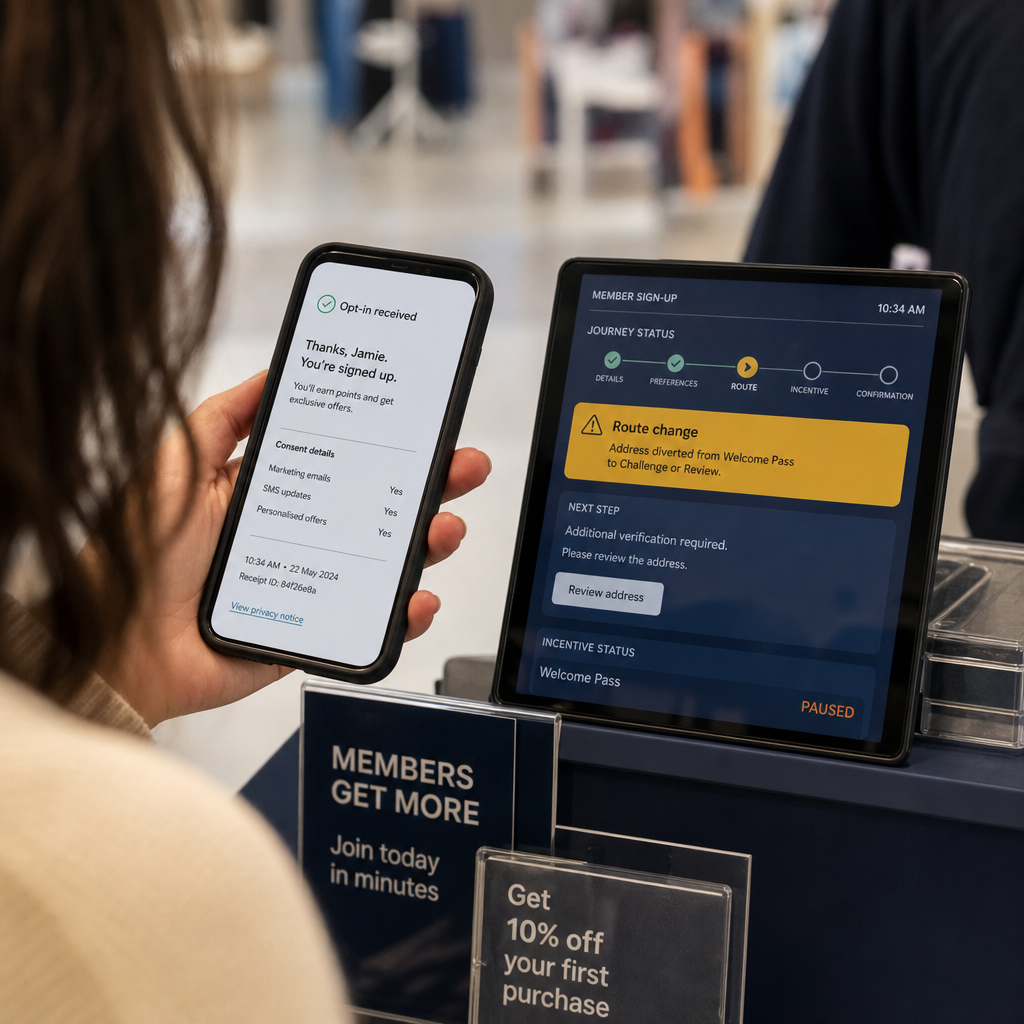
A strategy that cannot survive contact with operations is not strategy, it is branding copy. EVE grades pass, challenge, hold, review, or stop outcomes in real time and keeps the reasoning visible to the team. By processing these checks in around 50ms using more than 30 proprietary detection methods, keyboard walks, entropy analysis, and behavioural fingerprinting, the engine evaluates risk before the welcome email is triggered.
Two implementation choices matter here. First, the judgement layer sits close to the event creating the risk, the coupon-led sign-up, rather than in a nightly hygiene sweep. Second, risk scoring does not automatically mean rejection. Some records can look suspicious for legitimate reasons, particularly where privacy-first or less common mailbox setups are involved. Reject too early and the list may look cleaner while acquisition efficiency quietly drops.
Deliverability protection versus blunt fraud blocking
Deliverability protection versus blunt fraud blocking is the next necessary trade-off. Blunt blocking ruins the consent journey and adds friction. A simple double opt-in gate might seem sufficient, but the evidence shows otherwise. Double opt-in strengthens permission evidence, yet it remains a single gate. A malformed or low-integrity address can enter the system, trigger sends, and muddy reporting before the confirmation step has done its work.
When EVE sits directly after submission, low-risk records move straight into the welcome flow. Higher-risk records are routed into an email confirmation loop, held back from immediate send, or sent to review when the signals conflict. Since EVE stores no personal data and keeps its processing cache minimal, compliance is straightforward and audit trails remain intact.
What the evidence supports
The right baseline during a coupon surge is not top-line sign-up volume. It is the share of records that can enter the welcome programme as usable, permissioned, and deliverable contacts without creating extra handling. The supplied material supports the reported 43 per cent uplift in sign-ups for the GetPRO Campaigns launch. It does not break out downstream bounce rates or conversion quality after that uplift, so stronger outcome claims should wait.
However, what the evidence does support is the operating model. The useful comparison is governed automated judgement with thresholds and exception handling versus silent rejects, mailbox-quality drift, or avoidable human handling. If high-risk records are challenged, held, or stopped using EVE’s sub-50ms engine before the first send, the team protects early sender reputation and limits manual review to the narrower set that genuinely needs it. The caveat still matters: authenticity is inferred probabilistically, not proved with certainty. Borderline cases remain borderline cases.
The next move for lifecycle teams
Tiered routing, passing clear entries, challenging the uncertain middle, holding obviously poor records, and reviewing the small remainder, is a defensible model during a promotional spike. Start with the welcome path you already have. Insert route-state logic between form submission and first send. Define what pushes a record into a specific risk tier. Then watch the measures that actually show whether the model is working: acceptance quality, challenge completion, welcome performance, and review load.
The tension does not disappear once the model is live, but the operational burden shifts from emergency cleanup to governed tuning.
As it stands, the evidence is strong enough for one clear recommendation. Coupon-led growth is worth a closer look, but only when the welcome flow separates genuine demand from toxic data before it spreads. To pressure-test that routing before your next campaign window, book a frictionless validation walkthrough with our solutions team.
Proof and original case study
This interpretation draws on a public Holograph case study. For the original source detail, see kosmos.software, kosmos.software, the original Holograph case study and more Holograph case studies.