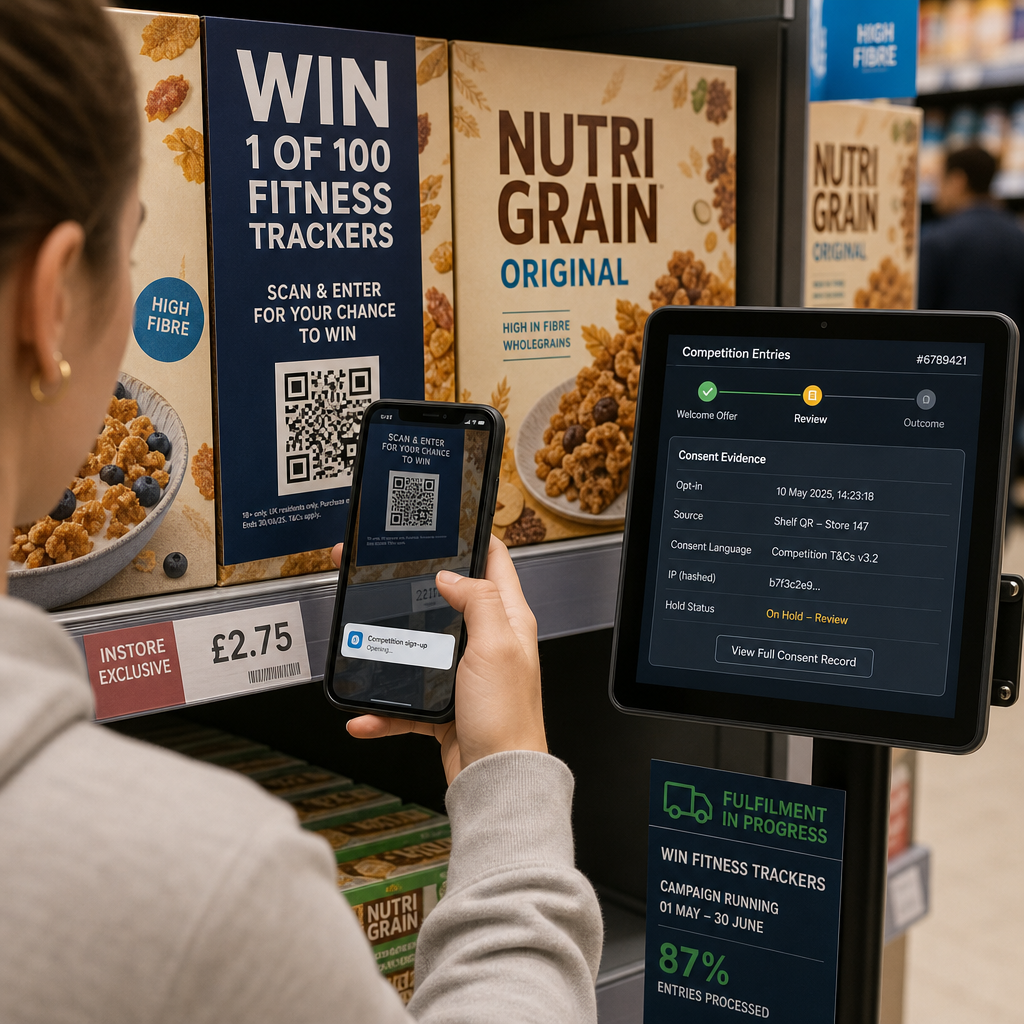
Full article
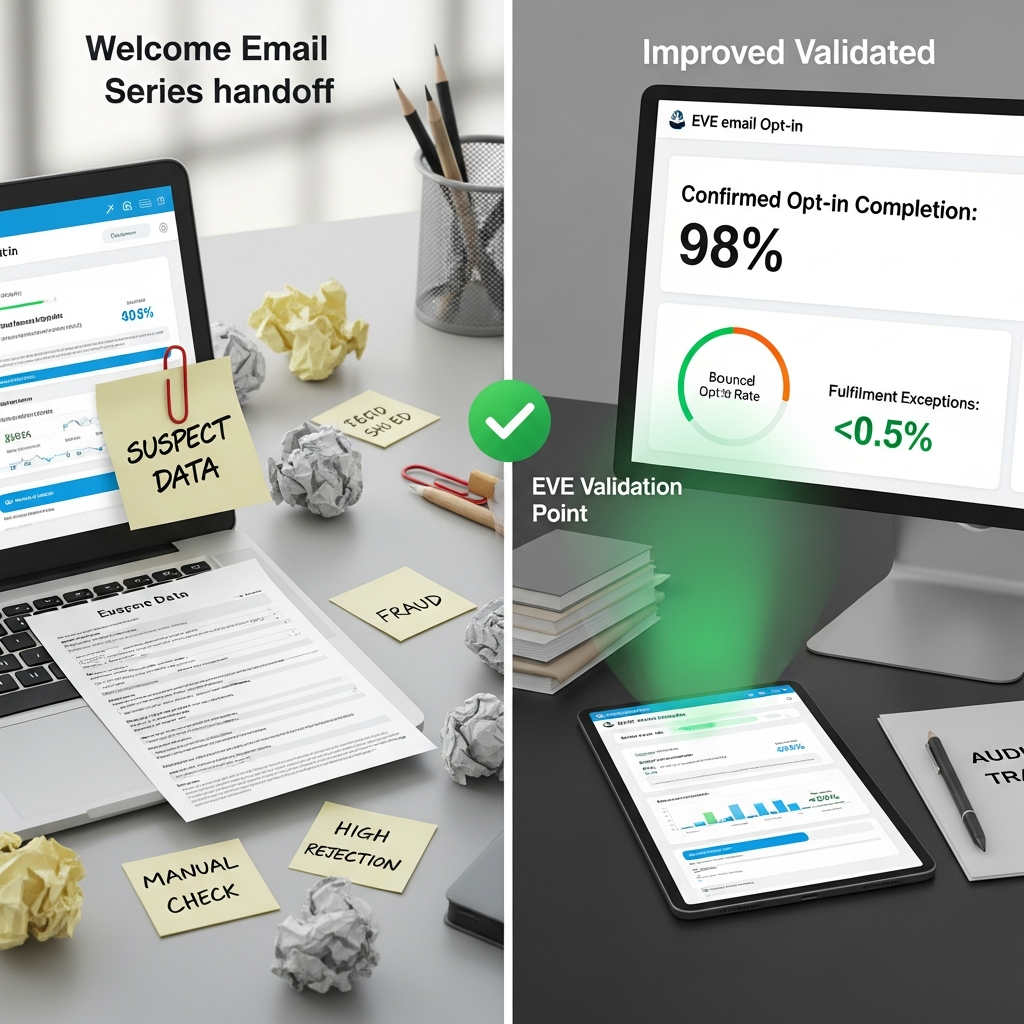
Competition volume flatters until the first email goes out. Then hard bounces rise, consent evidence gets thinner and prize fulfilment is left checking records that should never have passed the form. That is the contradiction at the heart of competition mechanics: more entries help, until toxic data is allowed to move as if it were genuine.
The short answer is straightforward. EVE belongs at three points in a UK competition flow: at entry, inside the email confirmation loop and again before prize claim. Each checkpoint has a different consequence. Entry protects CRM ingest. Confirmation decides whether medium-risk records progress. Prize claim is the last control before anything of value is released. Leave the route states or owners vague and the control starts to loosen.
The practical problem
Competition traffic is unstable by design. A quiet form can turn into a high-volume intake once paid media, influencer activity and retail promotion land together. The input changes too. Typos, disposable inboxes and coordinated fake entries all arrive through the same route.
The damage shows up later, not on the form. Poor-quality records push up hard bounces on the first welcome send, and mailbox providers do not care whether the source was a prize draw or a standard newsletter join. The consequence is operational, not theoretical: genuine subscribers become harder to reach because toxic data was admitted first.
That is why static regex checks and brittle allow-lists are rarely enough. They catch obvious mistakes, miss stronger fraud patterns and can still block legitimate entrants who are moving quickly. The more useful comparison is real-time email judgement against fixed front-end rules. EVE scores an address in under 50ms, returns a route state such as pass, challenge, hold, review or stop, and keeps the reason visible. That gives teams something to govern. Silent rejects do not.
How the route works
EVE works best here as a governed validation engine, not as a blunt block at the gate. The decision is not how many addresses to stop. It is where each threshold should sit so the team catches toxic data early, keeps the form usable and does not turn ordinary decisions into manual work.
The trade-off shifts by stage. At entry, the job is to intercept obvious failures and high-risk patterns before CRM ingest. In the email confirmation loop, the logic narrows: lower-risk sign-ups should continue, while medium-risk records face a light test rather than a hard stop. Before prize fulfilment, the priority changes again. At that point the issue is no longer list hygiene. It is reward protection.
EVE draws on more than 30 signals and methods, including entropy analysis, keyboard-walk detection, alias unmasking and behavioural fingerprinting. That is not a guarantee of authenticity, and it should not be sold as one. It is a consistent and auditable route for deciding what moves forward, what pauses and what stops. For teams balancing deliverability against friction, that distinction matters.
| Checkpoint | Purpose | Primary owner | Acceptance criteria | Weekly checkpoint |
|---|---|---|---|---|
| Entry form submit | Catch obvious invalid and high-risk emails before CRM ingest | CRM Manager | Known syntax failures and disposable patterns held or challenged; genuine users can correct obvious typos | Initial rejection or challenge rate |
| Email confirmation loop | Verify medium-risk sign-ups without adding heavy friction | Deliverability Lead | Confirmed opt-in rate remains stable while medium-risk addresses are reviewed | Confirmed opt-in completion rate |
| Prize claim | Reduce fulfilment fraud before reward dispatch | Compliance or Promotions Lead | High-risk or mismatched records stopped before prize release | Reward distribution failure or exception rate |
Where it usually breaks
The weak point is usually governance, not detection. One team is rewarded for list growth. Another inherits bounce remediation, complaints and manual clean-up. The trade-off across the whole route sits nowhere in particular, which means it is not being managed.
The next failure sits in exception handling. Pass and stop are easy. Hold and review are where poor operating design becomes obvious, because those states need visible reason codes, a defined decision path and an audit trail. Without that, teams guess, override inconsistently or let records sit unresolved. None of those outcomes protects deliverability, compliance or customer experience.
Then thresholds drift. Fraud patterns move. Acquisition sources change. Campaign mix rarely stays still for long in competition traffic. A threshold that looked sensible at launch can age quickly. So the route needs review points and logged changes, not launch-week confidence followed by silence. Weekly audits of hold volume, bounce movement, complaint signals and confirmation completion are the practical minimum.
One point is worth keeping blunt. Do not optimise a competition form for raw entry volume if the downstream email programme cannot absorb the quality hit. Big entry numbers prove very little if follow-up mail is harder to deliver or prize claims need manual repair.
What a sound setup looks like
For a UK competition flow, the setup should stay simple enough to run and strict enough to defend. Best-practice promotions guidance still applies: keep forms simple, keep opt-in wording clear and include an easy opt-out route where follow-up data is being collected. Clean acquisition and compliant acquisition are part of the same job. The historical GetPRO Campaigns Tesco and Co-op campaign, with a reported 43% uplift in email sign-ups, is a useful reminder that acquisition mechanics are sensitive. Extra friction has a cost.
- Before launch: the CRM Manager owns entry-form thresholds and signs off acceptance criteria for pass, challenge, hold and stop.
- During launch week: the Deliverability Lead monitors first-send hard bounce rate and confirmed opt-in completion, then flags movement outside agreed tolerance.
- Before any prize fulfilment: the Compliance or Promotions Lead confirms that high-risk claims are rechecked and exceptions are logged with an outcome.
- Each week: the project owner reviews change logs, hold volumes, override decisions and complaint signals, then sets the next adjustment date.
The checkpoints worth tracking are practical: initial rejection or challenge rate, confirmed opt-in completion rate, first-send hard bounce rate, override volume and prize-claim exception rate. If one moves, threshold decisions follow. If none is tracked, the route is being run on instinct.
What to carry forward
Not every email in a competition journey needs the same treatment. Entry checks protect the CRM from toxic data. The email confirmation loop protects deliverability and strengthens consent confidence. Prize-claim checks protect fulfilment and budget. That is the route map. It is narrower, and more useful, than many teams make it.
If EVE is already in the stack, use it where the decision has a clear consequence: before bad data enters, before medium-risk records are promoted and before rewards are released. Set the owner, set the threshold review date, agree the acceptance criteria and keep the change log tidy. Otherwise the route will drift under pressure.
If you are reviewing a live or upcoming competition and need a clearer path to green, book a frictionless validation walkthrough with EVE’s solutions team. We can help you map the three checkpoints, define the owners and pressure-test the risks before the next spike hits. Cheers.