Full article

UK retail loyalty sign-ups surge, but that growth masks toxic data that damages sender health if judgement waits. More volume brings ambiguous addresses, fabricated entries, and deliverability harm after the first send.
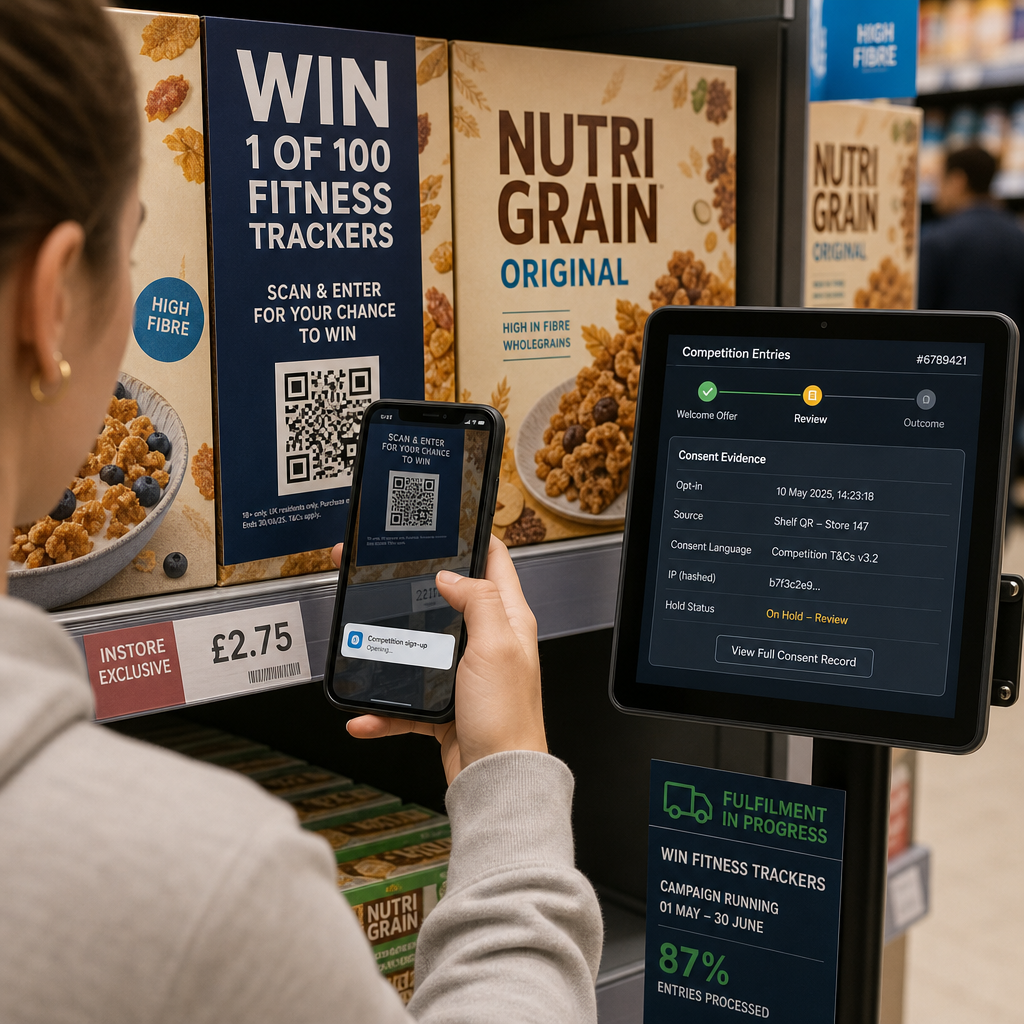
Promotional spikes and proof-of-purchase mechanics boost acquisition, compressing the window for email risk monitoring and clean consent capture. The tension is where to place judgement so growth does not become operational drag.
Quick context
When a promotion works, weak records hide in growth. GetPRO Campaigns reported a 43% uplift in email sign-ups for Tesco and Co-op, showing the upside. Pushing extra volume into a welcome flow built for normal conditions risks bounce and complaint issues.
Common trade-offs include validating too lightly at capture and discovering problems after send, or tightening rules so hard that legitimate sign-ups are blocked. A better frame is a trade-off map.
| Option | Advantage | Constraint | Likely commercial effect |
|---|---|---|---|
| Judge after first send | Lowest immediate form friction | Bad records enter onboarding unchecked | Faster list growth, weaker sender health within days |
| Judge at sign-up only | Early screening | Can over-block edge cases if logic is blunt | Cleaner list, possible acquisition drag |
| Judge at sign-up and before first send | Balanced pass, challenge and hold decisions | Needs threshold design and an audit trail | Stronger list quality without broad suppression |
The third option requires clear reason codes and exception handling, matching the problem's shape: some records are sound, some risky, and a middle band needs handling. EVE fits here, grading pass, challenge, hold, review, or stop outcomes in real time without manual work.
Step-by-step approach
Place the first judgement at capture, the second before the first send. At capture, screen obvious toxic data without adding drag. EVE validates emails in under 50ms with 30+ detection methods like keyboard walks and entropy analysis, catching coordinated fake entries.
The second checkpoint before the welcome email allows pass, challenge, or hold decisions:
- Pass: low-risk records with clean signals move to welcome automation.
- Challenge: ambiguous records enter a confirmation loop.
- Hold: high-risk records stay out pending review.
This reduces hard bounces, fabricated entries, and consent disputes, protecting revenue with timing.
Pitfalls to avoid
First, segment growth: coupon, store receipt, and organic traffic. Second, avoid silent rejection; use visible pass, challenge, hold routes with reason codes. Third, do not over-correct on friction; a reviewable hold state is safer when rules change.
No validation engine guarantees absolute certainty. EVE infers authenticity probabilities, allowing threshold calibration against campaign economics and list health.
Base decisions on evidence: compare bounce rate, complaint rate, confirmation completion, and conversion by source.
Checklist you can reuse
- Split sign-up sources: coupon, store receipt, organic.
- Apply capture-stage validation with pass, challenge, hold thresholds.
- Ensure consent capture is explicit and UK GDPR-compliant.
- Run a pre-send decision layer before the first welcome.
- Review suppression and resend logic to prevent re-entry.
- Monitor cohort indicators: bounces, confirmation, complaints, redemption.
- Keep an audit trail for threshold changes.
Timing matters; value shows in reduced wasted sends and cleaner reporting.
Closing guidance
Place judgement at sign-up and before activation. Keep forms light, consent clean, and outcomes auditable. For UK retail teams, better judgement before the welcome series starts is key. To map EVE in your flow, book a frictionless validation walkthrough with our solutions team.