Full article
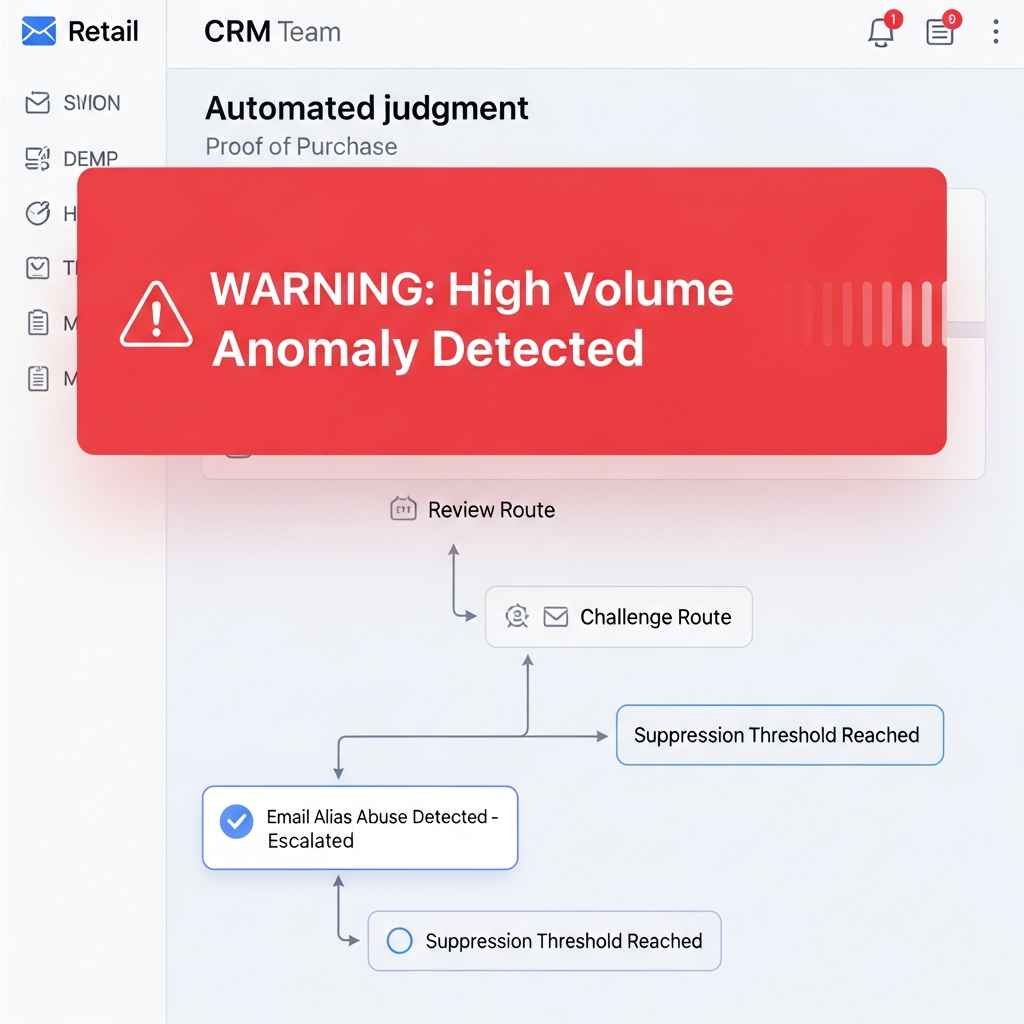
Static rules hold steady until a proof-of-purchase surge flips user behaviour. Customers rush, mistype addresses, submit duplicates. Bad records flood in, hard bounces rise, reputation takes a hit. UK retail CRM teams have 48 hours to reset thresholds, not wait for a monthly cleanup.
What EVE does differently at the proof-of-purchase checkpoint
EVE isn't a one-bit verifier. It checks syntax, domain health, entropy anomalies, keyboard walks, behavioural fingerprinting, and suppression context, all within 50ms. A record can be technically valid yet commercially toxic if the pattern suggests abuse. EVE infers authenticity probability without retaining data, keeping GDPR audit trails intact while the form stays fast.
Why proof-of-purchase surges break static validation rules
Static rules assume yesterday's risk profile holds. The GetPRO Campaigns precedent, a 43% uplift from Tesco and Co-op, shows how acquisition mechanics reshape list composition overnight. Tight rules stop toxic data today but also block revenue. Loose rules keep conversion high but degrade inbox placement in weeks. Challenge and hold routes need to absorb temporary uncertainty instead of forcing a permanent verdict at capture.
The three thresholds to reset within 48 hours
Pass threshold. Raise the evidence bar during incentive-led flows. Alias patterns mixed with inconsistent behavioural signals should not pass without extra checks.
Challenge threshold. Use a low-friction prompt, email confirmation loop or address re-check, for likely typos, unusual character sequences, or repeat attempts from similar fingerprints. Challenge works best when targeted at specific risk signals, not broad suspicion.
Hold threshold. Tighten hold rules when manual queues can manage. A 24 to 48 hour hold band lets CRM ops observe whether a pattern is promotional enthusiasm or coordinated misuse. Every hold protects deliverability, but some delay a sale. Manage the trade-off openly.
Which addresses should pass, challenge or hold during a retail spike
Pass: stable domains, clean syntax, low-risk behavioural signals, no suppression match. Challenge: probable genuine addresses with recoverable problems, typos, character swaps, first-seen unusual combinations without clear abuse signals. Hold: multiple stacked signals, disposable tendencies, alias unmasking concerns, repeated submissions from linked fingerprints, records that clear formatting but resemble known fraud patterns.
Where review and stop belong in the wider lifecycle flow
Review and stop decisions should connect across capture, confirmation, welcome, reward fulfilment, and early retention. A pass at sign-up shouldn't be irreversible; a hold shouldn't mean permanent exclusion. Teams need override discipline, audit trails, and clear rules on who releases or suppresses a record. If one team overrides for acquisition targets and another carries the bounce cost, the operating model is broken. Adjust capture thresholds first, monitor confirmation and first-send outcomes, then revisit suppression once patterns stabilise.
What CRM and operations teams should measure before the thresholds settle
Measure pass, challenge, hold, review, and stop rates by source, offer, and device. Track hard bounce rate on first send, confirmation completion for challenged records, complaint and unsubscribe rates in welcome messages, time-to-release for held records, and override frequency by team. These signals show whether the reset protects revenue or just shifts friction. Record-level risk plus programme-level outcomes prevent dashboard flattery.
Reset your thresholds and watch the first-send evidence. Book a frictionless, same-day EVE risk walkthrough with our solutions team to compare your current proof-of-purchase rules against graded routing.