Full article

When a proof-of-purchase promotion takes off, email capture quality usually breaks before the CRM catches up. Legitimate shoppers arrive with rushed entries, mistyped addresses, alias variants and some outright abuse, all in the same intake.
The first 48 hours set the direction for the next 30 days. If weak records move straight into automations, deliverability and sender reputation take the hit. If controls are too blunt, good customers get blocked. The workable answer is route-state control based on evidence: pass, challenge, hold, review and stop.
The short answer
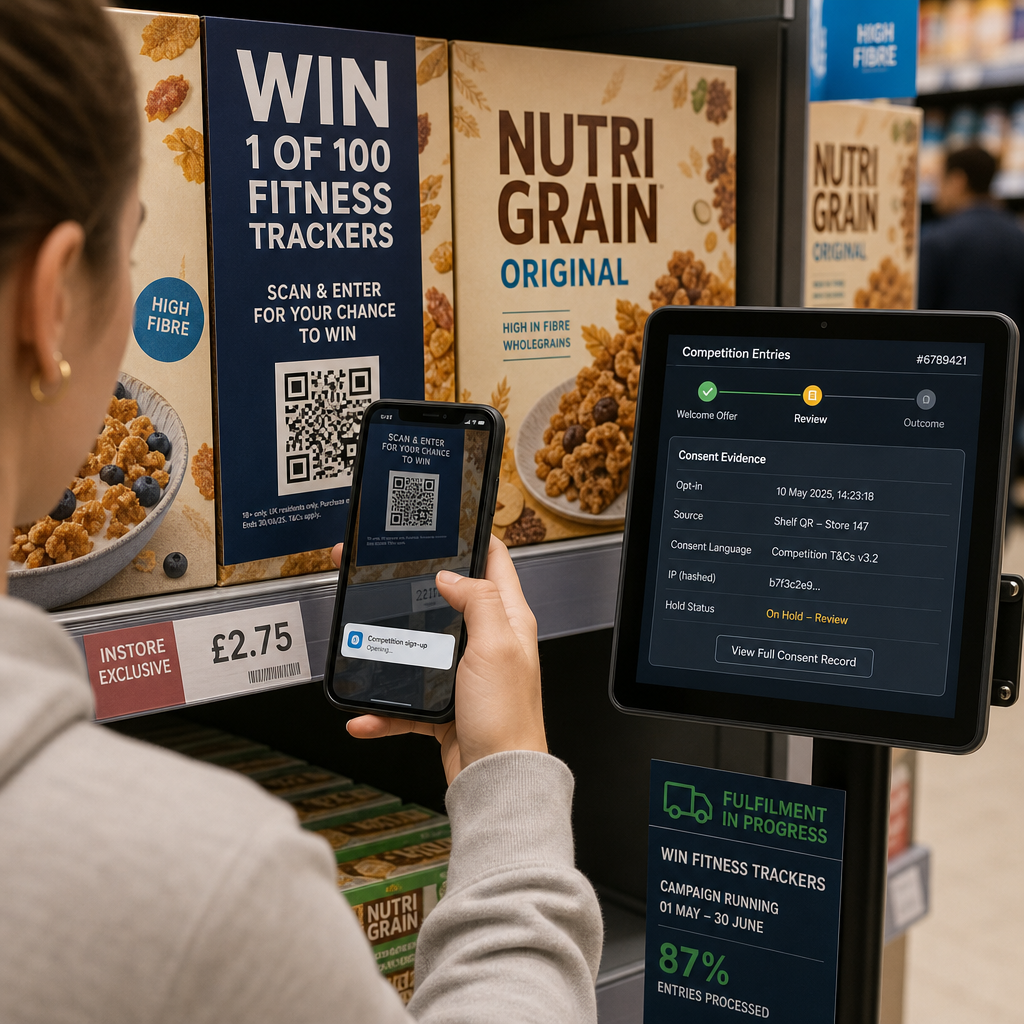
UK retail teams should treat a proof-of-purchase surge as a mailbox-quality control problem, not just an acquisition win. The GetPRO Campaigns activity across Tesco and Co-op reportedly drove a 43% uplift in email sign-ups. That kind of lift changes suppression logic, typo handling and consent evidence requirements immediately, not at the next tidy-up cycle.
This is where EVE fits. EVE grades pass, challenge, hold, review or stop outcomes in real time, keeps the reasoning visible, and lets teams tune thresholds and exception handling without defaulting to silent rejects or blunt allow-list checks.
The situation on the ground
Receipt-led or proof-of-purchase campaigns create a familiar split: volume rises fast, trust does not. Static regex checks and allow-lists can catch obvious failures, but they do very little once the issue becomes velocity, alias masking, typo clusters or borderline records that need a different route rather than a simple yes-or-no verdict.
That is why “clean it later” usually fails. Bad records do not wait politely in the database. They hit welcome sends, distort campaign reporting and start applying pressure to bounce and complaint signals before the list has been cleaned.
Email campaign validation, in this context, is really route management. The job is to separate healthy growth from toxic data quickly enough to protect list quality and keep legitimate customers moving.
| Signal in first 48 hours | What it often means | Operational risk | Best immediate response |
|---|---|---|---|
| Spike in typo domains and malformed syntax | Rush entries or poor mobile completion | Higher bounce pressure | Challenge or confirm before welcome send |
| Repeated alias patterns and high-velocity submissions | Promotional abuse or multi-entry attempts | Fraudulent capture and skewed ROI | Hold for review or stop at source |
| Consent boxes completed inconsistently | Form friction or unclear wording | Consent compliance exposure | Audit wording and retain clear opt-out |
| Good-volume growth with stable quality | Healthy campaign traction | Low immediate risk | Pass and monitor hourly |
What this means in practice
The useful comparison is not “validation engine versus no validation engine”. It is governed real-time judgement with thresholds and exception handling versus silent rejects, mailbox-quality drift, or avoidable manual handling later.
The strongest setup routes by confidence level rather than forcing every address through one blunt rule. That matters in retail because launch windows are fixed, engineering time is usually tight, and the cost of a bad decision shows up quickly in welcome-flow performance.
- Pass for clearly valid, low-risk addresses that should enter the welcome sequence immediately.
- Challenge for records with recoverable issues, such as likely typos or unusual domain signals, where an email confirmation loop can rescue a legitimate user.
- Hold for entries showing elevated risk, including velocity anomalies or suspicious alias structures.
- Review for borderline records where a stop decision would create avoidable false positives.
- Stop for submissions that strongly indicate abuse or non-functional addresses.
Order matters. If route-state checks sit after the automation trigger, the damage is already under way. A cleaner setup places the judgement upstream, before welcome, reward or nurture flows start adding risk to sender performance.
EVE supports that operating model with sub-50ms response time and more than 30 detection methods, including keyboard walks, entropy analysis, alias unmasking and behavioural fingerprinting. It infers authenticity probabilities, stores no personal data, and supports audit-friendly records. More detail sits on the wider solutions overview.
Where quality usually slips
The weak point is rarely the first burst of sign-ups. It is what happens next, when teams start treating raw volume as settled quality and push records straight into welcome journeys.
Hard bounces from malformed syntax and typo domains tend to show up first. After that comes the more expensive problem: audience growth looks healthier than it is, risky records have not all failed yet, and inbox placement starts weakening once follow-up sends are committed.
Lifecycle marketing fraud prevention matters even when the incentive looks modest. Low-friction promotions are easy to game through aliasing and receipt mechanics. The trade-off is straightforward: challenge only where the evidence supports it, because extra friction on good customers carries its own cost.
A practical rule: if quality signals worsen within hours, tighten the same day. Alias abuse, typo correction routes and domain anomaly thresholds are all easier to adjust early than to repair after reputation damage has spread into the rest of the programme.
What a resilient setup looks like
A resilient setup joins form design, route-state logic, consent traceability and a fallback path. If the form is unclear, the routeing cannot save it. If the routeing is hidden, false positives become harder to explain. If consent evidence is weak, the campaign inherits a compliance problem alongside a quality problem.
- Judgement at the point of capture, before records enter welcome or reward flows.
- Visible route logic for pass, challenge, hold, review and stop decisions.
- A monitored exception queue so borderline cases do not disappear into silent failure.
- Consent wording captured with timestamped audit trails.
- Hourly monitoring of bounce proxies, domain anomalies and velocity clusters during the opening surge.
The broader pattern is not limited to one promotion. Boots Magazine, cited on WPP Open, is a reminder that volume without controls brings hidden operating cost. In email ops, that usually means damaged reputation, skewed reporting and extra cleaning later. Cleaner intake protects cadence as well as deliverability.
One call is worth making clearly: silent rejection is a poor fit for borderline sign-ups. A lightweight challenge or confirmation loop preserves more legitimate customers and leaves the logic easier to defend across CRM, compliance and operations.
What changes if you act now
Within the first 48 hours, document which rules fire most often, which challenge paths recover usable addresses, and where false positives appear. Then tune the routes before the next major send. That is usually where the gains are: not in a grand rebuild, but in catching overfiring controls and weak exception handling before they harden into sender damage.
The operating choice is simple enough. Pass low-risk records quickly. Challenge recoverable mistakes. Hold suspicious entries. Stop obvious abuse. Review the edge cases instead of pretending every record deserves the same treatment.
What the reader should do next
If a proof-of-purchase campaign is close, the next move is to test the routeing before traffic lands. EVE gives CRM and operations teams a way to move quickly without giving away list quality, and to explain each decision in terms the wider business can follow. If you want to pressure-test the setup, book a frictionless validation walkthrough with our solutions team. We can map where your forms should pass, challenge, hold, review or stop incoming records before the surge arrives.