Full article

What shifts when a Tesco and Co-op promotion drives a 43% uplift in sign-ups? Volume rises, and proof-of-purchase checks, welcome emails, and fraud controls start to conflict immediately.
UK retail CRM teams face this now. A sign-up surge hides toxic data, distorts consent records, and erodes sender performance. Teams that tighten validation and proof rules early avoid bounce spikes. Position UK email risk monitoring at capture to handle purchase-led jumps.
Decision context
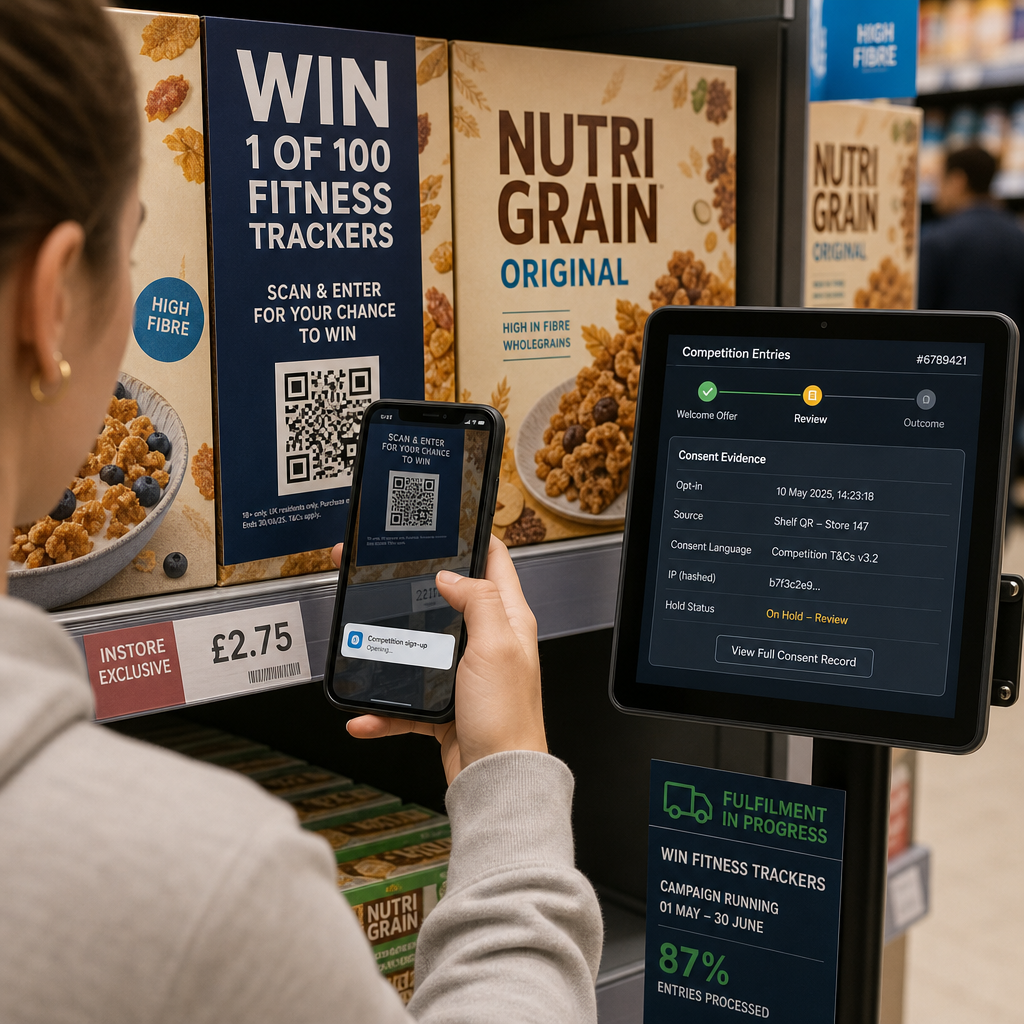
The GetPRO Campaigns precedent reports a 43% uplift in email sign-ups for Tesco and Co-op. This growth changes the mix: genuine customers arrive alongside mistyped addresses, incentivised low-intent sign-ups, and deliberate abuse.
Proof-of-purchase checks confirm eligibility, not that an email address is safe, reachable, or fairly presented. A receipt can be valid while the address is disposable, role-based, or typo-ridden. Many teams still treat proof-of-purchase as the hard gate and email validation as back-office hygiene. That sequence is now misaligned.
Strategy must survive contact with operations. Operations teams need a three-way decision at capture: pass, challenge, or hold. EVE handles this split with 30-plus proprietary detection methods, including keyboard-walk detection, entropy analysis, alias unmasking, and behavioural fingerprinting. It returns a result in under 50 milliseconds with caching options, fitting checkout, voucher, and loyalty journeys that lack patience for heavy review queues.
Operational tests show a hard proof-first flow creates downstream exceptions once welcome sends begin. The better path layers purchase proof for eligibility with risk grading for address quality and intent.
Options and trade-offs
The choice is where to put friction, and for whom.
| Option | Upside | Constraint | Best use |
|---|---|---|---|
| Proof-of-purchase only | Fast acquisition, minimal form friction | Weak on email deliverability, poor visibility on toxic data | Low-risk campaigns with small volumes |
| Hard block on risky emails at sign-up | Cleaner list, fewer obvious bad entries | Higher false-block risk, harder to defend customer complaints | Narrow high-value journeys with manual support |
| Risk-graded pass, challenge or hold | Balances conversion, deliverability and auditability | Needs threshold tuning and review rules | Retail surges, loyalty onboarding, coupon or receipt-led capture |
The third route usually wins because it handles mixed intent better. A mistyped but legitimate address should not equal a scripted abuse attempt. A valid receipt should not wave a toxic record into the CRM untouched.
Paired comparison matters. A hard block reduces visible bad entries quickly, but can suppress real customers at the point of repeat purchase. A graded approach preserves commercial optionality. Pass obvious good records into the welcome flow. Challenge ambiguous ones with an email confirmation loop or light review trigger. Hold clearly suspicious cases outside normal campaign cadence.
This is not just a fraud problem. It is a measurement problem. If sign-up volume rises but first-send engagement softens, the issue may be poor capture quality, not weak creative.
Risk and mitigation
The biggest operational risk is over-correction. Tightening rules aggressively can challenge too many legitimate customers. The opposite risk leaves thresholds untouched to avoid friction. Neither extreme works.
A resilient model uses comparative constraints. For low-risk records with clean syntax, strong domain reputation, and normal behavioural patterns, pass immediately. For records with weaker indicators like probable typos or unusual alias structures, challenge lightly. For stacked risk indicators, hold outside core automation. EVE protects conversion without treating every anomaly as abuse.
An extra checkpoint may trim top-line volume, but weak controls can depress inbox placement, trigger manual cleaning, and undermine the welcome flow. One loss is visible today; the other arrives across the quarter.
The strongest intervention window is the first 24 to 48 hours after the volume jump. Suppression rules, resend logic, and welcome sequencing must tighten before poorer records contaminate onboarding benchmarks. Validation should move ahead of the first promotional send, not after complaints.
No validation engine claims perfect intent detection. EVE infers authenticity probabilities; it does not store personal data and is not an absolute arbiter. Governance with override rules, audit trails, and periodic threshold review is essential.
Recommended path
The best route for a retail sign-up surge is a staged decision model that resolves tension between proof-of-purchase and fraud gates.
Start with proof-of-purchase for eligibility. Then run EVE at capture or before the first automated send, using a pass, challenge, and hold framework. Tune suppression rules for risky domains and toxic patterns. Adjust resend logic so challenged users are not treated as disengaged too early. Keep consent records explicit, especially where voucher or loyalty sign-up language blurs permission.
Better validation at the front of a surge protects welcome programme value, keeps complaint and bounce pressure lower, and gives marketing directors a credible ROI story next week rather than next quarter. Threshold tuning is an operating decision, not a fixed doctrine.
If your team weighs where to challenge, hold, or pass, EVE provides the decision layer without turning onboarding into a blockade. To test how this applies to your current capture journey, book a frictionless validation walkthrough with our solutions team.