Full article

Start with the shortest honest answer. Payment Services gives consumer care, finance and compliance teams one governed payout flow for payee verification, approval routing and status handling, so payments can move without losing auditability. That matters because delayed goodwill payments rarely break at release. They usually start to drift earlier, when verification sits in one queue, approval in another, and claimant updates are left to email threads or case notes.
By the time finance is asked why the money has not landed, the transaction is no longer the main cost. The route has already picked up extra handling, claimant chasing and record gaps. In consumer payout operations, that is the point where a small payment starts behaving like an expensive one.
This field note follows that cost from approval route to claimant chase. The central point is plain enough: speed without ownership does not last, and control without visible status just lengthens the queue. Payment Services teams need to measure where delay begins, assign owners before exceptions pile up, and treat claimant communication as part of the control design, not a courtesy bolted on at the end.
Context
Goodwill payments look small on paper. That is often why the delivery work around them is misread. One case may pass through consumer care, an approver, finance and a release step, with each team assuming the dependency sits somewhere else. The weak point is rarely the decision itself. It is whether the evidence, authority and current status are visible in one controlled line of sight.
That is not awkward by accident. Goodwill handling often sits outside the core sales ledger, but it still carries financial control requirements and service expectations. When reimbursement governance is loose, low-value exceptions become steady operational drag. The answer is not more process for the sake of it. It is a controlled payment workflow that makes pace and audit trail visible at the same time.
What the signal actually tells us
The current signal is about visibility under pressure, not just payment volume. Public reporting on direct-payment timing and on rushed data-protection timetables putting consumer trust at risk points the same way. Teams are being pressed to show that payouts are prompt, controlled and traceable. Finance needs an evidence trail. Compliance needs a reviewable record. Consumer care needs fewer avoidable follow-ups. Claimants need to know whether the case has moved and when payment is due.
In practice, the repeat failure mode starts upstream of formal sign-off. Verification may be complete in one tool while the approver is still waiting for a summary by email. A case may show as approved in one platform while finance is still re-checking payee details because the release instruction does not state the acceptance criteria clearly enough. That drift has two consequences. Cycle time stretches because the next team cannot act on partial information. Claimant contact rises because no dated update has been triggered.
A workable route should show four checkpoints in plain terms: evidence received, approval decision made, release instruction authorised, claimant update sent. If one checkpoint has no owner, time leaks out of the route. If two have no owner, the claimant often ends up acting as the status monitor by chasing for an answer. The real test is no longer whether a payment can be made. It is whether the team can show who decided, when, on what evidence, and whether the claimant was kept informed.
Where the trade-off becomes visible
The face value of a delayed goodwill payment may be modest. The operating cost usually is not. Every avoidable day adds touches. Consumer care checks status. Finance re-validates details. An approver is chased again. The claimant follows up because there is still nothing concrete to work from. In a manual route, one extra touch across several teams is enough to turn a minor payment into a slow, noisy case.
Track four costs:
| Measure | What it shows | Why it matters |
|---|---|---|
| Elapsed time from claimant confirmation to payment release | How long the end-to-end route actually takes | Shows whether delay sits before approval, after approval, or across both |
| Touches per case, including internal chasers and claimant follow-up | How much handling the process creates | Exposes avoidable cost and weak handoffs |
| Exception rework after approval | How often supposedly ready cases are not actually ready | Shows where payee verification or acceptance criteria are failing |
| Audit completeness | Whether the record shows reason, authority, evidence and status history | Shows whether speed is being bought at the expense of traceability |
If those four measures are not reviewed regularly, the cost of delay is being guessed at rather than managed.
The claimant experience cost is usually felt early and measured late. Silence after approval drains confidence, even if the payment eventually arrives. There is a control issue here as well. A weak record of why a goodwill payment was authorised, by whom, and against which evidence makes later review untidy and slow. Once exceptions become routine, reviewers are left reconstructing the route from inboxes and spreadsheets. That is not a complicated failure. It is a preventable one.
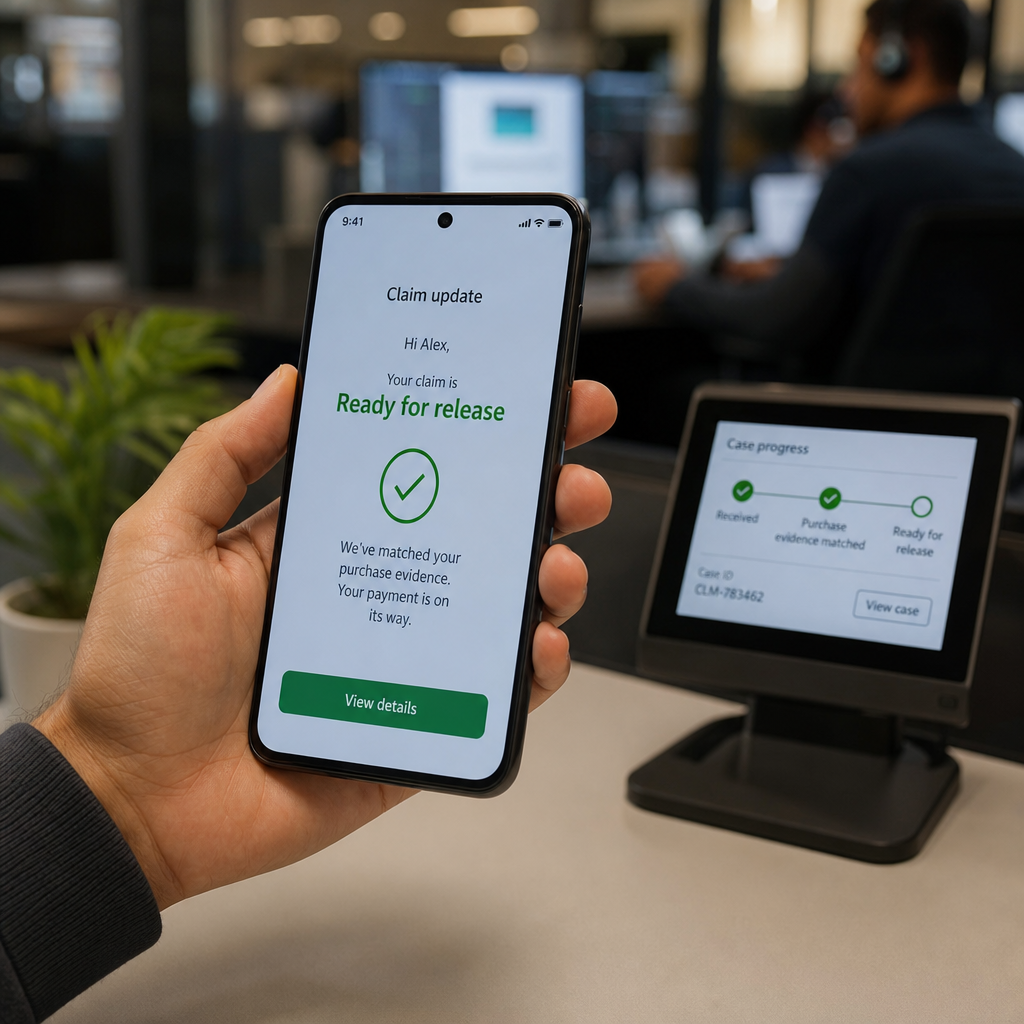
That is why claimant updates belong inside the control model. A dated acknowledgement, a dated approval confirmation and a dated release notice cut duplicate contact and leave a cleaner evidence trail. In governed payout work, that is not polish. It is control design.
Implications for Payment Services teams
The evidence anchor matters. Payment Services provides a governed direct-payment control layer with payee verification, approval routing and clear status handling, so teams can move faster without losing auditability. If that is the design goal, workflow changes need to connect pace, traceability and claimant confidence across the whole route. Tightening approval on its own will not get there. The cost usually appears in the handoffs either side of it.
Start with ownership. Consumer care should own evidence completeness at submission, with acceptance criteria set before a case enters approval. The approver should own the decision and decision date, not the chase for missing proof. Finance should own release validation against a complete instruction. Where Holograph is implementing workflow changes, the implementation owner should also hold the dated change log and release checklist.
Then measure outcomes that can be checked. A sensible operating aim is shorter end-to-end cycle time, fewer claimant chase contacts per case, and a higher share of cases released without rework after approval. Those measures do not prove a good process on their own, but they make status drift and weak handoffs harder to hide.
The part teams often skip is exception policy. Goodwill payments do not always arrive in a tidy form. A strong controlled payment workflow makes exceptions visible, routes them cleanly and stops them contaminating standard cases. Teams should document the tension between tighter evidence rules and payout speed, log the risk and mitigation, and decide where manual intervention is acceptable.
What to test before scaling
If the current route still depends on inbox chasing or status copied between tools, map the full path from claimant confirmation to payment release and assign four owners: evidence owner, approval owner, release owner and claimant-update owner. Put a target date on each step. Without named owners and dates, delay simply comes back under another label.
Set acceptance criteria before approval starts. A case should not enter the approval queue unless the required proof, payee data and reason code are present. It sounds procedural because it is procedural. It is also where later rework is either stopped or invited in.
Put claimant updates on the same control map as internal approvals. Issue a dated acknowledgement when evidence is complete, a dated notice when a decision is made, and a dated confirmation when payment is released. If an exception is holding the case, say so plainly and give the next review date. A vague holding message usually creates more contact, not less.
Review performance weekly against a simple assurance view: average cycle time, internal touches per case, claimant chase rate, and records complete enough for audit review. The owner should be an operations lead with enough authority to change handoffs rather than merely report them. If manual handling is still creating rework and status drift after that review cycle, the case for a more governed Payment Services workflow becomes easier to prove.
Log assumptions as well. If payment release depends on a finance batch schedule, write it down. Hidden dependencies are usually where tidy process maps give up.
Delayed goodwill payments are rarely the result of one late action. More often, they come from drift, handoff loss and ownership that sounds shared until a claimant asks for a date. The fix is not dramatic. It is a tighter route, visible status, named owners and dates that hold. If the current workflow is still a bit tight on time and looser than it should be on evidence, now is the point to sort it properly. Contact the Payment Services team to map the route, clear the blockers and set the next dates with intent.
The choice usually becomes clearer once Payment Services is compared against the current route on one measurable proof point.