Full article

Payment status drift is usually treated as background admin. In consumer payout operations, it is often where avoidable cost begins. Evidence fragments, reviews get repeated, and claimant updates fall out of step with the real payment path long before final sign off.
The useful starting point is straightforward. Delay rarely starts at final approval. It starts earlier, when payee verification, approval routing and settlement updates sit in different tools, under different owners, with no shared status trace. Payment Services is built to control that flow. It keeps those steps aligned, with clear ownership, dated actions and audit ready evidence.
Context
The obvious assumption is that the finance approval queue is where most of the delay sits. The pattern is usually upstream. Verification evidence lives in one place, the approval note in another, and the claimant update reflects neither. A manual goodwill desk held together by spreadsheets and inbox handoffs makes that split more likely. Consumer care teams cannot see whether funds have cleared. Finance teams cannot see the original approval rationale without asking for it again.
That is more than untidy process design. It breaks the evidence thread. When a case is reviewed later, teams have to reconnect the original issue, the verification step, the named approver and the final payment confirmation. If the record is spread across systems, recovery work follows. Then the chasing starts, first inside the business and then from claimants.
If your plan has no named owners and dates, it is not a plan, fix it. The first checkpoint is operational, not theoretical: map where status changes happen now, who owns each change and how long each handoff actually takes.
Where status drift actually happens
Status drift tends to show up in handoffs, not in the headline approval step. Verification may be complete, yet finance asks for the evidence again because the original check is not visible in the release workflow. Approval may be recorded, yet the claimant message still says pending because settlement status sits in a separate banking or payout tool.
That is where fragmented handling stops being a harmless workaround. The problem is rarely one team being careless. It is the absence of a single control layer connecting payee verification, approval routing, payout release and claimant updates. Once that gap opens, duplicate review becomes normal and teams start working around the process rather than through it.
A controlled payment workflow changes the operating conditions. Exceptions can be routed to a designated owner. Handoff dates and times can be recorded. The same case evidence can remain visible from verification through to settlement. That means less rechecking, fewer side channels and a cleaner path to green.
What it means for claimant trust and operating cost
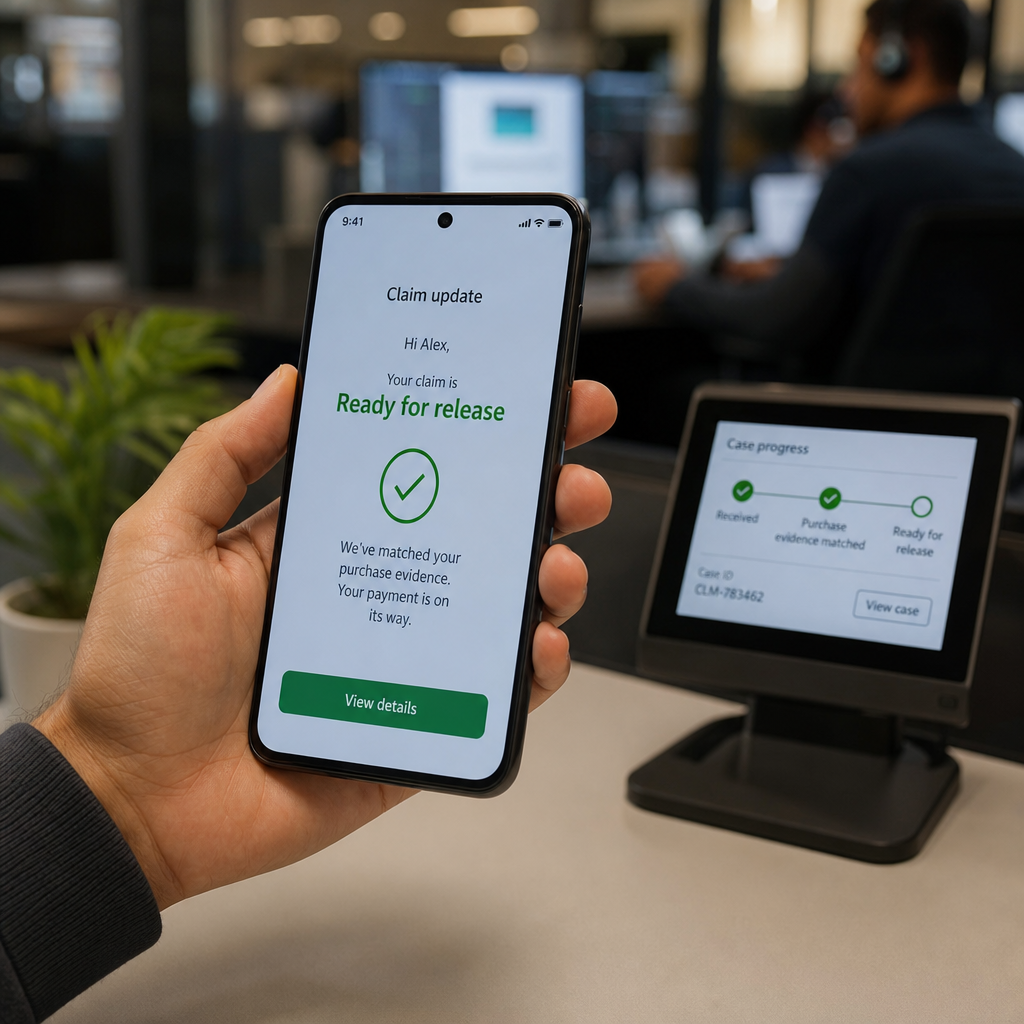
One recurring pressure point sits between internal approval and confirmed settlement. If claimant messaging stays generic while the case waits on payment progress, people ask for an update. Internal approval is not the milestone that matters to them. Payment movement is.
That creates two direct costs. One is contact volume. The other is rework, because agents and finance teams end up checking multiple systems to answer a basic question: has the payment moved? The draft evidence gives one usable benchmark. An inbound query about a missing refund can cost about £4.50 to handle manually. At any scale, that stops being a narrow service issue and becomes a cost control issue.
There is a governance problem in this as well. If fraud or security checks pause a payment and the front line cannot see that status, claimant messaging can drift away from the real case position. That is how a routine hold turns into avoidable friction. Better status handling is not about promising instant payment. It is about reflecting the actual case state in the workflow teams use to manage the case.
What a governed flow changes
Payment Services matters here because it replaces fragmented manual tracking with a governed control layer. Payee verification, approval routing and settlement updates stay connected in one operational flow instead of being reconstructed afterwards. For operations leads, that means each transaction can carry acceptance criteria, a named owner and an execution date that can still be checked later.
The value is practical. A governed flow cuts duplicate reviews when finance cannot rely on the original verification step being visible in context. It also gives claimant communications a firmer source of truth, so updates reflect payment progress rather than the last internal note somebody can find.
The claim should stay measured. A control layer does not remove every exception, and it does not settle governance on its own. Teams still need to decide who owns final review for exceptions and by when. What it does change is the quality of the evidence behind that decision. Inbox archaeology is replaced by a structured record, which is a better operating position.
Measures, owners, and checkpoints
If you need to test whether status drift is costing more than it should, start with a short delivery assurance view. Four checks are usually enough to show whether the workflow is under control:
- Owner check, every payout stage has a named owner, including exception review.
- Date check, approval date, release date and settlement confirmation date are all recorded against the same case.
- Evidence check, verification proof and approval rationale are visible without another team having to resend them.
- Contact check, chase up volume is tracked against payment status delays, not just against total case volume.
There is one concrete signal worth keeping. In test environments, feeding settlement status back into the claimant interface projected a 34 per cent drop in chase up calls over a standard monthly cycle. Sensible teams should treat that as directional, not guaranteed. It is still useful because it links a workflow change to a visible operational outcome.
Another checkpoint is acceptance criteria quality. Between an approval cut off and a settlement run, notification criteria need to account for delayed bank settlement. It is not glamorous work, but it stops support teams being blindsided later. If the edge case is missing from the criteria, expect it to return as live rework. Bit tight on time, usually.
Actions to consider
Start by mapping your current refund and reimbursement journey from verification through to settlement confirmation. Name the owner for each step. Record the working date rules, the handoff points and the acceptance criteria for claimant updates. Then look for the places where teams rely on spreadsheets, inboxes or separate portals to bridge gaps. That is usually where status drift sits.
If approval happens in one place, payment release in another and claimant messaging in a third, you do not have a joined up control model. You have a recovery model. That can hold for a while. It usually gets more expensive when volume rises or when audit questions land.
If Payment Services sounds like the more sensible path, contact the team for a practical review of your consumer payout operations. We can help you map the current gaps, define owners and dates, and shape a controlled payment workflow that is easier for finance, operations and claimants to live with. Cheers.