Full article

What should a team understand first about Payment Services? It is not a messaging layer added after the fact. It is a controlled payment workflow that keeps payee verification, approval routing and payment status aligned, so claimant updates match the real state of the payment instead of masking gaps between teams.
That distinction matters in consumer payout operations because chase-up contact usually starts long before final release. It builds when verification, approval and status handling sit in different tools or queues, and the claimant gets an acknowledgement without a useful account of what happens next. The result is familiar enough: duplicate submissions, status calls and internal chasing created by the process itself.
Quick context
Where is the friction really coming from? Usually upstream of approval. Final release gets blamed because it is visible, but contact demand often starts in the period between submission and payee verification. A claimant submits details, receives a generic confirmation, then waits while checks move elsewhere. By the time approval begins, confidence is already thin.
That is the first change to make. Approval may look like the obvious bottleneck, but fragmented handoffs between frontline teams and compliance often do more damage. If the claimant cannot see that the case has moved from submitted to verified, they chase. If there is no named owner and no date against that step, the operating model is still loose.
For Payment Services, the rule is simple. Complete payee verification before approval where possible, because post-approval rework adds handling, raises payment risk and creates avoidable claimant contact. The checkpoint to watch is the silent window between receipt and verification. Once that window breaches its agreed threshold, the care desk starts translating status rather than resolving issues.
- Owner: Operations lead for the verification queue
- Date: Set and publish a verification review window for every submitted claim
- Acceptance criteria: Claimant receives confirmation of receipt and an estimated verification date
- Operational measure: Monitor time from submission to first meaningful status update
Step-by-step approach
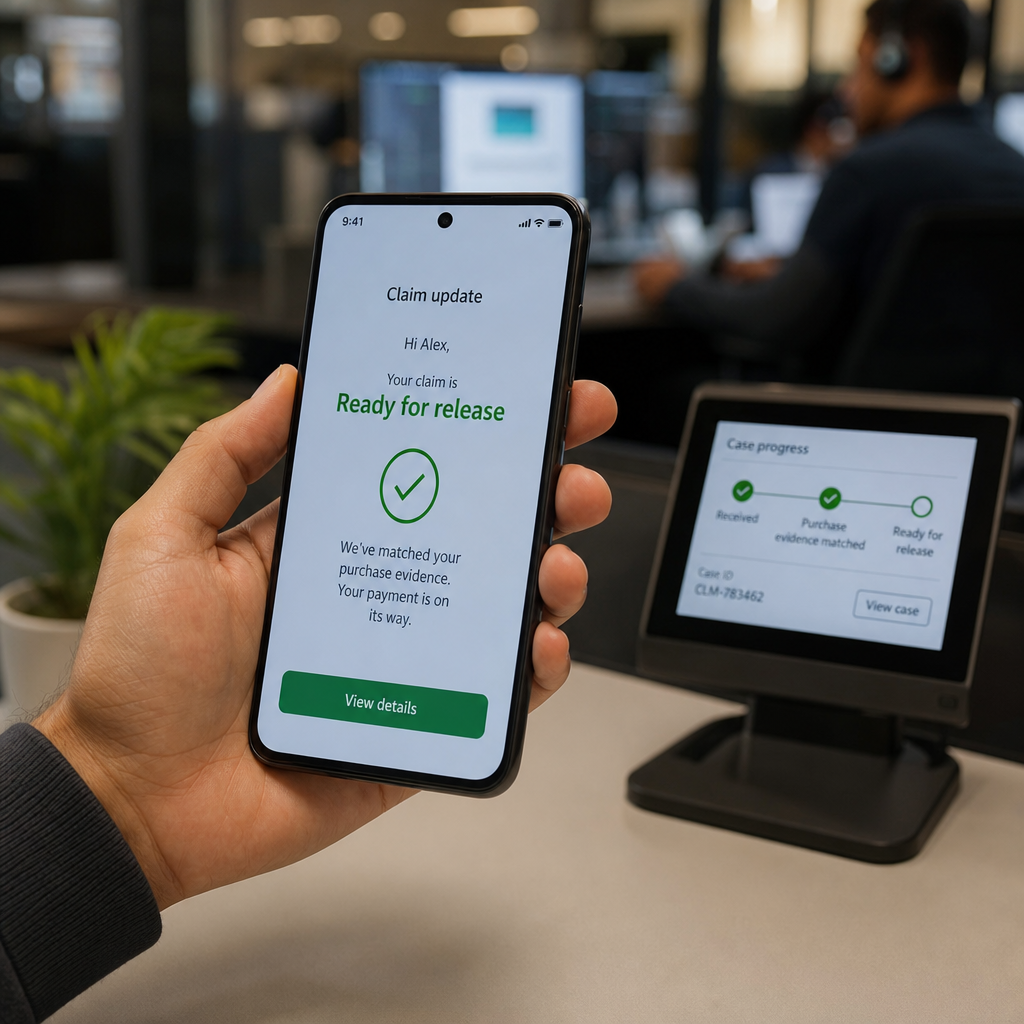
What does a workable claimant update journey look like? It links internal control points to claimant-facing updates. Fewer messages, tighter ones, and each one earned by a recorded state change.
Manual handling across email chains, spreadsheets and separate portals rarely stays coherent once volume rises. A controlled payment workflow keeps the communication state aligned with the approval state. In practice, claimant updates should be triggered by logged events such as receipt of details, completed payee verification, granted approval and payment release. Anything between those points should stay internal unless there is a clear exception to explain.
Generic “we’re working on it” emails usually increase contact rather than reduce it. They sound active but give the claimant nothing they can test. A useful update states what changed, who owns the next move and the expected window. If release timing depends on payment rails outside your direct control, say so plainly and give a realistic range rather than an exact time that is unlikely to hold.
When Holograph implements Payment Services, each claimant touchpoint is mapped to an internal state change and a trigger. That gives delivery teams a concrete test before go live and operations teams an evidence trail they can audit afterwards.
| Operational state | Internal owner | Claimant update | Acceptance criteria | Risk and mitigation |
|---|---|---|---|---|
| Details submitted | Consumer care lead | Receipt confirmed with expected verification date | Submission logged and timestamped | Risk: duplicate submissions Mitigation: immediate receipt confirmation |
| Payee verification passed | Compliance owner | Details verified and claim moved to approval | Verification evidence attached to record | Risk: rework after approval Mitigation: complete verification before routing onward |
| Approval granted | Finance manager | Approved for release with expected payment window | Approver, amount, and date recorded | Risk: uncertain expectations Mitigation: use operational windows, not exact promises |
| Funds released | Payment operations owner | Payment sent with clearing time guidance | Release event logged against claimant record | Risk: “money not received” calls Mitigation: give realistic payment timeline and internal reference |
The path to green is not complicated. Every status has an owner. Every owner has a date. Every claimant update maps to a genuine state change. That is what keeps a governed payout process from slipping back into manual status handling.
Pitfalls to avoid
Where does this break? The same three points come up repeatedly.
One is treating claimant communication as a service wrapper rather than an operational control. If care teams cannot see the same timeline as finance and compliance, they fill the gap with guesswork, callbacks and internal chasing. In a reimbursement governance model, that cost is usually self-inflicted.
Another is splitting auditability from service. A live audit trail is not just for case closure or compliance review. It is working evidence for frontline teams. When an agent can see when details were submitted, when verification passed, who approved the payment and when release happened, the answer to “where is my money?” becomes faster and more consistent.
The last is pretending the final payment window is fully controllable. It is not. There will usually be a period between release from your system and arrival in the claimant’s account. Better to state that cleanly than cover it with vague reassurance. The mitigation is straightforward: explain the release state, give the expected clearing window and make sure the care team is looking at the same evidence thread as finance.
- Checkpoint: Can a care agent answer a status query from one timeline without switching tools?
- Checkpoint: Does every outbound update correspond to a logged internal event?
- Checkpoint: Is there a named owner for exceptions such as failed verification or returned payments?
Checklist you can reuse
What should you change first if the current journey keeps generating status queries? Keep the review practical. A claimant update journey should stand up to scrutiny from operations, finance and compliance without dragging the claimant through internal process detail.
- Assign an owner to each stage: submission, verification, approval, release, exception handling
- Set target dates or service windows for each stage and make them visible internally
- Define acceptance criteria for each state before automating any notifications
- Verify payee details before approval routing to reduce rework and claimant uncertainty
- Give consumer care access to the same audit-ready timeline used by finance
- Track at least one operational measure, such as time to first meaningful update or chase-up contact rate by payment stage
- Log exceptions with owner, next action and revised date rather than leaving cases in a generic pending state
If one of those items has no owner or no date, it is still a draft, not an operating model.
Closing guidance
The useful question is not whether claimants want updates. They do. The real test is whether the update journey reflects the actual state of the payment or simply signals that someone is dealing with it somewhere in the background. In consumer payout operations, that difference often decides whether contact volume falls or keeps returning.
Payment Services works best when payee verification, approval routing, claimant updates and audit evidence sit in one controlled payment workflow. That gives operations leads a cleaner path to green, gives finance stronger reimbursement governance and gives claimant-facing teams something firmer than “we’re checking”. If you are reviewing a journey with too many status queries, callbacks or duplicate submissions, contact Payment Services and we can work through the current states, owners, risks and the next practical fix.
The comparison usually sharpens once Payment Services is set against the current route on one measurable proof point, such as time to first meaningful update or chase-up contact rate by payment stage.