Full article
Created by Marc Woodhead · Edited by Marc Woodhead · Reviewed by Marc Woodhead
GetPRO Campaigns' launch campaign across Tesco and Co-op delivered a 43% uplift in email sign-ups for its £1.50 off offer. This is more than a useful metric; it’s a signal that coupon value matters less than the redemption journey. If the path from interest to purchase is overcomplicated, the offer leaks value before it reaches the till. Good retailer-linked coupon design reduces friction for the shopper and gives the brand a cleaner way to capture consented first-party data.
Signal baseline
Most digital coupon campaigns fail not because the discount is too small, but because the hand-off between sign-up, validation, and redemption is badly designed. A shopper will forgive a modest offer more readily than a fiddly one. If they have to switch apps, type a code at the till, or explain the mechanic to staff, you are asking them to do operational work on your behalf. They usually decline.
The GetPRO Campaigns activation provides a public number tied to a named retail context: Tesco, Co-op, £1.50 off, and a 43% uplift in email sign-ups. This does not prove every retailer-linked offer will produce the same result. It does show the mechanism can support acquisition when the journey is built properly.
The trade-off is straightforward. Deeper retailer alignment usually takes more planning and a slower launch. In return, you remove avoidable drop-off and get cleaner reporting. I’ll take that bargain most days. When day-to-day friction is already high, adding more at redemption is a design mistake, not a minor inconvenience.
What is shifting
The shift now is from offer-led thinking to journey-led design. Teams used to ask, “How strong is the discount?” The better question is, “How many steps stand between intent and proof?” That is where performance lives.
In the GetPRO Campaigns case, the retailer-linked approach reduced those steps. The important element was connection: a mechanic tied to the way people already shop in Tesco and Co-op, not one that asked them to learn a new ritual for a one-off activation. This sounds obvious, but it is still missed in planning.
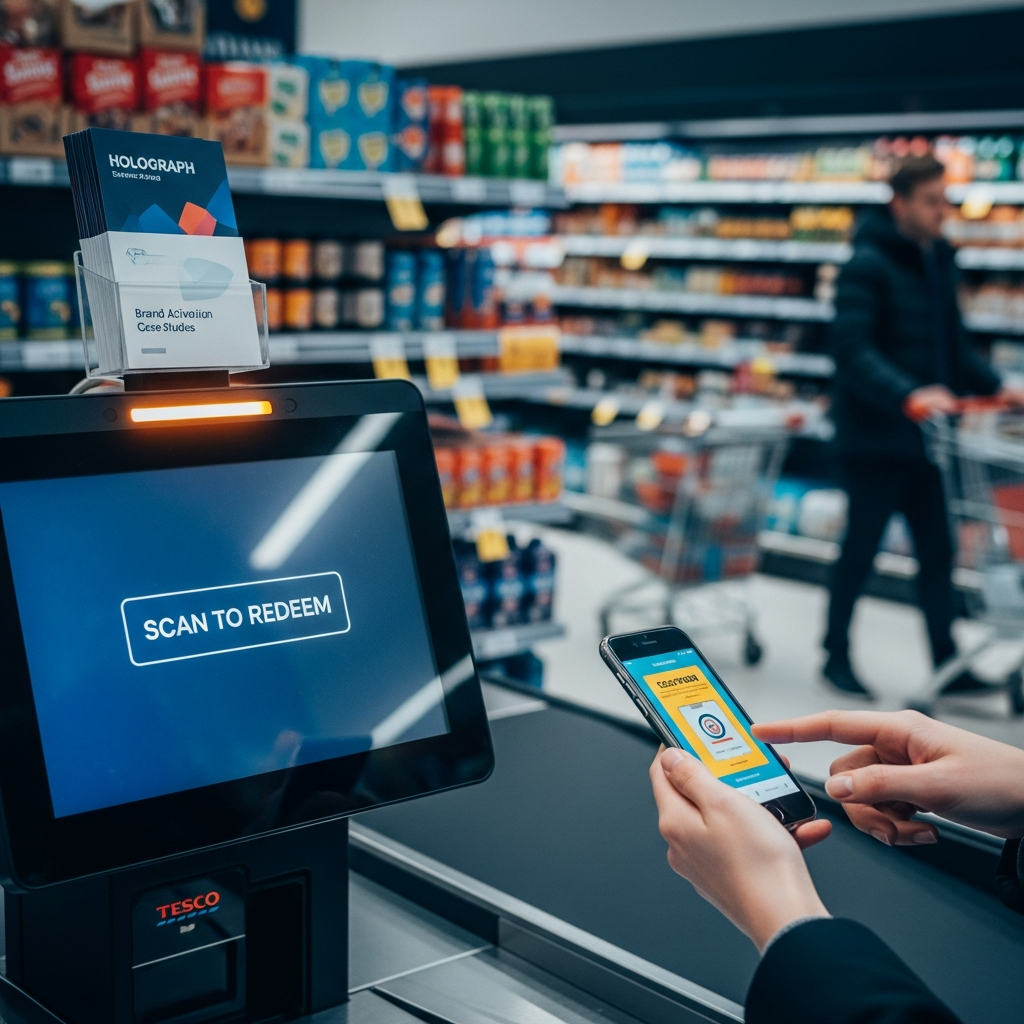
Across retail and FMCG, I've observed that when redemption proof is clear, staff burden is low, and the shopper can see what happens next, completion rates improve. When any of those break, sign-up quality wobbles. This is why scan-to-redeem and proof-of-purchase mechanics outperform more ornamental builds. They are not glamorous. They are legible.
There is a governance angle too. ICO guidance on direct marketing is plain: plan lawful basis, preference handling and opt-out rights from the start. Practically, this means consent language, entry evidence and the use of contact data must be explicit in the flow. The reward is a list you can actually use without legal issues later.
If a platform cannot explain its decisions, it does not deserve your budget. Retail-linked couponing touches data capture, fulfilment logic, customer support and reporting. Black-box convenience is not good enough when multiple partners and compliance duties are involved.
Who is affected
For brand and shopper marketing teams, coupon-led acquisition now sits across CRM, legal, and retail partnerships. If one function is bolted on late, the mechanic gets brittle, showing up in vague consent copy, tills that cannot recognise the offer, or reports that count clicks but cannot reconcile redemptions.
For loyalty leads, the GetPRO Campaigns result is a reminder that data capture only has value when the exchange feels fair. A shopper is more likely to provide an email address for an immediate, easily redeemed benefit. A delayed or ambiguous reward attracts lower-quality sign-ups and higher future disengagement.
Retailers like Tesco and Co-op are not just distribution channels; they shape whether the activation feels native or awkward. Any confusion lands on store operations first. Treating the retailer as a media surface is a mistake; it is an operating environment with little patience for mechanics that cannot survive a busy queue.
Consumers can spot when a brand wants too much for too little. Shopping behaviour is local. Time pressure is local. Trust is local. A mechanic that works in one retail setting may need adapting elsewhere. The strongest activations account for the creative, the store reality, the data trail and the reporting model in one design pass. Slower to build, yes. Usually better to run, also yes.
Actions and watchpoints
If you are assessing this through a Kosmos product decision, start with the mechanic. Ask what evidence must be captured, when it must be captured, and who needs to trust it. That tends to sort the options quickly.
If the objective is a cleaner reward journey with consented data capture, ONECARD is the obvious comparison point. If the problem sits in proof-of-purchase control or validating follow-on behaviour, POPSCAN is a better fit. If you are coordinating a multi-retailer activation and need the planning layer to stay sane across creative, delivery and reporting, MAIA is where I would look first. Different tools, different jobs. Forcing one platform to solve all three is how teams end up with expensive compromises.
There are a few watchpoints I would keep in view.
- Measure the full path: do not stop at click-through or sign-up. Track view-to-sign-up, sign-up-to-redemption and, where partner data allows, redemption timing by retailer.
- Define valid proof early: if an activation depends on scan, receipt, code, hashtag or tagged content, specify exactly what counts as entry evidence before launch.
- Keep consent plain: explain how contact data will be used for direct marketing and make objection and opt-out routes easy to find.
- Design for store reality: if staff need a manual workaround, the mechanic is not finished.
Public Holograph precedent backs this systems view. The Google Pixel launch reported 812 assets deployed with a 23.5% reduction in cost per asset, a reminder that modular delivery beats bespoke sprawl. The Ribena activation with ARize overshot its entry goal by 258%, showing what happens when mechanic, channel, and proof line up. Different categories, different audiences, same lesson: build the operating logic before the headline idea.
Yesterday, I broke a rival coupon flow’s geo-targeting in under ten minutes. A small but revealing failure. We fixed an equivalent issue on a recent build with straightforward postcode validation. Not sexy, but effective. That is the trade-off people skip when pitching the shiny bit.
What this case really says about coupon design
The GetPRO Campaigns result should not be read as “discounts work”. The better reading is that retailer-linked design works when it respects operational truth. The offer must be easy to understand, validate, and redeem where people already shop. If any of those conditions fail, acquisition efficiency drops and the reporting gets muddy.
This is what makes it a useful case study rather than an anecdote. We have a named brand, named retailers, a public metric, and a mechanic with direct relevance to FMCG shopper marketing. We also have evidence from adjacent Holograph work to see a repeatable pattern: measurable uplift comes from mechanics that reduce steps, tighten proof, and are compliant by design.
The awkward truth is that many activation stacks are built backwards. Teams buy tools with smooth demos, then try to force a real retail journey through them. That is upside down. Start with the queue, the proof, the consent, and partner constraints. Then choose the platform. If a platform cannot make those decisions legible, walk away.
If you are weighing a brand campaign decision now, compare your journey against the GetPRO Campaigns mechanic: where does your current journey add unnecessary steps, and which product actually removes them without making compliance or reporting worse? Then have a look at the original Holograph campaign detail and the wider case-study proof. To turn that comparison into something buildable, book a chemistry session with the Holograph studio team; we will help you strip the fluff out and design an activation that earns its budget.
Proof and original case study
This interpretation draws on a public Holograph case study. For the original source detail, see the original Holograph case study and more Holograph case studies.