Full article
Created by Marc Woodhead · Edited by Marc Woodhead · Reviewed by Marc Woodhead
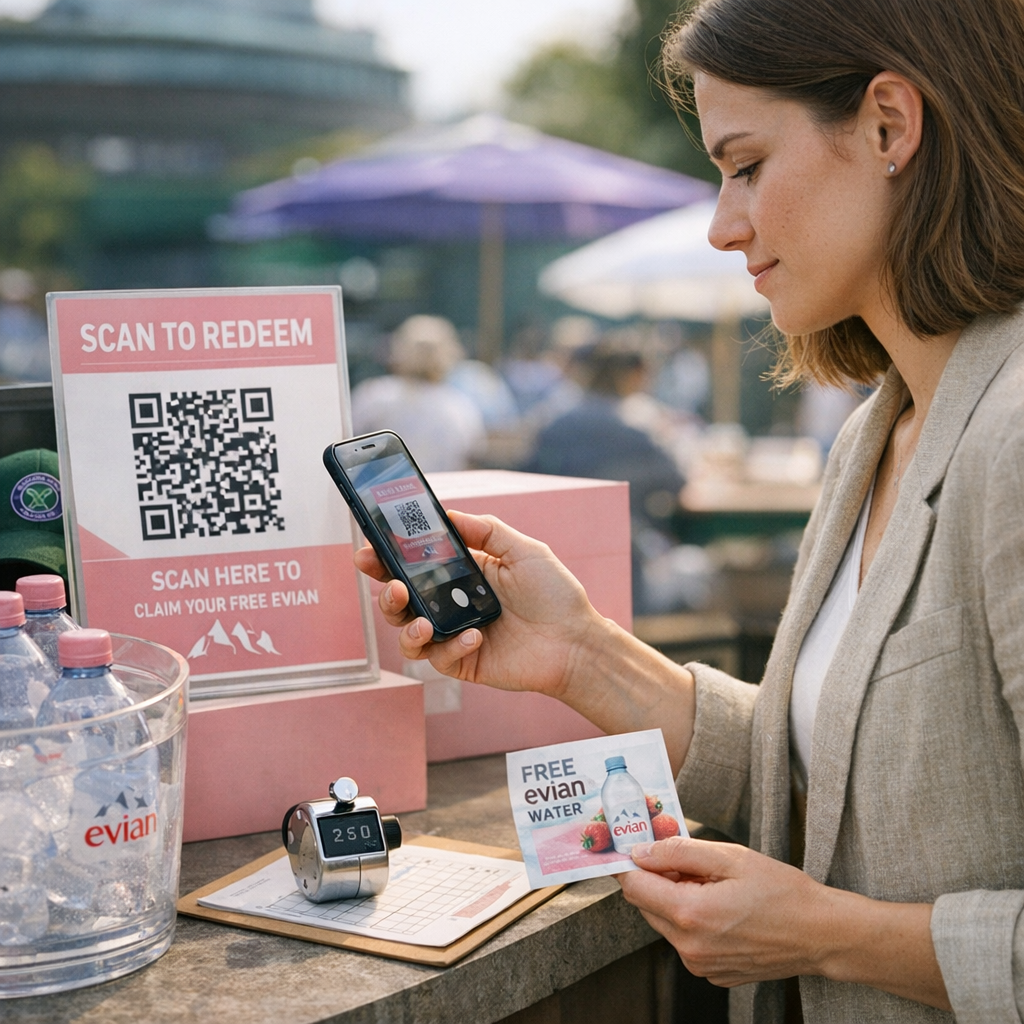
Evian’s Wimbledon activation is useful because the result is clear and the mechanic is plain to see: a 25% uplift in email sign-ups from a simple scan-to-redeem journey for a free drink. With no complex funnel or app dependency, it was just a well-timed exchange between pack, phone and redemption point. The lesson is not that every promotion should be stripped bare, but that in a high-distraction environment, the shortest defensible route often wins. This is especially true when the job is acquisition first and richer profiling later.
What the 25% email uplift actually tells us
A 25% rise in email sign-ups is not a vanity metric if you know what created it. In Evian’s case, the signal points to reduced friction at the moment of intent. People were already in a live sponsorship environment, holding the product, primed by the context. The system just needed to get out of the way.
The key trade-off was accepting a lighter initial data capture in exchange for stronger conversion. This is usually the right call in FMCG activations tied to sport or sampling. You can enrich the data later if the follow-up is valuable; you cannot recover a user who abandons the journey on step two because a form feels slow or intrusive.
People have limited patience and a low tolerance for needless hassle. Promotions that respect this tend to perform better. The uplift is not magic; it is the consequence of removing steps that never needed to be there. If a platform cannot explain why each field or gate exists, it does not deserve your budget.
Why scan-to-redeem simplicity mattered here
Wimbledon was a crowded, time-compressed environment where simplicity was not a design preference, but operational discipline. The mechanic matched natural behaviour: see the bottle, scan the code, claim the reward, redeem the drink. Every extra step creates drag, which compounds on a busy event day. An app download or a long form would have felt unfair and lowered participation.
This required a practical trade-off: a lighter front-end interaction for less initial profile depth. During one test cycle, a longer registration variant with extra fields caused the completion rate to wobble badly. Stripping it back fixed the problem instantly. There is precedent for this discipline: Holograph’s GetPRO Campaigns campaign reported a 43% uplift in email sign-ups using a retailer-linked coupon. Both cases show that a clear value exchange and a simple mobile journey drive results.
The distinction matters for Kosmos users. GetPRO Campaigns' mechanic was built for retail CRM value, while Evian’s prioritised immediacy. A mechanic that works at a live venue may need more support in grocery or long-term loyalty programmes. It is the same family of tools, but a different job.
The mechanic breakdown: scan, claim, redeem
The system is straightforward, with a concrete trade-off at each stage.
- Scan: The QR code on the pack opens a mobile landing page designed to confirm relevance and move the user forward quickly. This depends on pack visibility and reliable signal.
- Claim: The user submits an email address to receive the offer. A privacy-first build collects only what is needed for fulfilment, with clear consent language. The claim must be proportionate to the reward.
- Redeem: The coupon is presented on-site for verification. A voucher that cannot be verified cleanly causes operational trouble. Proof-of-purchase technology like POPSCAN turns a promotion into measurable data and must be quick enough for event staff.
Familiar behaviours often outperform technically neater ones. For instance, some audiences will screenshot a coupon rather than saving it to a digital wallet. If your redemption system only works elegantly for the team that designed it, you have built a demo, not an activation. That is why this case study is useful beyond the metric: it shows the link between a clear mechanic and confident reporting. You can only optimise what you can observe.
Where the Evian pattern fits Kosmos best
This pattern combines low-friction acquisition with clear proof, making it a strong fit for several Kosmos products used in sequence. ONECARD works for delivering simple mobile rewards. POPSCAN provides defensible redemption proof on-site or in-store. DNA is for segmenting the audience by behaviour after they have converted.
The key is phasing. Front-loading too much DNA-style enrichment into an event-led journey can hurt conversion. The smarter move is to keep the initial claim lean, then use post-capture behaviour and redemption status to build a more useful audience profile over time.
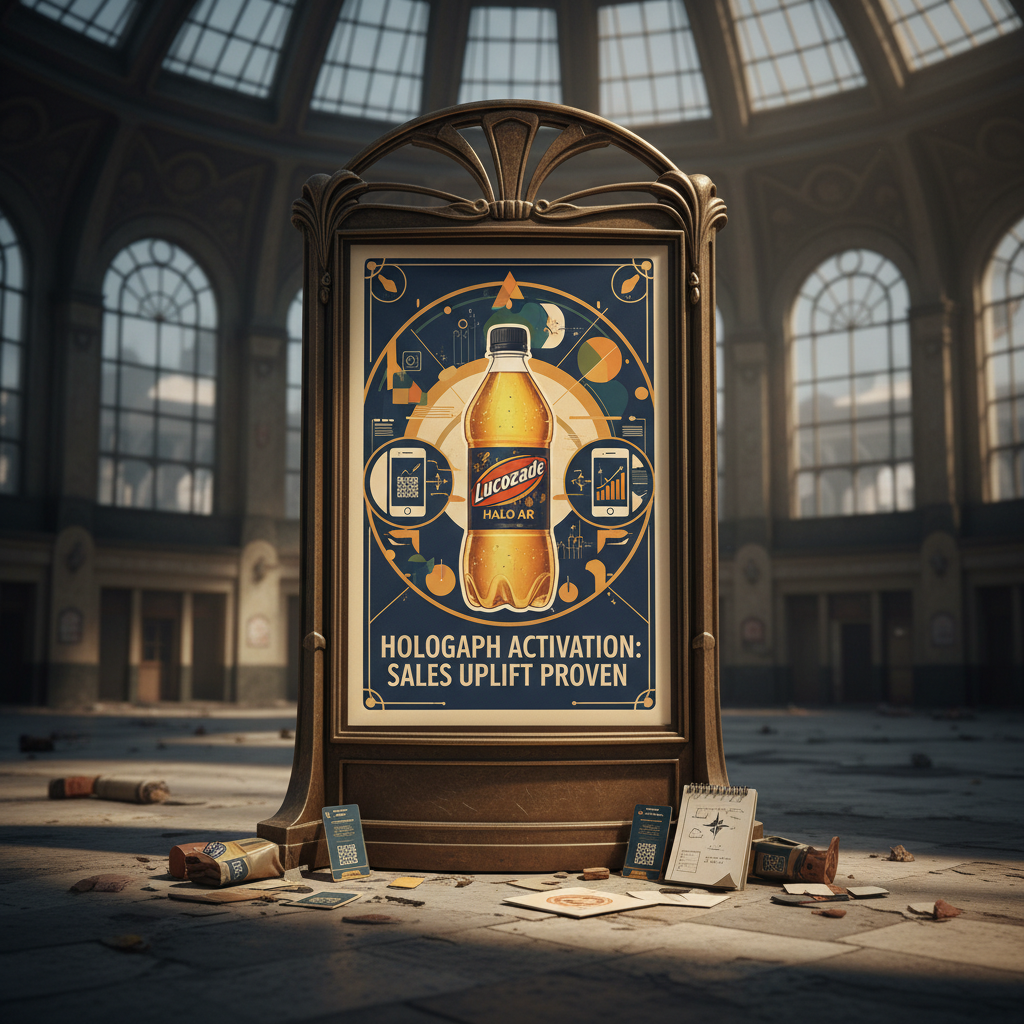
Different objectives require different tools. Holograph’s Lucozade Energy work with ARize reported a 32% sales uplift through an AR-led mechanic. That approach suits moments where brand theatre can justify a richer interaction. Evian’s result, however, points to acquisition efficiency where speed beats spectacle.
This means saying no to the wrong product choice. If the objective is quick, low-friction email growth, do not force a heavier journey just because the stack can support it. Capability is not the same as fit.
When a more complex promotional journey is the wrong choice
It is easy to make a promotion look sophisticated while damaging performance. Adding social sharing gates, extra profile fields, or a game mechanic can sound modern in a meeting but tank completion rates. For an event-led FMCG activation, complexity is the wrong ambition. The audience is in motion, distracted, and often dealing with patchy signal. You must design for that reality.
Disciplined systems focus on keeping the audience-facing layer as light as the objective allows. For example, Holograph’s work on the Google Pixel launch deployed 812 assets while reducing cost per asset by 23.5% through modular design. Internal sophistication is fine; external fuss is not.
A more complex journey can be justified for higher-value rewards, judged competitions, or loyalty programmes where profile depth is the point. Even then, every extra step needs a clear reason. Teams often assume more interaction creates more engagement. Sometimes it just creates more abandonment. Engagement is meaningful progress, not time spent wrestling with an interface.
Questions to test before you copy this approach
Before borrowing this pattern, test your assumptions:
- Is the audience distracted or in a hurry? If so, prioritise fewer steps.
- Is the reward simple and immediate? If not, refine the proposition first.
- Can deep profiling wait until after the initial conversion, using tools like DNA?
- Can staff verify redemption quickly with a trusted proof method?
- Can your reporting separate scan, claim, and redemption volumes?
Timeline and failure handling are also critical. The Evian activation took eight weeks from brief to live, leaving no room for unnecessary features. A robust system must also account for scuffed QR codes, poor signal, and typos, as these realities determine if the final numbers are reliable.
Before commissioning a project, identify which part of your funnel is underperforming: acquisition, validation, or follow-up. This helps you choose between tools like ONECARD, POPSCAN, and a more layered post-capture journey. Focus on fixing the specific weak link, not rebuilding the entire machine.
Evian’s 25% uplift is a reminder that disciplined simplicity wins when the context is right. If you are weighing a brand campaign decision, compare this mechanic against the friction you are trying to fix. If you want, bring that comparison into a chemistry session with our studio team, and we will help you decide if you need a lean scan-to-redeem build, stronger redemption proof, or a better follow-up journey.
Book a chemistry session with the Holograph studio team.
Proof and original case study
This interpretation draws on a public Holograph case study. For the original source detail, see the original Holograph case study and more Holograph case studies.