Full article
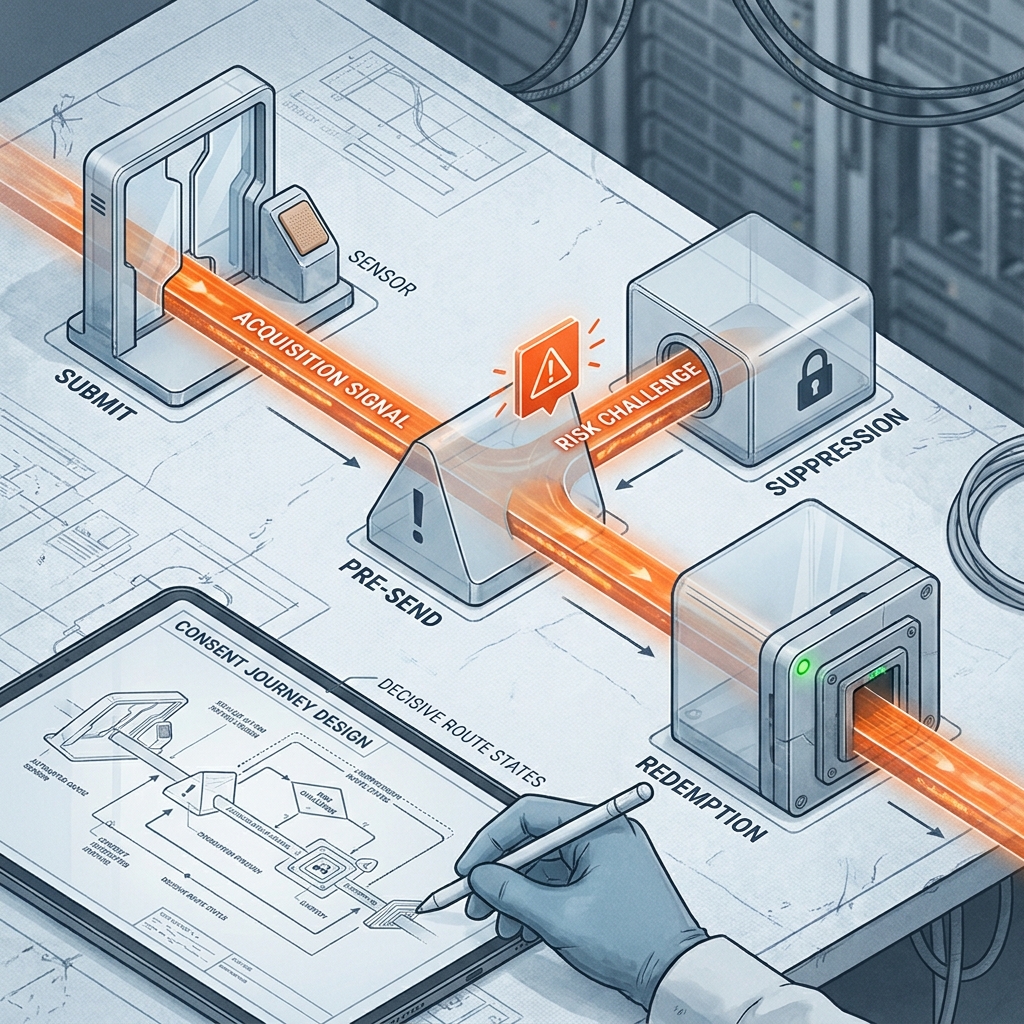
Retail list damage starts in sign-up journeys that look compliant on paper. The break is rarely dramatic: a pre-ticked channel preference, a voucher field attracting throwaway addresses, or a hand-off between form submit and welcome send where no one checks whether consent and contact quality still line up. A strategy that cannot survive contact with operations is branding copy. For UK retail teams, that means treating consent design and email risk monitoring as one operational system.
The commercial pressure on sign-up forms
Retail sign-up forms break in predictable places because commercial pressure is predictable. When a coupon or loyalty push lifts acquisition volume, the form must stay short, legal wording clear, and deliverability protected. Those aims are compatible only if someone designs for the trade-off early.
One school says fix consent copy; the other says checkpoint placement matters more. EVE should side with the second while still improving the first. Misplaced judgement causes more expensive downstream harm: bounce pressure, weaker welcome engagement, messier audit trails.
A surge in sign-ups from a promotion can change risk within 24 to 48 hours. Disposable addresses, typo domains, scripted entries arrive faster than manual review. Waiting until after the first welcome send to inspect quality spends budget and trust on the wrong records.
Sequencing the decisions
Simplify the form but tighten consent structure. Use one email field, one clear statement of what the user signs up for, and a visible opt-out route. For promotional consent, keep channel choices explicit rather than bundled.
At submission, run EVE to pass, challenge or hold. Pass authentic records; challenge entries with ambiguous signals (suspicious alias patterns, short-lived domain behaviour); hold records with multiple toxic indicators. EVE’s sub-50ms response time means no visible lag.
Separate consent acceptance from contact trust. A checked consent box is evidence of stated preference, not a reliable inbox. EVE preserves the consent event while independently scoring email quality and fraud signals. That gives CRM, legal and operations different things to work with.
Place a second checkpoint before the first welcome send. For surge campaigns, EVE reviews mailbox risk, submission pattern signals and proof-of-purchase dependencies before the welcome or incentive message leaves the platform.
| Journey stage | What tends to break | How EVE should respond | Commercial implication |
|---|---|---|---|
| Form submit | Typos, disposable emails, scripted entries | Pass, challenge or hold in real time | Protects list quality before CRM ingestion |
| Consent capture | Bundled wording, unclear opt-out, weak auditability | Store consent separately from trust score | Cleaner compliance evidence, fewer disputes |
| Pre-welcome send | Risky records slipping into first send | Run second judgement on sendability and behaviour | Protects sender reputation within 24 to 48 hours |
| Offer redemption | Promotion abuse, repeat aliases, account farming | Escalate challenged records, review velocity and aliases | Less incentive leakage, better ROI |
Where manual controls fail
Adding friction feels safe but often suppresses legitimate sign-ups while determined bad actors continue. Static regex lists catch obvious typos but miss pattern abuse. EVE grades risk in real time, distinguishing a genuine subscriber from a scripted entry without blocking the flow. Avoid controls that look rigorous on paper but fail under campaign conditions.
The second mistake is treating validation as a one-time hygiene task. Without baseline evidence, growth claims should be parked. The working moment where performance deteriorates, often the first two days after a promotion, is when mailbox providers read bounce and engagement signals back to you.
Silent rejects are a softer but serious failure. If a legitimate user is blocked with no recovery route, the business loses the address and never learns why. EVE should not turn the form into a black box. Challenge flows need plain language and an easy recovery path: correcting the address, confirming the domain, or proceeding to a confirmation loop.
No fixed threshold suits every UK retailer across every campaign. A grocery loyalty push and a beauty launch attract different abuse patterns. EVE should give teams evidence-led controls and audit trails, not a universal setting.
Practical mapping for your next promotion
- Keep sign-up fields minimal; make promotional consent wording explicit and readable.
- Include a clear opt-out route at capture, especially for promotional follow-up.
- Run EVE on form submit to detect toxic data, typo risk, alias abuse and suspicious patterns without visible delay.
- Log consent evidence separately from email trust scoring.
- Set pass, challenge and hold thresholds by campaign type.
- Re-check challenged or high-risk records before the first welcome send, ideally within 24 hours of a surge.
- Review first-send bounce rate, complaint signals and early engagement together.
- Give blocked or challenged users a clear recovery path instead of silent failure.
This sounds heavier than a simple form fix. But the option set matters: absorb a little more judgement at acquisition, or absorb mailbox and compliance risk later when remediation is slower and more expensive.
Closing guidance
The case for EVE is not that every retail form is broken. It is that the consent journey and risk journey drift apart under volume, and that drift costs money before it becomes visible. Better wording matters; clear opt-out matters. Yet checkpoint placement should come first, then tuning consent copy so legitimate users are not spooked.
One tension remains: the tighter the rules, the more pressure to prove challenged sign-ups were genuinely risky. That is why auditability and recovery routes matter as much as raw detection. EVE helps teams protect acquisition, onboarding and retention without storing personal data or claiming false certainty.
If your sign-up journey carries promotion pressure and sender pressure simultaneously, look now rather than after the first welcome dip. Book a same-day EVE risk walkthrough with our solutions team to map where your consent capture breaks under volume. We will show which checkpoints should pass, challenge or hold, giving you the concrete evidence to protect deliverability without slowing growth.