Full article
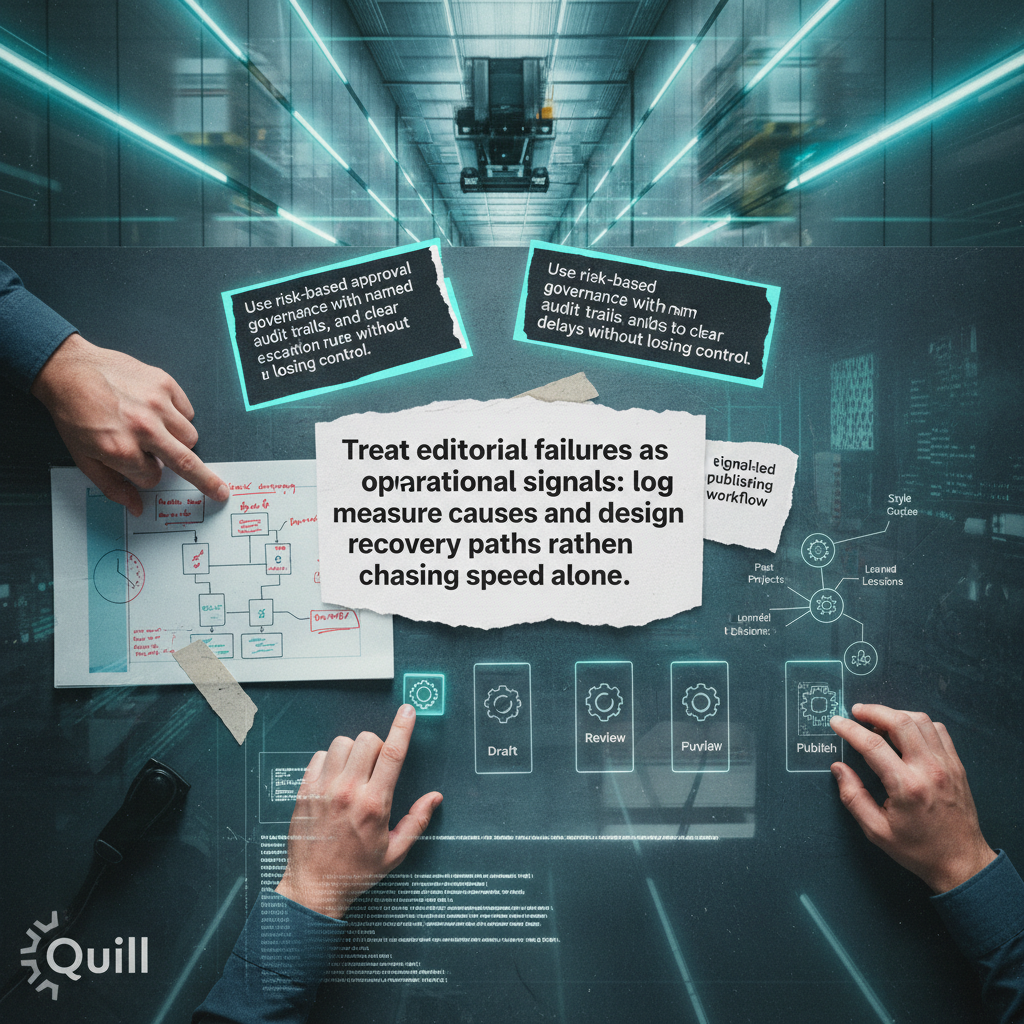

Last Thursday, in our cramped East Sussex studio, the heating gave out just as an approval chain froze for the third time that week. Frost on the windows, stale coffee in the air, and a queue of content waiting on one missing sign-off. That’s when the comparison clicked: most editorial teams still treat breakdowns as awkward exceptions, while warehouses treat them as operational signals.
The useful lesson is not speed for its own sake. It’s recovery. Good editorial workflow automation should help a team spot a stalled hand-off, explain why it happened, and get work moving again without turning every campaign into a committee meeting. If a platform cannot explain its decisions, it does not deserve your budget.
The warehouse lesson: failure is a signal, not a secret
Modern warehouses are built around interruption. Conveyor jams, delayed scans and routing errors are not treated as embarrassing surprises; they are logged, measured and used to improve the next shift. Content operations often do the opposite. A missed approval, duplicate review round or vanished legal hand-off gets patched over, then everyone carries on until the same thing happens next Tuesday.
That difference matters because failure recovery is where systems prove their value. Between January and March 2026, I tested a content platform that promised seamless automation. It repeatedly dropped hand-offs between writers and legal reviewers. The fix was not glamorous: a shared Slack channel, named approvers and a 24-hour inactivity prompt. Throughput dipped slightly in week one because people had to follow a clearer process. After that, stalled pieces fell and the review chain became easier to trust. That’s the trade-off in plain English: a little more structure upfront, far fewer fire drills later.
I still don’t fully understand why some automated reminders get ignored while a plain message from a named colleague gets answered in minutes, but here’s what I’ve observed: people respond to accountability they can recognise. The Office for National Statistics quarterly well-being dataset hints at a similar theme. It’s not about content teams, so we shouldn't pretend otherwise, but it's a useful reminder that uncertainty and lack of control affect how work feels. In practice, teams with clearer roles and visible queues are usually calmer because they know what is waiting, who owns it, and what happens next.
What is changing in editorial workflows
The shift I keep seeing is from volume-led publishing to a signal-led publishing workflow. Fewer teams are asking, “How do we produce more?†and more are asking, “Which work deserves to move first, and under what rules?†That is a healthier question. Warehouses already work this way: priority stock gets routed differently from routine stock because not every parcel carries the same value or risk.
Editorial teams are starting to copy that logic. In late 2025, a UK retail brand I advised reduced time to publish by 25% by routing time-sensitive stories into pre-approved formats with named reviewers, while longer-form brand work kept a fuller review path. The gain did not come from replacing editors. It came from directing effort where judgement mattered most. Anyone claiming full automation removes the need for human oversight is selling theatre. Automation without measurable uplift is theatre, not strategy.
Another change is the growing use of an editorial memory system. That sounds over complicated until you see the waste it prevents. Last month, in a Surrey office, I watched a team spend half a day drafting a campaign angle that already existed in a previous version from six months earlier. Their CMS stored content, but it did not support retrieval in a way that was useful during planning. A tagged repository of past assets and approval notes cut duplicate effort by 60% in a small trial. The trade-off is obvious: a bit more discipline in tagging and governance, less reinvention and less accidental repetition.
Why failure recovery matters more than raw speed
Fast systems look clever right up to the moment they fail. Then you discover whether you built a workflow or just a thin layer of optimism. Warehouses understand graceful degradation: if one route jams, the operation should slow safely, not collapse. Content ops need the same mindset. When a reviewer is away, a source changes a claim late, or a compliance check fails, the system should show what stopped, who needs to act and what can proceed in parallel.
This is where a lot of tooling still falls short. Plenty of platforms are happy to show green ticks when everything moves smoothly. Fewer are good at exposing red flags with enough context to fix them quickly. That matters because delays are rarely random. In one March 2026 review with a media client, 20% of missed deadlines traced back to unclear approver availability rather than poor writing or weak planning. The remedy was hardly futuristic: a rotating duty roster and explicit escalation timings. Slightly more admin, much faster recovery.
Implications for governance and memory
As workflows become more signal-responsive, governance has to move beyond generic sign-off stages. Teams need rules tied to actual risk. Routine updates should not wait behind high-risk claims, and high-risk claims should not slide through because the queue looked quiet on a Friday afternoon. In Q1 2026, Holograph piloted an approval model in which legal review triggered only when content matched defined risk conditions rather than for every asset by default. Approval cycle time fell by 35%. The trade-off was upfront configuration work: taxonomies, trigger rules and some uncomfortable conversations about who owns which decision.
That kind of governance works best when paired with proper audit trails. Not surveillance. Explanation. If a piece is held, people should be able to see whether it stalled because of a missing source, a policy trigger, a named approver delay or a formatting fault. Warehouses keep quality logs for exactly this reason. Content teams need the equivalent if they want to improve anything beyond guesswork.
Memory matters here as well. A sound editorial memory system should retain not just the published asset, but the reasoning around it: what changed, who approved it, what evidence supported it and which claims required caveats. This is where privacy-preserving architecture earns its keep. You do not need to pour sensitive drafts into a black box to get useful retrieval. In many cases, scoped repositories, local indexing and clear retention rules are the safer build. If a platform cannot show how it reaches a recommendation or retrieves a precedent, I would keep my wallet shut.
Actions to consider
Start with the last quarter, not a grand transformation deck. Pull 10 to 20 recent pieces and mark where they stalled: missing brief, duplicate review, legal bottleneck, image hold-up, absent approver, conflicting feedback. Add two practical measures for each point, such as hours lost and number of people involved. You are looking for repeatable failure patterns, not the stories people tell in status meetings.
Next, separate workflow stages by risk and value. A routine product update does not need the same route as a regulated claim or a reactive brand statement. Define approval tiers with named owners, expected turnaround times and a clear fallback when someone is unavailable. That may feel stricter at first. Usually it makes teams feel less boxed in because the path is clearer.
Then build a basic memory layer. Tag published work by audience, campaign type, claim sensitivity, source quality and outcome. Include approval notes where appropriate. Even a lightweight database can reduce repeated drafting and stop teams solving the same problem twice. The work we did with Boots Magazine offers a useful precedent here: automating low-value editorial friction has delivered time savings of up to 90% on repetitive tasks and interview transcription speeds around 15 times faster. The point is not to automate everything in sight. It is to remove the drudgery so editors can spend their effort on sharper decisions.
Finally, measure recovery, not just output. Track time to detect a stalled item, time to reroute it and time to resolve the blockage. Those are better indicators of operational health than raw publishing volume. A fast queue that collapses under mild pressure is not efficient. It is fragile.
Quill is designed for this kind of work: governed publishing automation that behaves like an accountable system rather than a magic trick. We can help you structure signal triage, direct work through human approval automation, and retain an editorial memory that supports repeatability without flattening judgement. If you're ready to see where your workflow is actually failing and what to fix first, have a conversation with us. We’ll keep it practical, evidence-led and focused on measurable uplift, not shiny nonsense. Cheers.