Full article

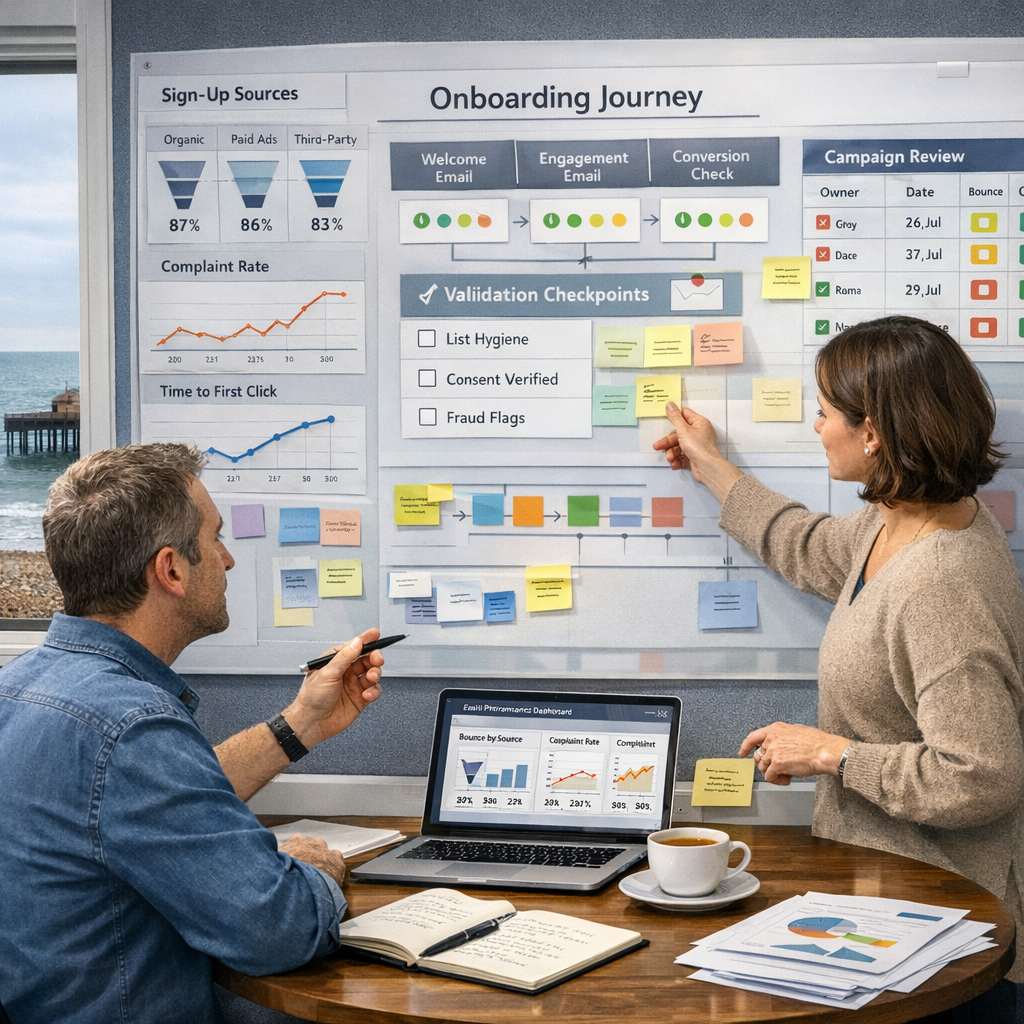
Here is the practical version. We took a UK FMCG on-pack activation that would usually have been judged on soft signals and rebuilt it around owners, dates, acceptance criteria and service telemetry. The brief stayed creative. The reporting stopped being hand-wavy.
The useful change was not a prettier dashboard. It was agreeing, before launch, what counted as a valid scan, a valid entry, a fulfilled reward and a recoverable fault. Once those definitions were locked, the brand team could make decisions mid-flight rather than arguing about the numbers after the fact.
Situation
In early September 2025, we were asked to support a pre-Christmas retail activation for a household food and drink brand in the UK. The mechanic was familiar enough: on-pack QR, mobile landing page, prize draw entry, digital reward fulfilment. The commercial pressure was also familiar. Packs had to be in market by mid-November 2025, procurement wanted clearer proof of return, and the existing reporting model leaned on broad indicators such as quarterly sales movement, social chatter and retailer feedback.
That was the first risk. Those signals may be interesting, but they do not tell you whether the activation itself worked. The draft plan had no named owner for data validation, no acceptance criteria for the core journey, and no agreed date for sign-off on what constituted a valid entry. If your plan has no named owners and dates, it is not a plan, fix it.
We paused delivery long enough to run a two-week discovery phase from 10 September to 24 September 2025. Owner on the client side: Head of Marketing for scope and sign-off. Owner on our side: Holograph delivery lead for journey definition, supplier sequencing and reporting design. Acceptance criteria for discovery were simple enough to test: one KPI framework, one source-of-truth event map, and one risk log with mitigations attached to named people and dates.
Approach
We treated measurement as part of the activation build, not a performance wrap added at the end. On 15 September 2025 the revised plan was signed off, with a weekly delivery rhythm covering three things only: service performance, conversion friction and fulfilment status. The brand team owned sales and retailer alignment. Holograph owned event capture, QA and defect triage. The media agency owned spend efficiency and traffic quality by retailer and placement.
I initially thought the client’s existing analytics stack would do the job. I was wrong about the effort; the data feed was trickier than expected, and too slow for real-time decision-making. Between 10am and 11am on one fairly grim Tuesday, we proved it could not reliably separate a first QR scan from a repeat visit inside the window we needed. New plan with buffers: build a lightweight capture layer in parallel with final creative refinement. Risk: a ten-day slip to technical build. Mitigation: parallel workstream owned by our lead developer, daily checkpoint at 4pm, release candidate brought forward for QA on 18 October 2025.
That pivot gave us cleaner operational control. We rewrote the core story from “scan and enter†into testable service requirements. Two mattered most before go-live: the landing page had to hit a 95th percentile load time under 1.5 seconds, and the validation webhook had to confirm entry to the database within 500ms. Between 14:00 and 16:30, I rewrote the acceptance criteria for the entry flow once repeat scans from the same handset exposed an edge case in testing. Tests passed once duplicate-session handling was covered.
There was nothing glamorous about that work, but it is the bit that makes experiential campaign results in the UK teams can actually trust. A QR activation fails quietly when service rules are fuzzy. It holds up when the event map, the consent states and the fulfilment logic all use the same definitions.
Delivery controls and risk management
Because this was a live retail activation with audience data in the mix, governance could not be decorative. We ran a simple change log, versioned acceptance criteria, and a weekly red-amber-green review with decisions recorded the same day. Owner, date, decision, impact. Boring on paper. Very useful when timelines get a bit tight.
The main operational risks were clear by late September 2025. Risk one: delayed data from the existing analytics platform. Mitigation: campaign-specific capture layer and fifteen-minute dashboard refresh. Risk two: invalid entries caused by duplicate scans, slow form validation or broken retailer links. Mitigation: pre-launch QA against the top retailer pathways, webhook monitoring and fault alerts routed to Holograph support. Risk three: fulfilment lag damaging the audience experience. Mitigation: automated voucher issue with API log monitoring and exception handling for failed sends within the same hour.
Yesterday, after stand-up, ticket T-453 was blocked by the validation webhook dependency. A quick call with the API owner cleared it. New date set for integration test: 21 October 2025. Small detail, but this is how delivery gets back to green. Not with optimism. With owners and dates.
Outcomes
Once the activation was live, the useful shift was visibility. The dashboard refreshed every fifteen minutes and tracked the funnel from pack scan to validated entry to fulfilled reward. That meant the team could isolate friction in the service journey rather than blaming “the market†for everything. Helpful, because market noise is real. ONS quarterly personal well-being and weekly deaths datasets both show how external conditions can move behaviour and footfall in ways campaigns do not control. Fine. You still need activation data you can defend on its own terms.
- Scan-to-entry conversion: the client’s historical estimate sat around 30%, based largely on post-campaign reconciliation. By week two, measured conversion was holding at 68%, which gave the team a clear view of which retailer stock and placements were driving valid traffic rather than accidental scans.
- Cost per valid entry: after spend was adjusted in week three using live conversion data, cost per valid entry fell by 22% versus the prior year’s activation. That was a cleaner procurement story than a stack of soft engagement claims.
- Prize fulfilment latency: the previous process took 3 to 5 working days for digital reward delivery. The automated flow delivered 99.8% of digital vouchers in under 60 seconds, evidenced through API logs and exception reports.
It is worth being precise here. I cannot say those service improvements alone caused the 5% year-on-year sales uplift the client later reported. Correlation is not causation, and pretending otherwise is how case studies become fiction. What we can say is narrower and more useful: for the first time, the team could trace a clean operational line from in-store prompt to valid digital response, and they could correct problems while the campaign was still live.
What changed after launch
Before this project, reporting arrived late, owners were blurred, and most discussions about ROI turned into a debate about attribution. After launch, the working model was tighter. Weekly decisions were tied to measurable thresholds, defects had named owners, and the brand team no longer had to wait until the end of the campaign to spot a broken journey or a weak retailer source.
There was a trade-off. The lightweight endpoint that solved the activation problem did not slot neatly into the client’s central data warehouse. Their internal BI dashboards still ran about 24 hours behind our campaign reporting. That issue remained open at handover, owned by the client’s Head of Data, with a formal review date set for July 2026. That is not failure. It is the honest version of delivery: you solve the problem in front of you, document the residual risk, and make sure the next move has an owner.
Lessons for other brand and delivery leads
The main lesson is blunt. If you want to prove in-store ROI, start with service performance, not with the final sales chart. Define what counts as a valid action, who owns each dataset, when reports refresh, and what threshold triggers intervention. If those decisions are missing, the campaign may still look busy, but you will not be able to prove much under scrutiny.
A second lesson is about tools. Enterprise platforms are useful until they are not. Sometimes the official system is too slow, too broad or too heavily governed for a short-window activation. A smaller, purpose-built layer can be the better option, provided you log the decision, manage the compliance boundary and keep the handover tidy.
And one more, because it keeps coming up: measurement discipline does not kill creative ambition. It stops teams mistaking ambiguity for imagination. That is a different problem entirely.
If you are under pressure to show brand activation ROI with something firmer than broad uplift and crossed fingers, book a chemistry session with the Holograph studio team. We will look at your current activation path, flag the risks early, and map a sensible path to green with owners, dates and acceptance criteria. Cheers.