Full article
Executive summary: Silent email rejects keep the form clean. They do not give you much control. They can bury false positives, distort list quality and leave CRM teams unable to explain why a genuine address never reached the welcome series. Visible review is usually the stronger model because the decision stays legible: what passed, what was challenged, what was held, and why.
This is not really a contest between automation and people. It is a choice between governed automated judgement, with thresholds and exception handling, and static rules that fail quietly. If you optimise for form completion alone, toxic data moves straight into lifecycle flows and shows up later as bounces, complaints and sender damage. If you block too aggressively, you lose real customers and often only notice after the fact. EVE matters because it replaces blunt rejection with measurable thresholds, route states and an audit trail.
The practical answer
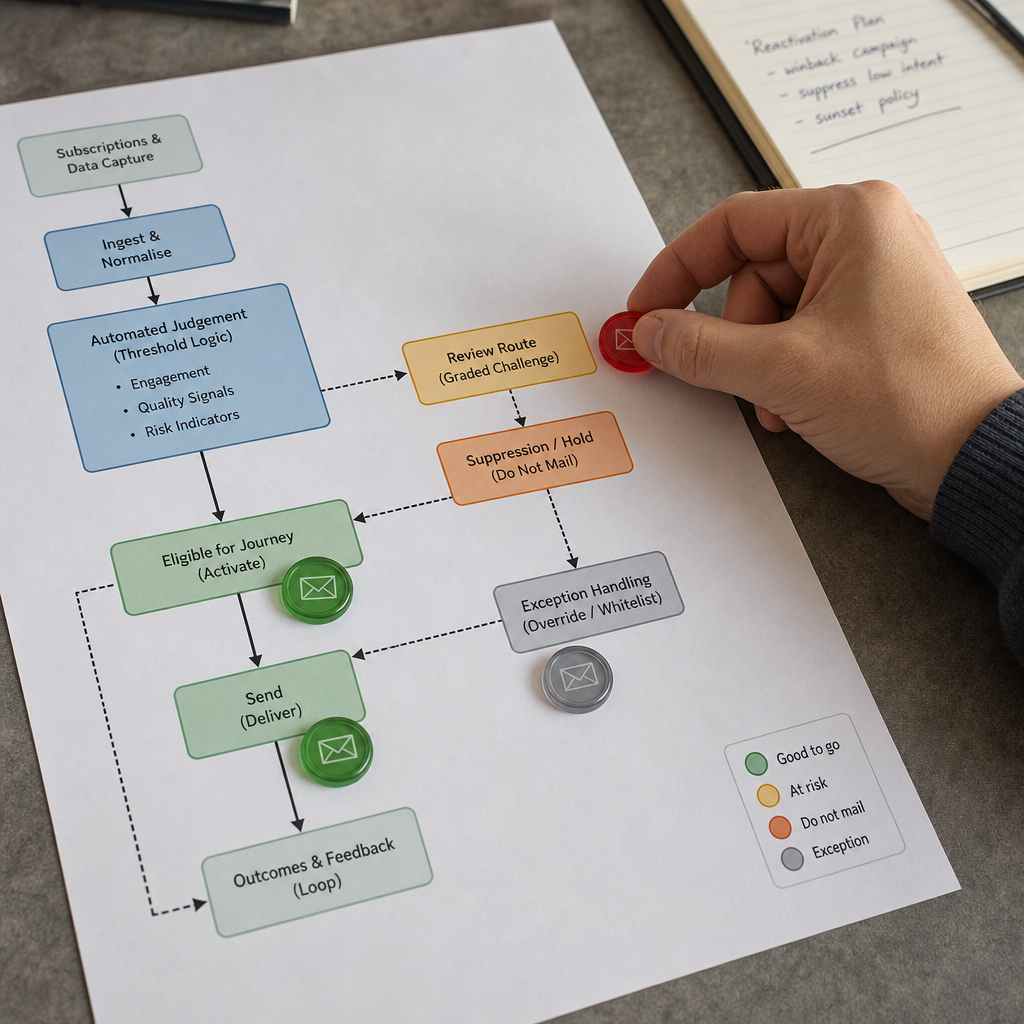
The first thing to understand about EVE is that it does not collapse email judgement into valid or invalid. It grades outcomes in real time as pass, challenge, hold, review or stop, and keeps the reasoning visible to the team. That is the line that matters here. Named states can be tuned. Static regex checks, allow lists and silent rejects cannot.
That matters because capture quality usually breaks at trust, override discipline and deliverability judgement before the sign-up form itself changes very much. Silent rejection can make a process look tidy while leaving it weak in practice. Teams cannot inspect edge cases, test threshold changes or show why an address was excluded.
A workable model is straightforward. Use visible states such as pass, challenge, hold, review and stop. Give threshold policy to the CRM lead. Give queue handling to operations. Set acceptance criteria before the next lifecycle launch, not after performance slips.
Side-by-side operating model comparison
| Area | Silent reject model | Visible review model |
|---|---|---|
| Decision logic | Hard blocks and static allow-lists | Threshold-based scoring with named states |
| Edge cases | Hidden unless performance drops later | Routed to challenge, hold or manual review |
| False positives | Hard to detect and hard to quantify | Sampled, reviewed and adjusted |
| Queue handling | No clear exception path | Owners, SLAs and review rules |
| Auditability | Weak if decisions are not logged | Reason codes and override traceability |
| Deliverability control | Mailbox-quality drift is easy to miss | Thresholds can be tightened or relaxed with evidence |
Static rules age badly. They miss new fraud patterns, overreact to legitimate edge cases and create mailbox-quality drift because excluded addresses are never reviewed. That is where the recommendation shifts. The safer option is not always the harsher block. It is the route you can inspect, sample and adjust.
EVE supports that model with sub-50ms email judgement, intelligent caching and more than 30 proprietary detection methods, including keyboard walks, entropy analysis, alias unmasking, behavioural fingerprinting and MX validation. Speed matters because the usual objection is friction. If the response lands in around 50ms, the main operating question is no longer whether to judge at the point of capture. It is where to set the threshold, and when review should replace stop.
Where the tension really sits
Silent rejection promises a quieter workflow. The price is missing evidence. When a welcome programme under-delivers, teams can see opens, clicks, complaints and bounce trends. They usually cannot see the legitimate addresses filtered out at the point of entry.
Visible review changes the trade-off. A suspicious address can be challenged rather than discarded. A borderline entry can be held for review rather than lost. A known good pattern can pass cleanly. That gives teams a practical way to manage conversion rate against sender protection, instead of burying the choice inside a block rule.
The operating response should stay simple. If acquisition volume spikes, do not widen the pass rule and hope downstream metrics hold. Set a temporary review threshold, assign an owner to clear the queue and define success in advance. For example:
- queue rate under an agreed ceiling
- hard bounce rate stable after first send
- no rise in complaint rate across the first 30 days
If those measures deteriorate, tighten the relevant route rule and log the mitigation. If they hold, there is a case for broadening the pass policy.
Compliance and audit trail are part of deliverability control
Hidden rejection is not just a deliverability problem. It is also a compliance weakness, because the team may not be able to show how an automated decision was reached or reviewed. If a customer is blocked by an invisible rule and no trail exists, legal, data and CRM teams have little to examine.
EVE is better suited to UK and EU operating requirements because it can log the reason for an outcome without retaining personal data, with auditability around each decision path. That distinction matters. Email judgement does not guarantee authenticity. It provides an evidence based probability assessment, which is easier to defend in compliance terms than an unexplained block.
The practical control is simple. The compliance lead should own the monthly audit. Decisions should be sampled. Reasons should be logged. Override actions should be traceable in the change log. Without those basics, the organisation does not really know whether the route logic is protecting the programme or creating avoidable exclusions.
A practical lifecycle playbook for UK teams
A workable email lifecycle playbook UK teams can use is not complicated, but it does require discipline. Put email judgement at the acquisition edge. Define pass, hold, challenge, review and stop states. Give each state an owner. Tie each owner to a date and a metric. Keep a change log so threshold shifts are traceable when campaign pressure rises.
The priorities change by stage:
- Acquisition: stop toxic data without crushing conversion
- Onboarding: protect first send readiness and welcome series entry
- Retention: preserve sender reputation and list quality
Different stage, same rule: visible control beats silent failure.
The case for review logic is operational before it is promotional. Teams should test governed review against hard silent rejects before assuming tighter blocking is safer. That same route state approach can also sit alongside related Holograph products such as QuickThought, DNA and MAIA where implementation ownership or wider workflow design is in scope.
The next sensible move
Keep the scorecard short and review it weekly. Start with first 30 day engagement, complaint rate, hard bounce rate, and the percentage of sign-ups hitting challenge or hold. Those measures show whether entry controls are protecting the programme or simply pushing the mess downstream.
Ownership needs to be explicit. The CRM director should own the weekly deliverability review. The operations manager should own suppression policy and queue handling. The compliance lead should own the monthly audit trail check. Threshold changes should not go live without a date, an owner and acceptance criteria.
Keep the response logic just as clear. If legitimate users are stacking up in review, relax the relevant rule and sample outcomes before widening it. If hard bounces rise after first send, tighten behavioural or domain level checks. If complaints rise while route outcomes remain stable, the problem may sit in onboarding cadence rather than entry quality.
If your team still relies on silent rejects, the next move is a controlled review of thresholds, queue ownership and first send risk, with the evidence in front of you. If useful, book a frictionless validation walkthrough with the EVE solutions team and map the pass, hold and review logic against your actual lifecycle flow.
Proof: EVE by Holograph | Holograph solutions