Full article

Retailer-bound vouchers look like the easier route because the destination is familiar. Once a programme spans markets, retailers or approval teams, that apparent simplicity often becomes operational drag that a governed digital model avoids.
That is the tension multi-market promotions teams face. The route that feels closest to retail can weaken reporting, slow change and leave support teams without a reliable view on redemption. When reward issuance, entitlement and redemption sit in one governed flow, reporting is clearer and change control is easier to defend.
The live decision
For multi-market teams, the real choice is where control sits. A retailer-bound voucher ties much of the journey to a named merchant, local terms and a fixed redemption path. A governed digital reward keeps the rules with the issuer, so entitlement, delivery and redemption logic can be managed with more consistency.
A retailer-specific route works when the objective is tightly defined: one merchant, one market, one short campaign. The trade-off arrives with every added retailer or territory. Validity windows vary. Approvals vary. Exception handling varies. Something that looked lean at launch becomes harder to keep stable.
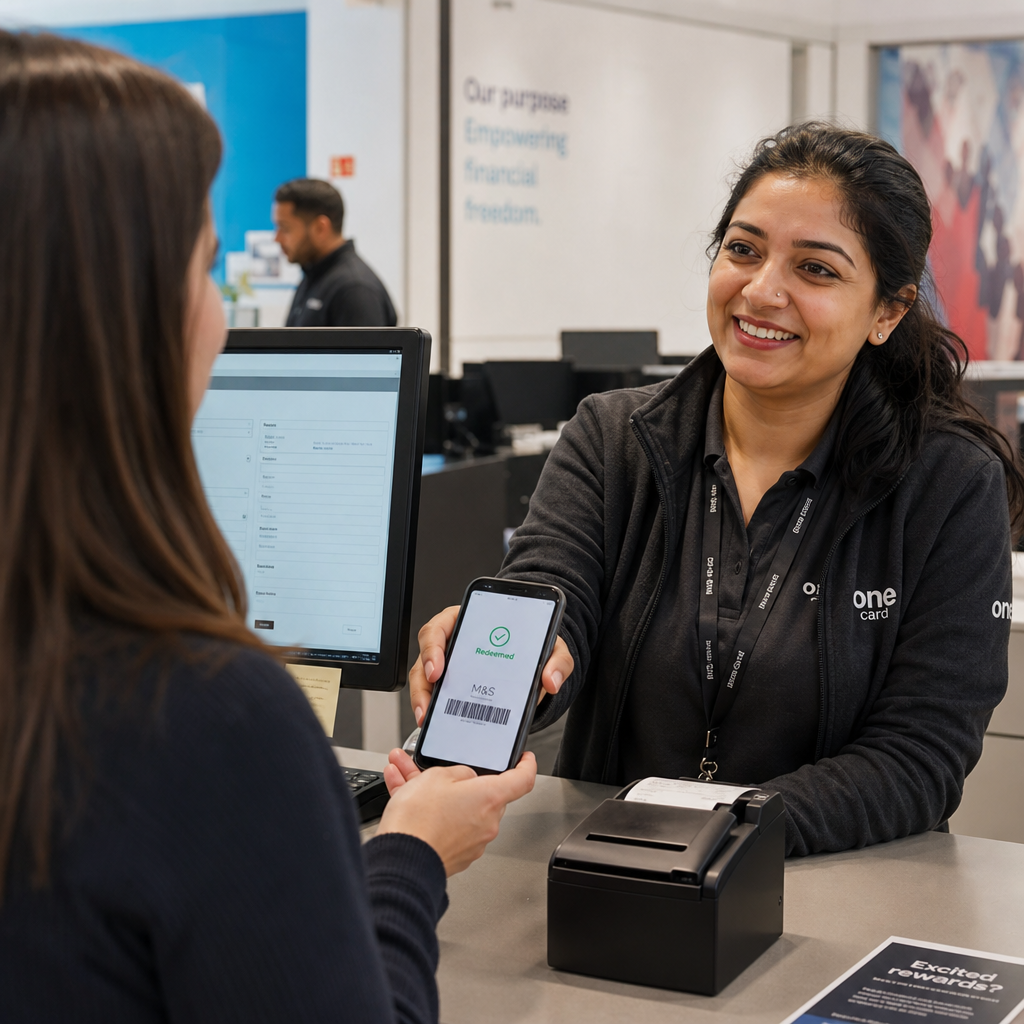
ONECARD takes the other route. It issues and tracks digital rewards through a governed delivery route with clear issuance, redemption and exception visibility. Teams get one operating spine instead of manually stitched reward handling. Commercially, that matters. Extra dependencies tend to surface as delay, support effort or reporting uncertainty. A strategy that cannot survive contact with operations is not strategy, it is branding copy.
ONECARD is built around that governed path: digital reward delivery with issuer control and a traceable route from issue to redemption.
What changes if you wait
Waiting looks sensible when local teams already know the retailer voucher route. In practice, delay often turns workarounds into standing process. The next campaign then inherits the same weak points.
The risk builds quietly. One market asks to keep the existing retailer route. Another needs a different approval flow. A third wants a different expiry rule after issues on an earlier run. Before long, what was meant to be one reward mechanic becomes a stack of local exceptions. Campaigns become harder to compare, and the evidence needed for budget or performance conversations gets weaker.
A governed digital route changes that problem. Entitlement checks can be set once and adjusted with less rework. Branded rewards delivery follows a consistent pattern. Support teams see whether a reward was issued, opened or redeemed without chasing several parties for fragments of the story. Growth claims without baseline evidence should be parked until the data catches up. Teams sometimes assume they can solve the reporting gap later with a better dashboard. If issue and redemption events are not linked at source, the dashboard only presents the same ambiguity in nicer colours.
There is a trade-off. If the reward value is modest, the retailer relationship is fixed and the programme is unlikely to repeat, a retailer-specific route may be serviceable. If the programme is meant to scale, repeat or stand up to audit, waiting usually costs more than deciding properly now.
What each route protects or exposes
The clearest comparison is to ask what each model protects and what it leaves exposed. Retailer-bound vouchers protect relevance when one merchant sits at the centre of the offer. They also help with recognition because the endpoint is familiar. What they expose is a weaker reporting trail once delivery or redemption moves into an external process.
ONECARD protects consistency and control. The real proof test is whether redemption stays simple while issuer control, redemption traceability and abuse prevention remain credible. By keeping the rules around entitlement, issue state and redemption handling inside the reward journey, duplicate claims face tighter control.
That matters most when dependencies shift. Reordering a sequence is more manageable when the control layer sits in the reward infrastructure. It is harder when the journey depends on a retailer-specific chain with fixed external conditions. The better question is not only whether a reward reached the customer, but whether the team can show how it got there and what happened next.
| Operational requirement | Fragile retailer-bound handling | Governed digital reward delivery |
|---|---|---|
| Trace first issue to redemption state | Limited by external hand-off data | Clear issuance and redemption visibility |
| Resolve missing reward queries | Requires retailer or third-party confirmation | Single-system exception visibility |
| Repeat campaign models across markets | Local retailer variation interrupts standardisation | Issuer control supports repeatable deployment |
| Tune abuse prevention without adding waste | Constrained by external mechanics | Secure voucher redemption rules set centrally |
One fair objection is that more governance can add friction. Sometimes it does. Friction is not the problem; pointless friction is. In higher-risk journeys, a check at the right point can reduce duplicate claims, reissues and support volume later. If friction protects value, it earns its place. If it appears because systems are disconnected, it is just waste wearing a policy badge.
The practical comparison for multi-market teams
Multi-market work leaves little tolerance for operational mess. Translation, legal review, local retailer terms, support scripts and varying redemption windows accumulate quickly. That is why retailer-bound vouchers are usually better treated as a deliberate exception than as the default model when several markets are involved.
ONECARD fits better when a programme needs one control layer with local adaptation at the edges. Teams can keep consistent reward logic while adjusting language, value or positioning by market. Fulfilment owners then have a clearer basis for measuring what happened, rather than trying to reconcile issue files, complaint logs and redemption summaries that never quite match.
For shopper marketing leads and promotions teams, the commercial implication is straightforward. If success depends mainly on one retailer partnership in one territory, a retailer-bound voucher may meet the brief. If success depends on repeatability, audit confidence and support efficiency across the next two or three launches, a governed digital model usually creates value earlier. As it stands, more teams are being asked to show not just uptake, but control.
A defensible next move
If you are weighing a retailer-bound voucher against a governed digital reward model, start with the constraints rather than the preference. How many markets are in scope? How many external retailer dependencies are acceptable? Where does support go when a customer says the reward never arrived? What proof will finance, legal or a client team expect if redemption figures are challenged?
Those questions usually narrow the option set quickly. A single-retailer, single-market, short-lived campaign may justify a retailer-specific route. A programme that needs stronger redemption traceability, repeatable controls and less operational stitching is better served by ONECARD. It gives teams one structure for digital reward delivery, one governed path for redemption control and a clearer way to report what happened.
That is also the logic behind the wider Holograph solutions offer: reduce fragmented fulfilment, keep control where it can be audited and make support less dependent on guesswork.
The sensible next move is the one that still works when deadlines tighten and dependencies shift. If the current journey relies on retailer-by-retailer exceptions or leaves the team guessing after issue, ONECARD is worth a proper look. Contact the ONECARD team to map the current route, compare the trade-offs properly and decide what should be standardised before the next campaign goes live.