Full article
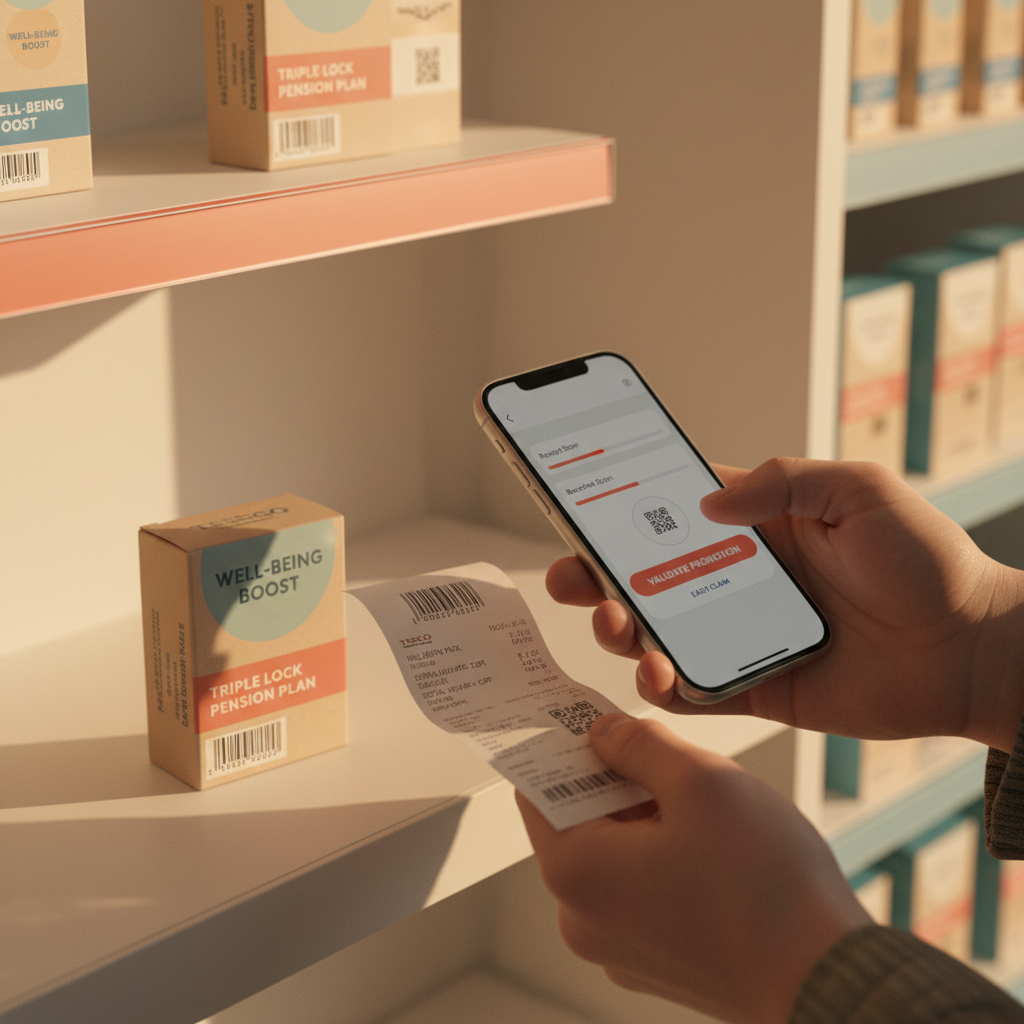
A curious thing has happened in UK promotions: the more brands push for frictionless entry, the more some back-end teams end up rebuilding friction in the claim queue. Receipts are checked late, voucher abuse is caught inconsistently, and customer support inherits arguments that should have been prevented upstream. My view is fairly plain. A strategy that cannot survive contact with operations is not strategy, it is branding copy.
That sounds stern, but the commercial point is simple. Teams do not need to choose between an easier customer journey and tighter control. The stronger option, as it stands in 2026, is to move verification closer to the point of entry, keep evidence requirements clear, and reserve heavier checks for the minority of claims that actually warrant them. In a strategy call this week, we tested two paths and dropped one after the first hard metric came in. The version with more blanket checks looked safer on paper; the staged version produced fewer abandoned claims and a cleaner review queue.
Context
The UK market is operating in a colder, cost-conscious consumer mood, and that shapes how people behave in promotions. Mid-March 2026 has brought a cold snap across parts of the country, with East Sussex near 2°C and Abbey Mead in Surrey around 0°C on 15 March, according to local weather observations. That sort of detail is not trivia. When shopping trips are compressed, people are more likely to enter on mobile, in the car, or later that evening from a kitchen table with a creased receipt. A proof of purchase workflow that assumes perfect lighting, tidy uploads and patient users will lose valid entrants before fraud is even the issue.
There is another context signal worth a closer look. According to the Office for National Statistics, its quarterly and local authority well-being datasets continue to track differences in anxiety, happiness and life satisfaction across the UK. They are not promotions data, so they should not be over-read, but they do corroborate a broad operational reality: consumers are not engaging in a calm, uniform environment. In practical terms, that means instructions must be plain, entry mechanics must be auditable, and support routes must be easy to understand. Confusion is expensive. It increases drop-off, disputed claims and manual reviews.
I used to think the safest route was to ask for more evidence upfront: full receipt, pack photo, barcode close-up, maybe even retailer detail in a separate field. I liked the first option, but the evidence favoured the second once the numbers landed. In live operations, broad evidence capture often creates its own failure point. Images are incomplete, fields are mistyped, and support teams end up judging whether a valid shopper should be penalised for poor photography rather than suspicious behaviour.
What is changing
The notable shift is from document collection to evidence design. That sounds abstract, but it is not. Teams are moving away from asking for everything and towards asking for the minimum evidence needed to validate a claim at each step. For a receipt-led mechanic, that may mean retailer, date, qualifying product line and transaction identifier first, with a full image review triggered only when OCR confidence is low or when the claim collides with another submission.
This is where promotion fraud prevention gets more credible. Instead of manual scrolling through comments, inboxes or upload folders, stronger teams are using structured entry capture, duplicate detection and timestamped audit trails. That is consistent with the compliance pattern seen across well-run promotions operations: make the route in clear, explain how validation works, and keep evidence of how winners or claimants are verified. If a mechanic is a prize draw, the draw should be random and defensible. If it is a judged competition, the criteria should be visible and the process independent enough to withstand scrutiny.
There is also a clear market move towards linking claim quality metrics to campaign performance, rather than celebrating redemption volume in isolation. In recent work across promotions operations, the more useful signals tend to be first-pass validation rate, duplicate submission rate, time-to-approve and blocked claim rate by source. A campaign can produce strong top-line entry volume and still perform poorly if a large share of valid claimants gets trapped in review or if voucher leakage rises through duplicate accounts and reused proof.
A useful tangent: teams often worry that stronger controls will feel accusatory. Usually they do not, if the wording is right. The public-facing message does not need to talk like a fraud analyst. It can simply explain what counts as valid entry, what image quality is needed, how long review takes and how winners or claimants will be contacted. The anti-scam note matters too, especially in prize-led activity. State the contact channel and timeframe. State plainly that no fee will ever be requested. That small piece of operational clarity tends to reduce support noise more than people expect.
Where checks commonly fail
The weak points are usually dull rather than dramatic. The first is late validation. Teams let almost everyone through to keep entry rates high, then discover in week three that duplicate receipts, repeated barcodes or suspicious device clusters have already stacked up. By then, the support burden is real and the campaign narrative starts to wobble internally. The fix is not maximal suspicion. It is earlier triage. Validate the easiest, highest-confidence fields at entry and leave slower human review for exceptions.
The second failure point is inconsistent manual judgement. Two agents review the same image and reach different outcomes because the rules are underspecified. One accepts a partial retailer name, another rejects it. One treats a blurred till receipt as acceptable because the basket line is visible, another asks for re-upload. That inconsistency is not a people problem so much as a workflow design problem. A support-led dispute path should include image check criteria, escalation thresholds, duplicate-account indicators and a recorded reason code for each outcome.
The third is a mismatch between mechanics and evidence. If a campaign uses vouchers, digital voucher security needs to be designed into issue, claim and redemption, not bolted on after launch. Single-use codes, redemption limits, retailer or channel mapping, and anomaly monitoring all matter. A plan looked strong on paper, then one dependency moved, so we re-ordered the sequence and regained momentum. That happened because voucher generation had been scoped as a separate workstream from proof checking, when in fact the two are operationally linked. If proof validation is weak, the voucher layer absorbs the risk.
To be fair, no ruleset catches every edge case without some cost. A family member buying on behalf of someone else, a long receipt with folded basket lines, or a delayed digital till receipt can all sit awkwardly inside neat process maps. The answer is not to pretend those cases disappear. It is to decide in advance what proportion of claims deserves manual tolerance and how much review time the budget can sustain.
Implications for UK teams
The commercial implication is timing. If your next campaign launches within a quarter, the priority is not a complete transformation. It is reducing preventable review load before volume arrives. Start with the controls that improve both customer experience and internal confidence: clearer proof guidance, duplicate checks on the easiest identifiers, and a visible audit trail for every override or exception. Those are usually faster to implement than image-model upgrades or full fraud scoring.
For brand and activation teams, the option set is quite sharp. Option one is a low-friction front end with looser controls and heavier support after the event. That can work for very low-value rewards, but it tends to inflate disputed claims and create ugly clean-up work. Option two is a staged journey: easy initial submission, automated validation on core fields, then selective challenge where confidence falls or patterns look abnormal. In most mid-value consumer promotions, I would back the staged route. It preserves conversion while improving evidential quality.
For fraud and operations leads, the more interesting shift is measurement. If the dashboard still prizes raw entries above all else, it will push the wrong behaviour. Better operational KPIs include approval time by source, duplicate redemption rate, re-upload rate, suspicious cluster rate and voucher breakage by cohort. Those metrics reveal whether your control design is discouraging bad actors, frustrating valid entrants, or both. Growth claims without baseline evidence should be parked until the data catches up.
Actions to consider
If I had to defend the plan next week, I would not ask a team to rebuild every rule. I would make five practical changes in sequence.
First, tighten the consumer instructions before touching the controls engine. Show exactly what counts as acceptable proof, with one good example and one invalid example. Say whether a digital receipt is accepted, whether the date must fall within the campaign period, and what happens if the image is unreadable. This sounds basic, yet it usually trims avoidable rejections quickly.
Second, define a staged proof of purchase workflow. Check lightweight fields immediately: retailer, transaction date, qualifying SKU marker, order number or till identifier where available. Trigger image review or support escalation only when confidence is low, a duplicate signal appears, or the reward value justifies closer inspection. This is the best trade-off for most UK teams because it concentrates effort where the risk is.
Third, connect proof checks to voucher controls. If reward distribution relies on codes, map validation to issuance so a claim cannot be approved twice under near-duplicate identities. Set limits by account, device or household where the terms allow. Keep a timestamped log of issuance, resend requests and redemption status. For judged promotions or prize draws, store the entry list and the selection record in a way an internal auditor could follow without interpretive dance.
Fourth, give support teams a real dispute protocol. That means reason codes, re-upload rules, duplicate review thresholds and a named path for edge cases. It also means deciding what support may fix manually and what must return to the claimant. The faster this is settled, the fewer inconsistent exceptions creep in during week two when the campaign manager is already juggling paid media, stock queries and legal wording.
Fifth, watch the right metrics in the first seven to ten days. If first-pass approval falls unexpectedly, if duplicate submissions bunch around a channel, or if re-upload requests spike after a creative change, intervene early. The first hard metric is usually more useful than a tidy forecast. Operations rarely offers perfect symmetry, only better control of the trade-off.
The practical opportunity for UK teams is not making promotions feel policed. It is making them feel fair, clear and dependable while quietly strengthening the control layer underneath. Better proof checking should remove uncertainty for valid entrants, not transfer it from your fraud queue into their hands. If your current process still relies on broad evidence capture, manual inconsistency or post-campaign clean-up, now is the moment to redesign the flow. contact Holograph to review your promotion journey, tighten validation where it matters, and build a workflow that stands up in operations as well as on the slide.
If this is on your roadmap, Holograph can help you run a controlled pilot, measure the outcome, and scale only when the evidence is clear.