Full article

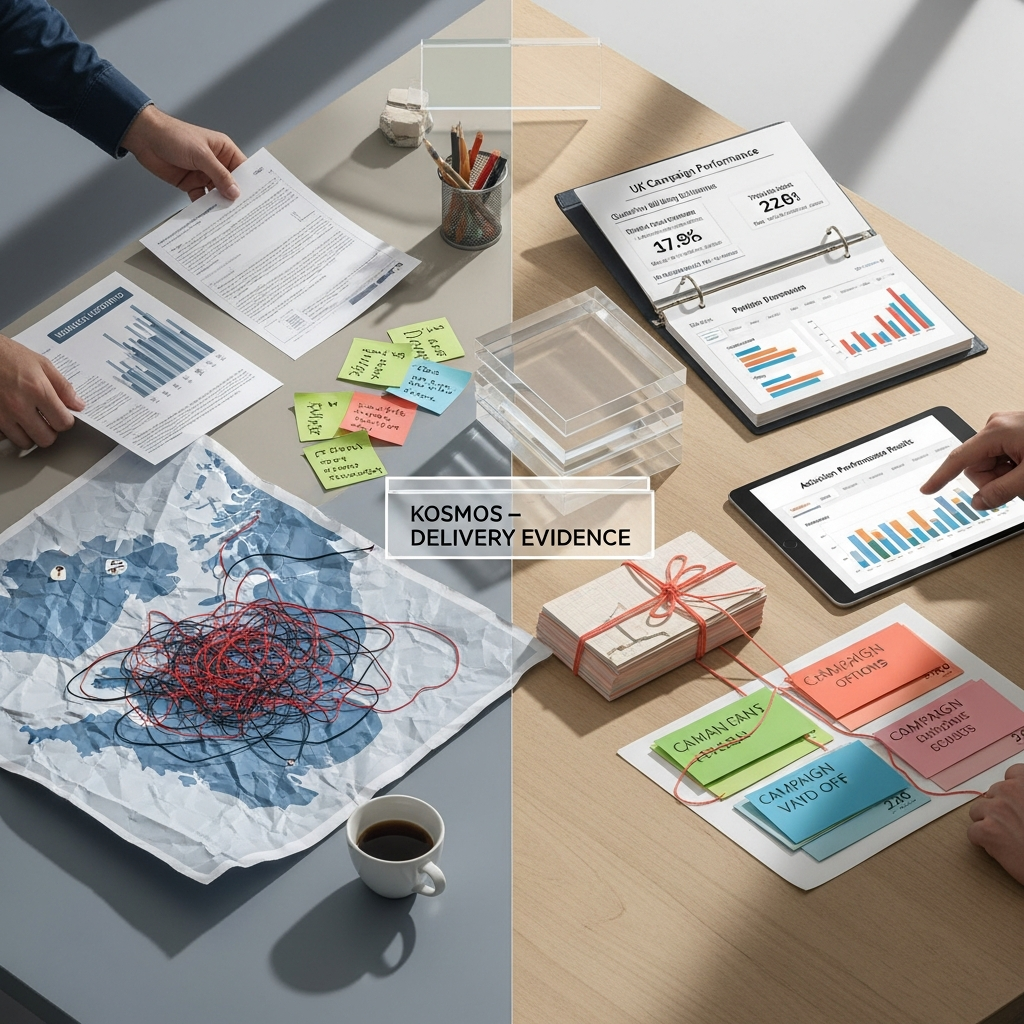
A surprising amount of campaign reporting still tells the wrong story. It shows reach, clicks and a neat final slide, yet leaves a commercial leader unable to answer the harder question: could this team actually deliver under pressure, with constraints, and produce results that can be trusted?
That gap matters more in 2026 than it did even a year ago. Budgets are tighter, operating scrutiny is higher, and patience for decorative reporting has thinned. If you want a credible campaign case study in the UK, the useful unit is not a list of outputs. It is a chain of evidence, from original constraint to intervention to measured change, with enough operational texture that a buyer can see how the work survived contact with reality.
Quick context
Commercial leaders rarely buy a campaign in isolation. They buy confidence in execution. That means reporting has to prove more than media efficiency or creative volume. It has to show how the delivery system held up when timing shifted, approvals slowed, stock changed, QR scans peaked unexpectedly, or fulfilment introduced friction.
The market has moved towards this more exacting standard for a simple reason: high-level growth claims are easier to make than ever, but baseline evidence is still scarce. I’ll put this plainly because it is worth defending in a boardroom next week: a strategy that cannot survive contact with operations is not strategy, it is branding copy.
Underlying signals are visible. According to the Office for National Statistics, UK decision-makers and teams are operating in an environment where anxiety and personal well-being remain measurable parts of day-to-day life in national and local reporting. The ONS quarterly and local authority well-being datasets track shifts in anxiety, happiness and life satisfaction across the UK, reminding us that operating conditions are human as well as financial. Reporting that ignores internal load, delivery limits and response times will look thin because it is thin.
The stronger approach is to present campaign performance as proof of managed execution. Precedents from adjacent delivery work support that. Google Pixel’s modular asset system, for example, deployed 812 assets while reducing cost per asset by 23.5%. Hawkstone’s Harvest IPA sprint increased asset volume 33 times and produced more than 100 unique assets in one day. Different categories, yes, but the same strategic lesson applies: volume and speed only become persuasive when tied to a method, a limit and an outcome.
Step-by-step approach
If you want reporting to function as delivery evidence, not just campaign narration, build it in five linked layers. Each layer answers a different commercial objection.
1. Start with the original constraint. Name the friction clearly. Was the issue limited pack space, a six-week activation window, retail compliance across regions, or a fulfilment cap that would affect redemption? Be specific enough that the difficulty feels real. “Needed more awareness†is too vague. “Needed to drive on-pack QR engagement across two retail partners before Easter distribution closed†is better because timing and dependency are visible.
2. Define the option set and the trade-off. In a strategy call this week, we tested two paths and dropped one after the first hard metric came in. Showing one chosen route without the discarded option often makes a case study less credible. Commercial readers want to know what you ruled out and why. Perhaps a hero creative route looked cleaner, but a modular system allowed faster regional localisation. I liked the first option, but the evidence favoured the second once the numbers landed.
3. Show the intervention as an operating method. Do not say “we optimised the campaignâ€Â. Say what changed in workflow, resourcing or mechanics. For example, did the team move from weekly to daily QR scan monitoring? Did it connect creative tagging data to activation reporting via an API? According to the Holograph precedent on Boots Magazine, automating repetitive editorial tasks saved up to 90% of time on lower-value work and increased interview transcription speed by 15 times. The campaign lesson is that low-value friction should be removed early so human attention can stay on decision quality.
4. Separate output metrics from operational proof. Outputs matter, but they are not enough. Asset count, impressions and clicks should sit alongside practical indicators such as time to launch, scan-to-landing completion, redemption processing time, and stakeholder sign-off lag. If a campaign generated strong engagement but broke under delivery pressure, a commercial leader needs to know that.
5. Finish with measurable change and timing. The final measure should show not only what improved, but when value appeared. Did response time fall in week two after introducing triage rules? Did activation performance results strengthen only once stock allocation was rebalanced by region? Timing tells the reader whether success was immediate, delayed or dependent on a specific fix.
| Reporting layer | What to include | Commercial value |
|---|---|---|
| Constraint | Original limitation, timing window, channel dependency, fulfilment or approval limit | Shows realism and execution difficulty |
| Option set | Paths considered, route chosen, route rejected, reason for choice | Demonstrates judgement, not hindsight polish |
| Intervention | Process change, tech integration, staffing pattern, content or activation redesign | Makes the method repeatable |
| Evidence | Named metrics, observation dates, data source, channel-level movement | Builds trust and comparability |
| Outcome | Measured shift, timeframe, commercial implication, unresolved tension | Helps leaders assess partner capability |
A useful tangent: do you always need perfect attribution? No. You need proportionate evidence. If a retail-led campaign cannot produce flawless user-level attribution, that is normal. What matters is whether you have enough linked signals to make a credible judgement, and whether the missing piece is acknowledged.
Pitfalls to avoid
The first pitfall is mistaking activity for proof. A report that says 120 assets were produced may sound productive, but volume alone tells a buyer very little. The more revealing question is whether those assets reduced launch risk or helped a team test variants quickly enough to protect spend. The Google Pixel and Hawkstone examples tie high asset volume to efficiency or testability.
The second pitfall is hiding constraints for fear they make the work look weaker. Usually the opposite is true. If an on-pack activation had to work with fixed print deadlines, retailer-specific compliance checks and a capped reward pool, that detail strengthens the narrative. A plan looked strong on paper, then one dependency moved, so we re-ordered the sequence and regained momentum. That sentence often tells a commercial reader more about delivery capability than three pages of tidy charts.
The third pitfall is collapsing every result into one total number. Blended reporting can obscure what actually changed. Split the view by channel, audience, retailer, region or week where it matters. The ONS local-authority data model is a helpful reminder of why granularity matters. National averages can be informative, but local variation changes interpretation.
The fourth pitfall is pretending certainty where there is only direction. Honest reporting can carry a small unresolved tension and still be publication-ready. For example, you might be confident that revised QR instructions improved completion rate within ten days, but less certain how much of the uplift came from improved pack visibility versus simplified landing-page design. Say that. Senior readers tend to trust controlled uncertainty more than forced precision.
The fifth pitfall is forgetting the commercial implication. Reporting should tell a leader what the result means for next quarter’s choices. Can the approach scale? Does it require more operations support than the margin can justify? Is the current process robust enough for a wider retail rollout before Christmas 2026?
Checklist you can reuse
If you are rebuilding a report or drafting a client-facing case study, this checklist keeps the document useful for commercial evaluation.
- State the original business problem in one sentence, including a constraint, a timing point and the affected channel.
- Name at least two options considered, and explain why one was rejected.
- Record who held decision accountability, especially where approvals or fulfilment influenced delivery pace.
- Separate campaign outputs from operational performance metrics.
- Use dated observations where possible, such as week-one scan rate, week-three redemption turnaround, or pre/post process changes.
- Include one limiting factor that remained unsolved or only partially solved.
- Translate results into a commercial implication, such as lower launch risk, faster rollout, better partner confidence, or improved margin protection.
For teams that want a tighter internal template, a reusable evidence spine can look like this:
Problem: What was blocking performance?
Constraint: What made the problem hard in practice?
Intervention: What changed in process, creative or technology?
Proof: Which metrics moved, over what period, and from which source?
Trade-off: What did the team give up to achieve the result?
Next move: What should be tested, scaled or stopped?
This structure works because it is legible to both delivery teams and commercial leaders. As it stands, that dual readability is one of the fastest ways to make reporting genuinely useful.
Closing guidance
If your current campaign reporting would struggle to answer a sceptical finance director, it probably needs reworking before it becomes a public case study. The better standard is not difficult, but it is disciplined. Show the starting constraint. Show the option set. Show the operating change. Show the measured outcome. Then leave enough texture in the story that the reader can see how the work held together when timing, compliance or fulfilment got awkward.
The real advantage is practical. Better reporting sharpens partner evaluation, improves internal decision speed and gives commercial leaders a clearer basis for backing the next activation. It turns a neat retrospective into evidence that can influence planning and budget release. To build stronger, publication-ready reporting with credible activation performance results and defensible delivery evidence, contact Holograph and start with one live campaign, not a pile of old slides.
If this is on your roadmap, Holograph can help you run a controlled pilot, measure the outcome, and scale only when the evidence is clear.