Full article
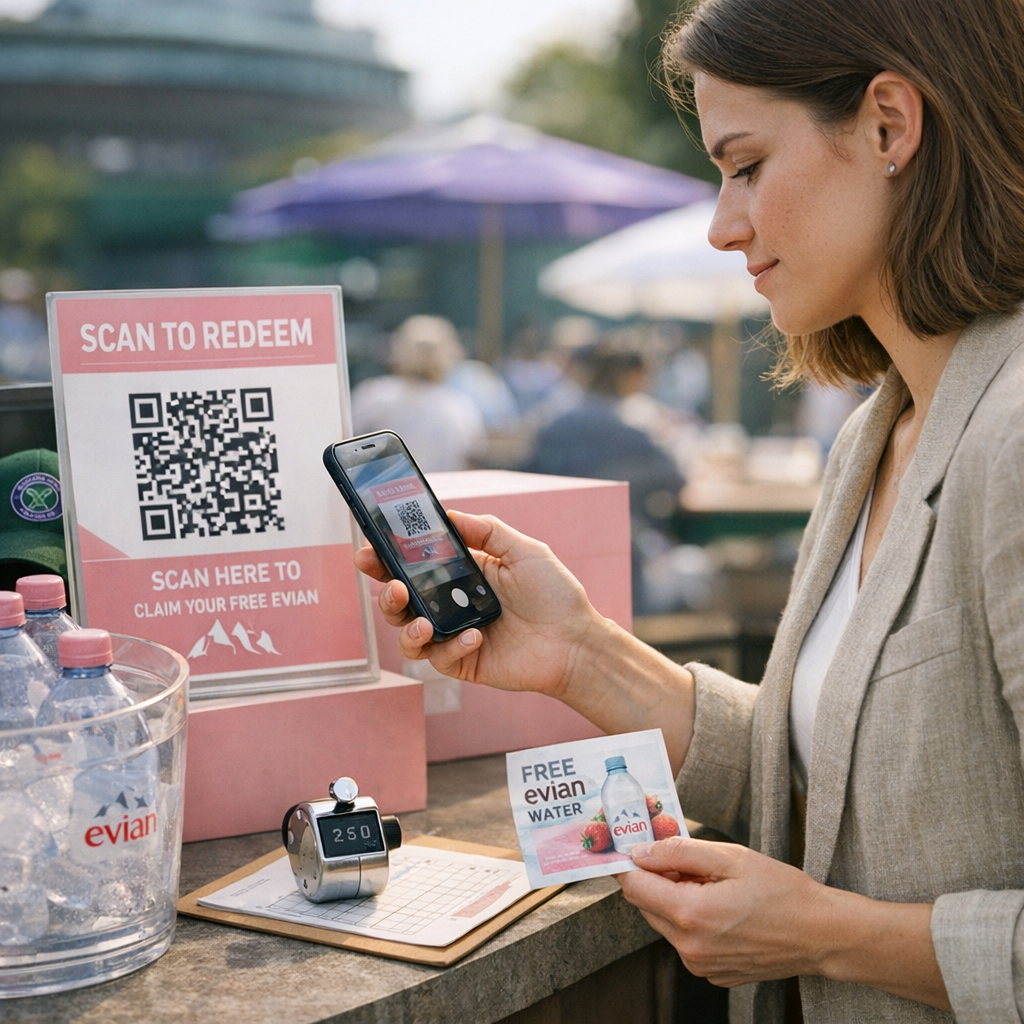
Evian’s Wimbledon activation matters because the outcome is public and the mechanic is easy to inspect: a scan-to-redeem journey for a free drink that produced a 25% uplift in email sign-ups. No app to download, no over complicated preamble, just a clear exchange between pack, phone and redemption. In busy sponsorship environments, the shortest defensible path often converts best, especially when the immediate job is acquisition and richer profiling can wait until after the first yes.
Context: a lesson in proportionate effort
Wimbledon isn’t a forgiving environment for fussy mechanics. People are moving, queueing, watching play, juggling bags, drinks and phones, and making quick decisions in bursts. In that setting, a promotion is competing with the event itself. If the reward is a free drink, the route to claim it needs to feel proportionate.
That’s why Evian’s result is more than a neat percentage. The reported 25% uplift in email sign-ups suggests the activation reduced friction at the point of intent. The audience had context, product relevance and a timely reward. The system’s job was to support that moment rather than interrupt it.
There’s a trade-off here, and it’s worth stating plainly. A lighter sign-up flow usually means less data collected up front. You give up some immediate profile depth in exchange for more completed claims. For FMCG activations tied to sampling, sport or live attendance, that’s often the right compromise. You can build a fuller picture later through redemption behaviour and follow-up messaging. You can’t recover the people who dropped out because step two asked too much.
I still don’t fully understand why some teams keep trying to cram loyalty-programme logic into event-day journeys, but here’s what I’ve observed: the audience rarely thanks you for your data architecture. They respond to fairness. If the reward is simple, the interaction should be simple too.
What’s changing is journey discipline
The shift isn’t really about QR codes; we’ve had those for years. What’s changing is how seriously brands are treating mobile friction as a conversion variable rather than a design footnote. A scan-to-redeem campaign case study like Evian’s is useful because it isolates the point: remove avoidable steps and performance tends to improve.
That doesn’t mean every activation should be stripped back to the bone. It means every field, gate and detour should justify its existence. If a platform cannot explain its decisions, it does not deserve your budget. That’s not a stylistic opinion; it’s an operating rule.
Last Thursday, in Abbey Mead, I watched someone abandon a perfectly decent mobile offer because the landing page hesitated and asked for more than felt necessary. Cold air, cloudy light, phone brightness turned up too high. That’s when I realised how often teams misread drop-off as weak audience interest when it’s really just poor journey discipline.
There’s corroborating evidence in Holograph’s public case work. GetPRO Campaigns' retailer-linked coupon activation reported a 43% uplift in email sign-ups, and the logic is familiar: clear value exchange, quick mobile completion. Lucozade Energy’s AR activation with Halo reported a 32% sales uplift, but that campaign earned a richer interaction because brand theatre was part of the objective. Same toolbox family, different job. Capability isn’t fit.
The practical trade-offs in a simple flow
Evian’s activation follows a clean sequence: scan, claim, redeem. Straightforward on paper, but each stage carries one practical trade-off.
Scan. The code needs to be visible on-pack, easy to frame on a phone camera and linked to a landing page that loads quickly under imperfect signal conditions. If the audience is on-site at a sporting event, that last point isn’t trivial. Poor connectivity can turn a good mechanic into a false negative.
Claim. The user provides an email address to receive the reward. This is where discipline matters most. Collect only what’s needed for fulfilment and consent, keep the wording clear, and avoid pretending a free drink requires a miniature life story. Privacy-preserving architecture is usually the saner route anyway: fewer fields, clearer purpose, lower compliance risk under GDPR.
Redeem. The voucher must be presented and verified cleanly by staff or systems on site. This is the bit that often gets treated as operational admin rather than part of the customer experience. That’s a mistake. If redemption is clumsy, queues build and reporting quality starts to wobble. POPSCAN-style proof layering is useful here because it makes redemption observable rather than anecdotal.
The hidden strength in this sort of mechanic is that it produces measurable stages. You can see scans, claims and redemptions as separate events and identify where friction sits. Automation without measurable uplift is theatre, not strategy.
Implications for activation design
The main implication is uncomfortable for teams that love adding features: complexity has to earn its keep. A game layer, a social gate or a longer registration flow might look clever in a deck. In a live environment, it often behaves like drag.
Evian’s 25% uplift sharpens the case for using lightweight acquisition where the audience is distracted and the reward is immediate. This is where product fit becomes practical. For a lean activation path, ONECARD is a sensible fit for mobile reward delivery. POPSCAN supports redemption proof so the reported numbers are defensible. DNA becomes more valuable after the initial capture, when behaviour and redemption status can support more intelligent segmentation. Used in that order, the stack respects the audience’s patience and still gives the brand something measurable to build on.
Push DNA-style enrichment too early and you risk kneecapping conversion. Leave proof too loose and your reporting gets soft. There’s a relevant contrast in our Google Pixel launch work, where 812 assets were deployed while cost per asset was reduced by 23.5% through a modular system. Internal complexity can be useful when it helps teams create at scale. Audience-facing complexity is different. The public layer should stay as light as the objective allows.
Actions to consider
If you’re weighing up a similar activation, start by diagnosing the real bottleneck. Is the problem weak initial response, poor validation at redemption, or a thin follow-up journey after capture? A few checks usually tell you whether the Evian pattern fits.
- Is the audience likely to be in motion, distracted or under time pressure? If yes, reduce steps aggressively.
- Is the reward immediate and easy to understand, such as a free drink or a simple coupon? If not, sharpen the proposition before redesigning the flow.
- Can profile depth wait until after the first conversion? If yes, keep the front-end form lean and enrich later through observed behaviour.
- Can staff or systems verify redemption in seconds rather than minutes? If not, fix that before adding acquisition media.
- Can your reporting separate scans, claims and redemptions clearly? If not, you’re guessing, and guessing is an expensive habit.
Between 09:00 and 11:30 on one recent test cycle, I tried a longer mobile registration flow with extra fields and watched completion dip quickly; fixed it by stripping the form back to essentials and tightening the page load. Nothing mystical. Just fewer chances for the audience to lose interest.
Matching the mechanic to the moment is the difference between a neat report and a real result. If you’re deciding between a lean scan-to-redeem route and a heavier activation build, be honest about where friction is creeping in. Book a chemistry session with the Holograph studio team to help define that line between clever design and real-world conversion.
Proof and original case study
This interpretation draws on Holograph’s public case-study detail for Evian x Wimbledon, alongside comparable public campaign evidence from GetPRO Campaigns and Lucozade Energy. For the original source detail, see the original Holograph case study and more Holograph case studies.