Full article
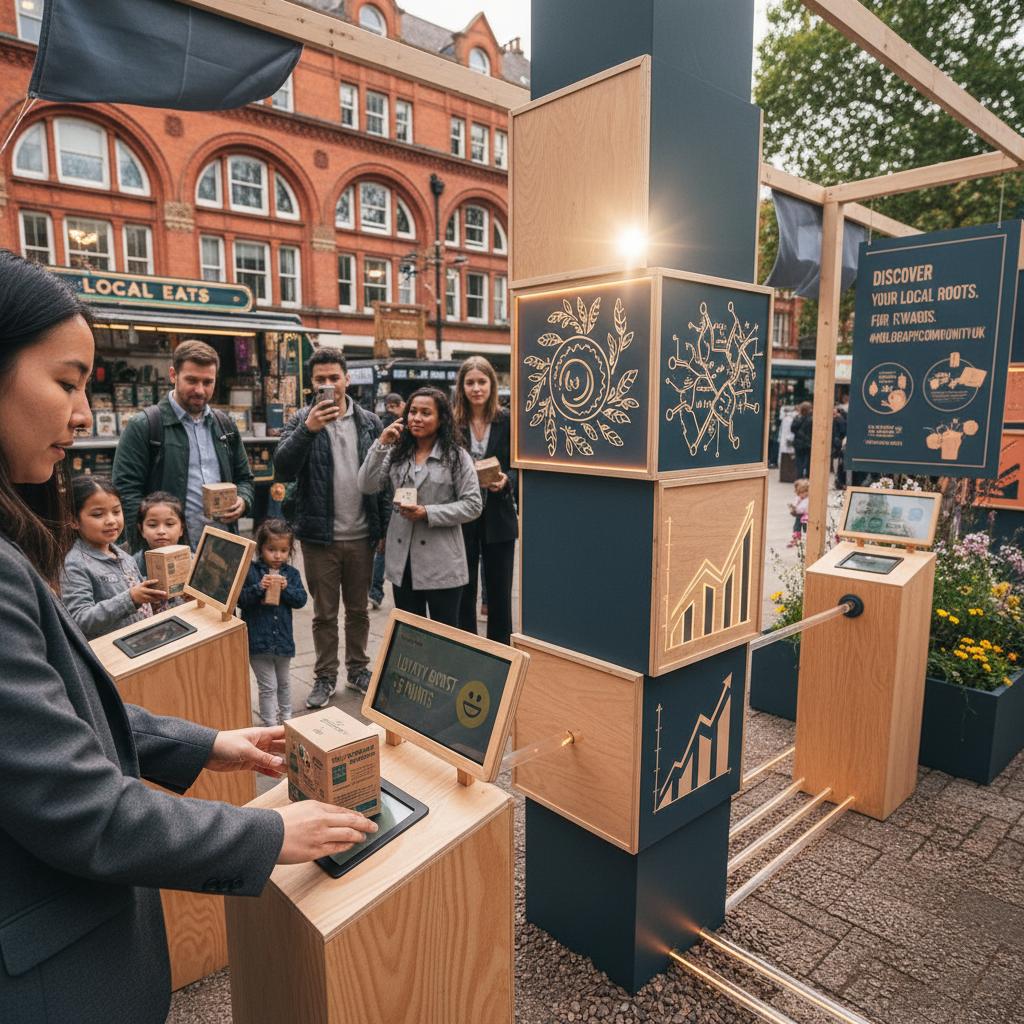
Why measure experiential marketing by photo snaps when repeat visits define value? Activations now pivot to loyalty mechanics, capturing local sign-ups for future perks. The old playbook of build, buzz, move on leaves money on the table.
Human behaviour underpins this. Office for National Statistics well-being data tracks life satisfaction and meaningful activity. These signals show locally relevant brands build stronger recall than noisy arrivals.
What changed
Pop-ups once relied on novelty. Now, attention costs more and fades faster. The change links live moments to subsequent actions: loyalty mechanics, follow-up offers, or measurable steps.
Case studies prove the point. Holograph and ARize brought the Halo Galaxy to life in AR for Lucozade Energy, driving a 32% sales uplift. In a separate activation, AR revived Hasbro's Monopoly for Ribena, overshooting the entry goal by 258%. Different brands, same lesson: immersive tech succeeds by enabling continuation, not just reaction.
Brand teams often separate experience and loyalty. They belong together. Budgets should fund explainable decisions; if an activation cannot trace journey from encounter to return visit, it funds theatre.
Why it matters
Boards demand clarity over vague stories. Experiential marketing now aligns with retail media and loyalty reporting, raising standards. Measurable uplift defines strategy, not theatre.
Local nuances matter. ONS well-being data at authority level reveals place-based variances. Avoid uniform approaches; Manchester, Guildford, and Glasgow differ in response.
Scepticism is due for strategies that prize awareness alone. Without measurable opt-ins, repeat visits, or sales, an activation merely demonstrates fabrication skill.
What to do now
Design backwards from desired post-activation behaviour. For repeat purchase, capture sign-ups and trigger incentives. For membership, ensure light friction registration. Simplicity is often overlooked.
Operate with three principles. Simplify participation: QR codes, NFC, or staff-assisted sign-ups. Clarify data use per ICO guidance; plain English boosts consent. Prioritise metrics: completion rates, qualified sign-ups, and repeat visits over social reach.
Stay pragmatic on tech. AR and XR enhance activations by reducing friction or adding tangibility, not as deck decorations. Low-tech solutions often succeed with well-briefed staff and simple interfaces, leveraging human reassurance for consent and fulfilment.
Watchpoints
Avoid measurement theatre. Dashboards without decision support yield colourful wraps devoid of consequence. Select directional metrics to guide weekly changes, not monthly presentations.
Control automation creep. Borrow martech for registration, redemption, follow-up where queues break. Excess automation risks mechanical experiences.
Balance consistency with local fit. National brands need governance but must adapt incentives and language locally. Fix core systems, flex surface layers.
Pop-ups endure but demand more. For activations that link live moments to loyalty and measurable outcomes, consult the Holograph studio. We refine ideas, remove fluff, and design for return visits. Cheers.
Book a chemistry session with the Holograph studio team.
Proof and original case study
This interpretation draws on a public Holograph case study. For the original source detail, see more Holograph case studies and holograph.digital.