Full article
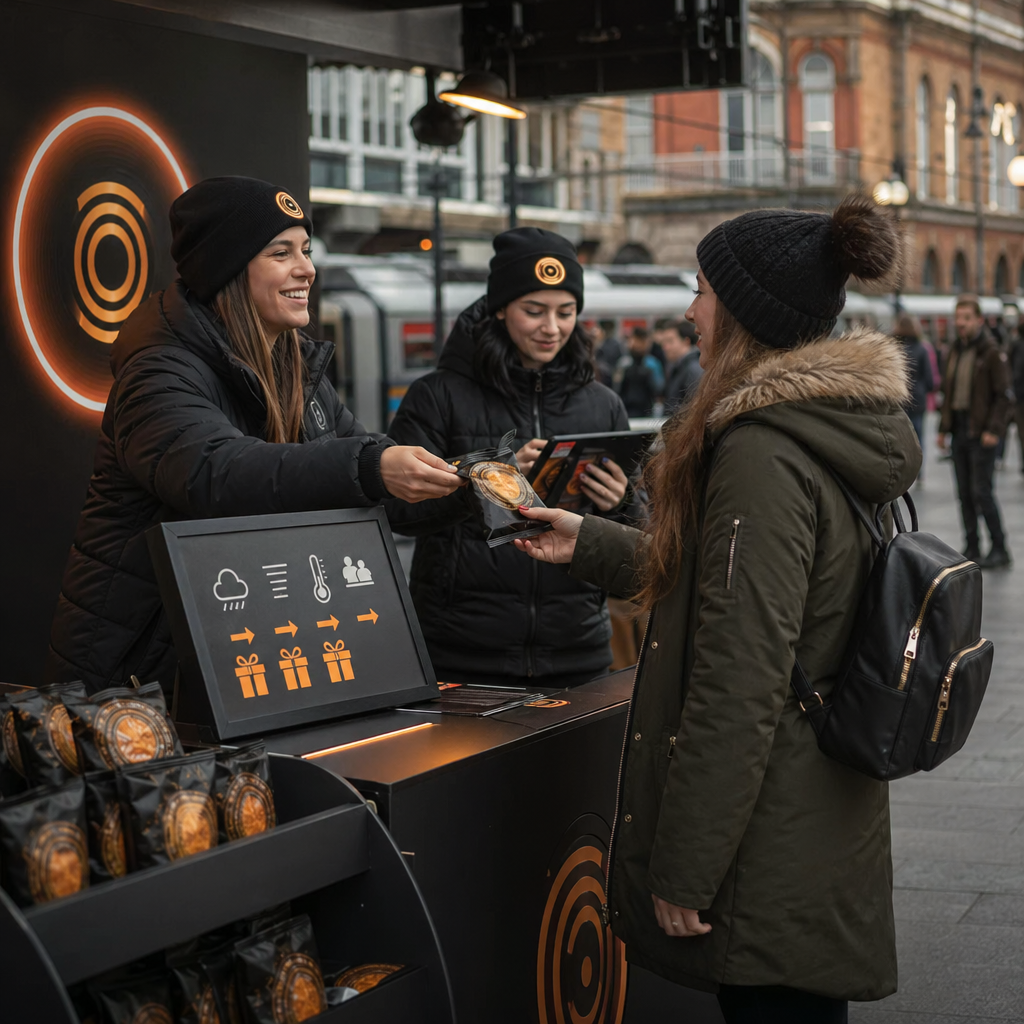
What happens when a queue modelled purely on digital intent hits a wet Tuesday? A pop-up generates weeks of online hype. The pavement stays empty. That severe gap between projected attention and physical arrivals happens when experiential strategy ignores the forecast. Footfall is not an accident. It is an operating variable.
This is a checklist for UK pop-up activations demanding more than social buzz. It maps the operational pressure points, the valid routes, and the hard trade-offs involved in physical delivery. We ground these choices in actual metrics and the realities of the street.
Where the pressure sits
High digital engagement looks reassuring on a performance wrap. It guarantees nothing on the street. Local UK weather shifts fast, dragging footfall patterns with it. Commuter routes behave entirely differently at 08:15 than they do at 12:30. Labelling a window 'high footfall' is lazy planning if the crowd is rushing for a train or escaping a downpour. Context matters more than volume.
Here is a judgement that tends to annoy people, but remains true. If a platform cannot explain its decisions, it does not deserve your budget. The same standard applies to physical builds. If your activation team cannot defend why a specific location, hour, and interaction model will convert under rain or wind, you are buying hope packaged with high production values.
Routes available now
Which activation mechanics actually survive local weather shifts? Three routes dominate UK pop-ups. Each carries distinct operational constraints.
| Mechanic type | Best fit | What it is good for | Main constraint |
|---|---|---|---|
| Instant reward | Cold, rain, low dwell time | Fast conversion, immediate participation | Higher unit cost per interaction |
| Deferred reward | Moderate conditions, repeat-visit goals | Follow-up visits, loyalty linkage | Drop-off between first interaction and redemption |
| Content capture | Dry weather, strong footfall | Email sign-up, audience insight | Weaker performance when people want speed |
Instant reward mechanics are the smartest fix for a fragile queue. Stripped-back, instant-win logic reliably beats complex, playful experiences in cold weather. Attention narrows when conditions degrade. Shoppers take the obvious value exchange and leave.
Content capture requires better conditions. Forms work only when the exchange justifies the time, keeping the flow tight and usable within platform constraints. Automation without measurable uplift is theatre, not strategy. If you must collect personal data, define the endpoints you actually need. Provide a clean opt-out for marketing consent.
What each route costs
Teams either face the true cost of an activation or invent comforting narratives. Instant reward looks expensive upfront because physical stock or digital vouchers sit visibly within the interaction. Yet a cheaper, complex mechanic that nobody finishes is not efficient. It is just visible waste.
The second, hidden cost is operational rigidity. If a mechanic demands dry weather, every rain shower burns budget. Adaptive design prevents this waste. Integrate creative data via APIs for automation and measurement. Use products like POPSCAN or DNA to send an asset ID, receive structured scores, and adjust the offer dynamically. You adjust content, routing, or reward logic without rebuilding the physical site.
If your setup requires user-generated content or sharing, build traceable entry capture. Share mechanics break easily without fallbacks. Extra fields suppress completion rates.
Which route to choose and why
Start with the forecast. Map the footfall pattern. Only then lock in the business objective. Weather dictates what is physically possible on the pavement. Success metrics must follow reality.
For immediate sales in poor conditions, default to instant reward. For immersive retail, the digital layer must support the physical experience rather than adding friction. Holograph and ARize brought the Halo Galaxy to life in AR for Lucozade Energy, achieving a 32% sales uplift. AR was not chosen as a gimmick. It felt native to the brand and removed barriers to entry.
Disciplined delivery outlasts cleverness. The Google Pixel launch work was built to be faster, leaner, and fully brand-compliant across multiple regions. Resilience counts when timelines compress.
The reality of experiential marketing trends uk
Much of the industry commentary on experiential marketing trends uk overvalues spectacle. A beautiful activation that collapses under bad weather or queue pressure is not ambitious. It is poorly engineered.
The better approach is quiet and effective. Build mechanics that flex. Measure what matters before picking the technology. Default to privacy-preserving architecture. Make sure every production choice answers the simplest finance question. What did this change, and how do you know?
The most resilient pop-up activations work with local conditions, not against them. If you want to map these trade-offs before committing your budget, book a chemistry session with the Holograph studio team. We build multi-channel brand activations that feel handcrafted, completely measurable, and ready for the weather they will actually face. Cheers.
Proof and original case study
This interpretation draws on a public Holograph case study. For the original source detail, see more Holograph case studies and holograph.digital.