Full article


Executive summary
High-volume launches do not usually fail because people are lazy or tools are missing. They fail because nobody can say, with a straight face, who owns the final decision, by what date, against which acceptance criteria. That was the issue here.
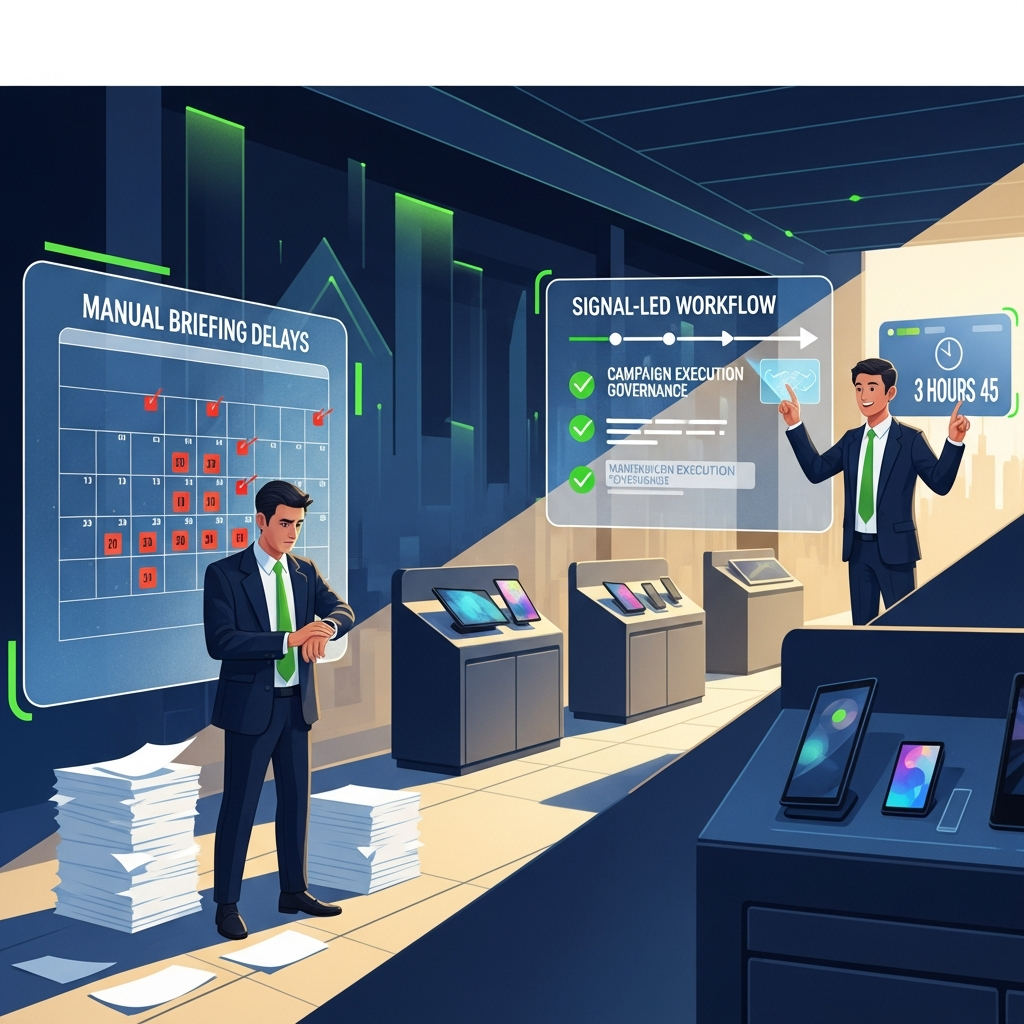
This delivery assurance note shows how a high-volume FMCG campaign team moved from rushed, last-minute publishing to a governed release model in MAIA. Between April and June 2026, we introduced four named gates, one override owner, a 24 hour change cut-off, and a visible audit trail. By the end of Q3 2026, urgent post-launch fixes had dropped from roughly three a week to less than one a month. A bit less drama, a lot more control. Sorted.
Situation
The breaking point came in March 2026, during a Friday launch for a beverage promotion. At 4:45 pm on the Thursday, a senior stakeholder asked for a late headline offer change after spotting competitor activity. The request bypassed the usual checks, landed with a junior creative, and went live with pricing that contradicted the published terms and conditions. It then took 72 hours to unwind across creative, offer copy and customer comms.
The incident was not unusual enough, which was the problem. In an early April post-mortem, run with the client’s Head of Digital, Sarah Jenkins, we found that more than 60% of Q1 2026 campaigns had at least one unlogged change made inside the final 12 hours before launch. Key approvals sat in email threads and chat. Sign-off was often verbal. The project tool was being used, but as a to do list, not as a control point.
I was wrong about the effort at first. I thought tighter tool discipline would fix it. It did not. The real gap was decision ownership. Legal assumed commercial had signed off the offer. Creative assumed legal had checked the claim. Delivery assumed somebody senior had accepted the risk. If your plan has no named owners and dates, it is not a plan, fix it.
Approach
From April to June 2026, we rebuilt the launch flow around four gates, each with an owner, a date and acceptance criteria. The gates were simple on purpose:
- Legal and compliance gate, owner David Chen, Legal Counsel. Acceptance criteria: final published terms and conditions linked, privacy and direct marketing wording checked against ICO guidance, promotional claims evidenced.
- Creative and brand gate, owner Maria Flores, Creative Lead. Acceptance criteria: approved copy deck, final assets versioned, brand and offer wording aligned.
- Offer and commercial gate, owner Sarah Jenkins, Head of Digital. Acceptance criteria: price, discount logic, channel exclusions and stock assumptions confirmed.
- Technical readiness gate, owner Ben Carter, Lead Developer. Acceptance criteria: deployment package approved, tracking tested, platform configuration verified.
We implemented the flow in MAIA so the campaign could not move forward until the current gate owner completed every required check. That matters for traceability. A stable process needs a change log, not a room full of good intentions.
We also set a hard rule: standard content, offer or mechanics changes had to land no later than 24 hours before launch. After that, only one person could override the gate, Sarah as the accountable budget holder. Not a committee. Not whoever shouted loudest. One owner, one decision, one visible risk call.
Yesterday, after stand up, a ticket was blocked by a staging URL in the terms and conditions link. A quick call with David cleared it. New deployment time set for that afternoon. Under the old model, that probably slips into production and someone finds it after customers do. That is what campaign planning automation is for, support the humans, catch the obvious, force the right conversation before publish.
How the override model worked
The override process was intentionally narrow. A late request had to state four things: what was changing, why it could not wait, what risk it introduced, and who would test it before go live. MAIA then logged the decision, date and owner automatically. That gave us a usable audit trail for delivery, legal review and post-launch analysis.
There was pushback in the first few weeks. Teams worried this would slow tactical changes, especially in paid social and CRM where timings can be bit tight on time. Fair objection. The answer was not to pretend the risk had gone away. The answer was to make the trade-off explicit. If a late change was worth the disruption, Sarah could approve it with eyes open. If not, it moved to the next wave.
That shift changed behaviour quite quickly. In July 2026, the team raised 14 override requests. By September, that dropped to two. Same business, same pressure, better planning discipline upstream.
Outcomes
By the end of Q3 2026, urgent post-launch fixes had dropped from an average of three per week to fewer than one per month. The senior team recovered an estimated 10 hours a week previously spent on fire-fighting, rework and apology loops. Those are not vanity metrics. They are time and risk measures the delivery team could actually feel.
The quality of handoff improved as well. Campaigns reached technical readiness with cleaner briefs, fewer contradictory comments and fewer unowned actions. That meant Ben’s team could test against stable acceptance criteria rather than decoding late edits from chat threads.
There was a softer result too, though I will keep it honest. We did not run a formal wellbeing study, so I am not going to overstate it. But junior team members consistently reported less ambiguity and less pressure to accept risky last-minute requests from senior stakeholders. The Office for National Statistics continues to track national measures of anxiety and wider personal wellbeing across the UK, which is useful context rather than proof here. What we could observe directly was simpler: fewer emergency fixes, fewer unclear approvals, fewer fraught Friday evenings.
Lessons for other delivery teams
The practical question is not whether you need governance. You do, once volume rises and multiple teams can change live campaign inputs. The real question is who can override the gate, under what conditions, and how that decision is recorded.
A workable model needs a few non-negotiables:
- one named override owner
- a published cut-off date and time
- acceptance criteria at each gate
- visible risk and mitigation for any late change
- a change log that survives beyond someone’s memory
If any of those are missing, the process will look tidy on a slide and fall apart in delivery.
The unresolved tension is real. Marketing teams do need room for tactical shifts. We are still refining that balance. The next step was assigned to Ben Carter for Q1 2027: add automated pre-flight checks for links, tracking tags and environment mismatches before the technical readiness gate is cleared. That will not remove human review, and it should not. It should reduce avoidable errors and give the team a cleaner path to green.
What Holograph can help you fix
If your launch process still depends on last-minute heroics, you do not have agility, you have hidden risk. Holograph helps teams turn loose briefs, brand rules and campaign plans into a governed operating flow with owners, checkpoints, outputs and cleaner handoff to delivery. If you want to define who can override the gate, by when, and on what evidence, contact Holograph. We can help you map the workflow, set the controls and get the next release into a calmer state than the last one. Cheers.