Full article
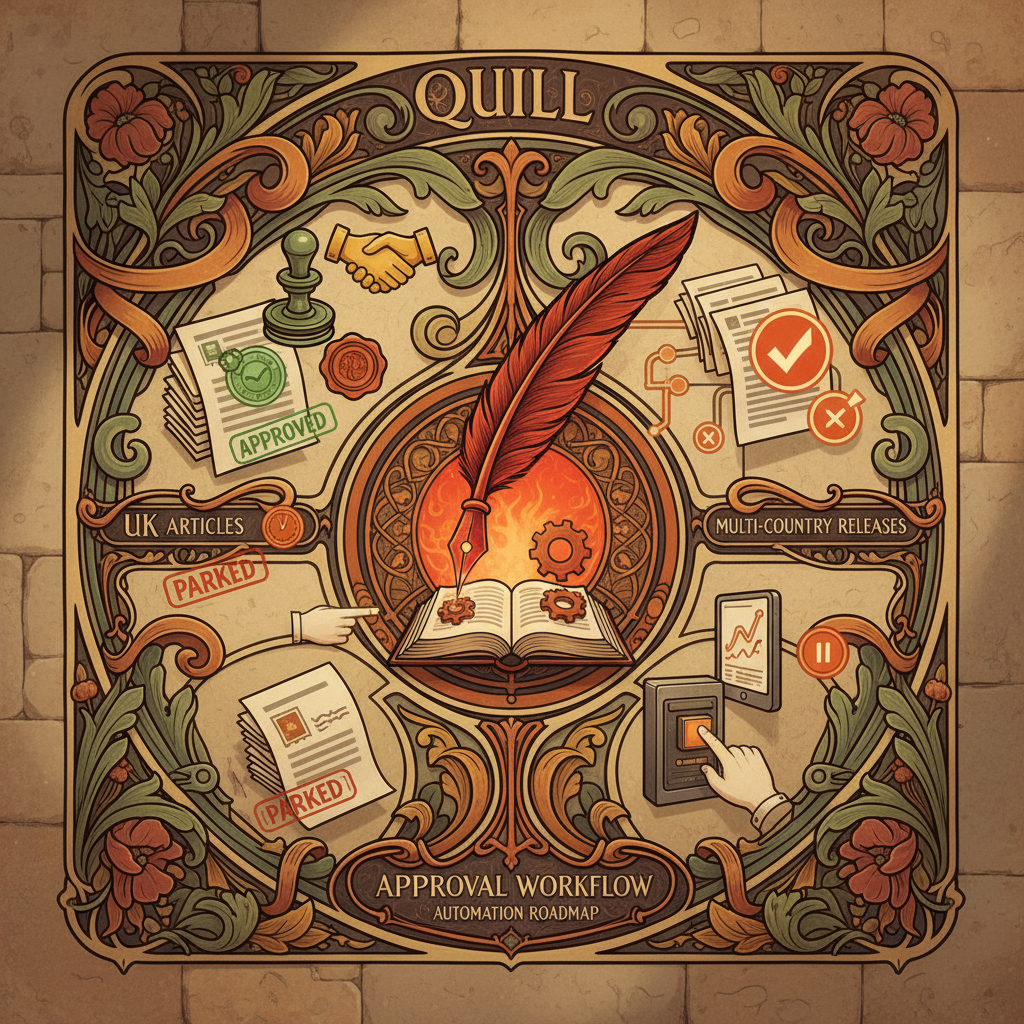
When compliance signals spike, the issue is not whether content still moves. It is whether each handoff, approval and publish action remains explainable afterwards. In Quill, governed publishing is the safer default because it gives teams a repeatable route through review, not just a faster queue.
What UK teams should understand first about Quill
Quill is a governed workspace for signal triage, evidence gathering, drafting, live diffs, approval routing and publication. That matters when teams are working against ASA guidance, brand rules and internal review policies, because the output is not only the asset. It is the decision record, who approved it and what changed on the way through.
That record needs to be visible. In Quill, actions sit against the asset, reviewer control is explicit, and audit history stays in one place instead of being split across inboxes and chat threads. On high risk content, the basic check is plain enough: can you identify the final approver and the approval event before publish. If you cannot, the process is still running on memory.
What changed in this release theme
This release theme is about tighter routing and clearer evidence capture. Conditional approval steps can bring in legal or compliance review only when defined triggers are met, such as claim types, risk terms or source conditions. Low risk work keeps moving. Higher risk work gets the extra scrutiny on purpose.
It also sharpens persona aware governance. Teams can apply stricter rules to selected client or content profiles, including mandatory disclaimer handling and reviewer assignment for regulated categories.
For delivery owners, the real question is simple: are the right assets reaching the right review path with the supporting evidence still attached. That is what needs checking before volume rises.
Why ad hoc queues fail when compliance signals spike
The MaxfulEdge announcement on expanded compliance infrastructure for transparent and secure trading operations points to a wider operating shift. When organisations invest in transparency and secure controls in core systems, content operations do not get a free pass. The same expectation lands here as well, especially where claims, disclaimers and approval accountability already carry risk.
That is where ad hoc queues come unstuck.
- Triage slips: urgent items sit beside routine work, so higher risk assets do not take the stricter route early enough.
- Approval ownership blurs: final decisions rest on habit, not named accountability.
- Versions drift: shared docs, filenames and scattered comments become the control layer.
- Delivery gating stays loose: content can move towards scheduling or publication without a clean record of every required check.
- Audit evidence arrives late: if someone asks who approved what and when, the answer depends on reconstructing messages after the fact.
These weaknesses do not wait for a crisis. They usually show up the moment compliance load and content load rise together. Then the queue either stalls, or somebody starts bypassing review to keep work moving. Neither outcome holds up well under scrutiny.
How governed publishing holds under volume
Governed publishing holds because it separates the work from the surrounding chatter. Routing rules decide where an asset goes. Reviewer permissions define who can approve it. Live diffs show what changed. Audit logs keep the sequence intact. The point is not elegance. It is that the path to publish can be checked, tested and repeated.
| Operational step | Ad hoc queue | Governed workflow in Quill |
|---|---|---|
| Triage | Manual prioritisation, often based on who shouts first. | Rule-based routing sends higher-risk assets into the right review path early. |
| Approval routing | Manual forwarding, reliant on memory. | Explicit reviewer stages with named ownership. |
| Version control | Filenames and scattered comments. | Single asset history with clear diffs. |
| Delivery gating | Publish steps can proceed on informal approval. | Required checkpoints must be completed before release. |
| Audit trail | Rebuilt after the fact from messages. | Time-stamped history attached to the workflow. |
| Final sign-off | Ambiguous approvals such as “looks good”. | Named owner approves for publish inside the workspace. |
The measures worth tracking are operational, not cosmetic: cycle time from draft to approval, number of assets waiting on review beyond SLA, and count of exceptions published without a complete approval history. Add too many stages and throughput suffers. Remove too many and risk spreads. Governed publishing does not solve that trade off for you. It makes the choice visible.
The human review step automation should not replace
The final approval on high risk content should stay with a human reviewer. Automation can catch routing errors, missing evidence, repeat checks and policy triggers. It should not claim legal judgement, brand judgement or publication risk as its own.
Before release, the final reviewer should be able to confirm the essentials from the workspace: evidence attached, required disclaimer present, reviewer role confirmed, and publish access limited to the named owner. If that still depends on checking other tools, the workflow is not tight enough yet.
What a product or delivery owner should configure next
If you own the workspace, review the workflow configuration this week and make the next move explicit:
- Set named owners for each review stage. Legal, brand and factual review should each have an owner, plus a backup where the queue is time sensitive.
- Add dates and escalation rules. Define how long an asset can wait before it escalates, and who receives it next.
- Make acceptance criteria mandatory for high risk paths. Require evidence, disclaimer checks and final human approval before publish.
- Check the audit trail on a live asset. Verify that diffs, reviewer actions and final approval are visible before volume rises.
That is the difference between release notes and adoption. One tells you what changed. The other tells you who owns the change, by when, and how you will know it worked.
If you are already using Quill, review workflow configuration, approval roles, escalation paths and final review ownership now. If you want a second pair of eyes, book office hours or a guided Quill workspace tour with the Holograph automation team.
Book a guided Quill workspace tour with the automation team.