Full article

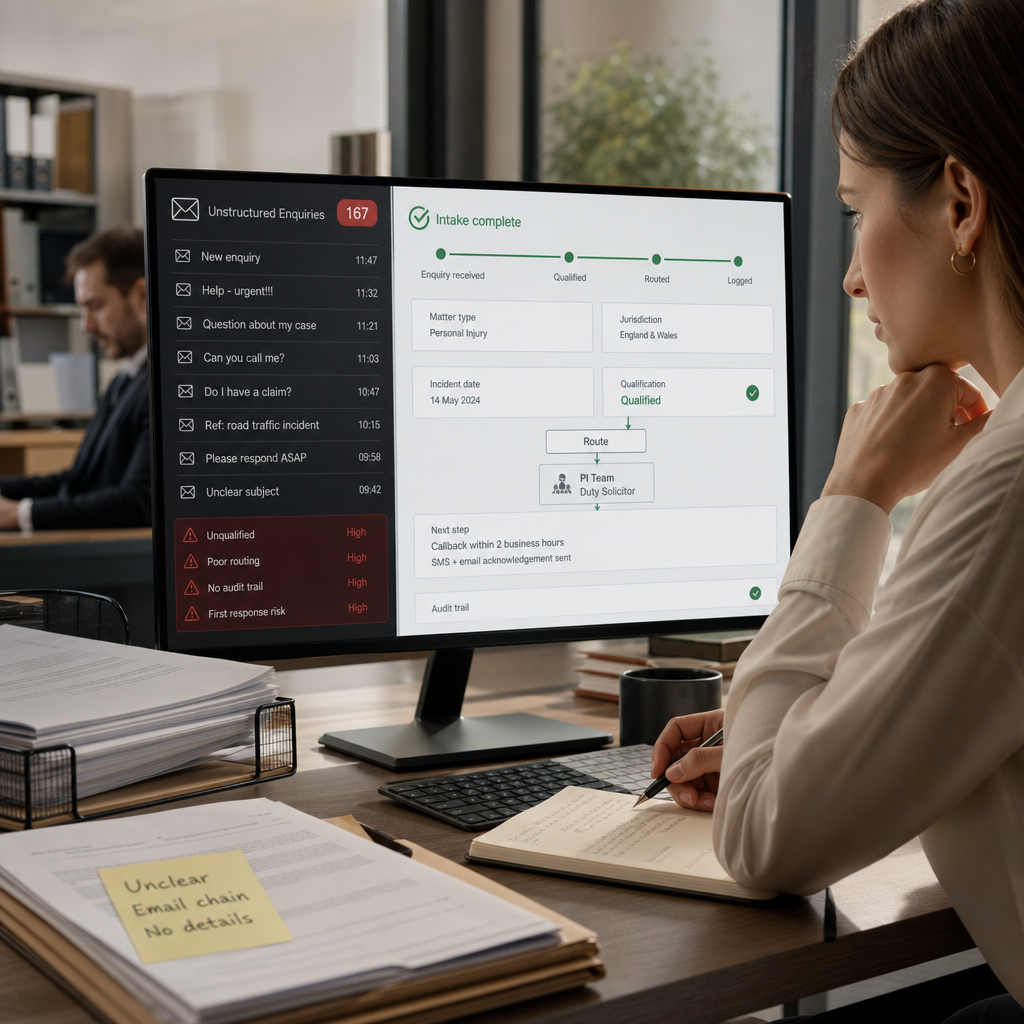
The 10 pm website submission is a clean operational test. It reveals whether your firm can gather minimum facts, send the matter to the right team and leave a compliant record. QuickThought does exactly that - qualifying and routing enquiries before a fee earner ever sees them. Many firms fail this test. The weak point is rarely legal judgement. It is the front door. If your site collects a vague block of free text and dumps it into a shared inbox for interpretation at 08:30, delay and rework are already locked in. A proper intake build requires discipline. Structured questions. Explicit routing rules. An audit trail that proves why a matter went where it did.
The live decision
An after-hours enquiry forces an operational choice. Either the website qualifies it at the point of submission, or the firm waits for somebody to interpret it later. On a contact page, both look identical. In the queue, they diverge entirely.
Relying on free-text forms means a human must read a rushed paragraph tomorrow morning to guess matter type, urgency and ownership. That introduces immediate lag. Decision-tree qualification changes the timeline. The website asks for the precise fields needed for routing - matter type, location, urgency - before the form even submits. The handoff then rests on structured inputs, not guesswork over coffee.
This shifts who does the work and when it happens. Crucially, it dictates whether routing logic can be reviewed afterwards. If a platform cannot explain its routing decisions, it does not deserve budget approval. In legal operations, that is basic hygiene.
Blunt default routing remains a stubborn failure mode. A firm receives heavy personal injury volume overnight, but the website pushes everything to a generic mailbox. Staff spend the first hour reading, re-routing and apologising. A decision-tree model fixes this upstream at the point of capture. It does not need to be chatty. It just needs to be clear.
What changes if you wait
Waiting until the next working day to qualify an enquiry looks cautious. Operationally, it is expensive. Law Firm Suites notes a familiar conversion warning: firms responding within five minutes are far more likely to convert than those waiting half an hour. Delay damages outcomes.
Speed is only half the equation. Misrouting is the more stubborn cost because it spreads quietly. If a boundary dispute lands with the wrong solicitor, someone must read it, reject it, pass it on and explain the handoff. That is fee-earner interruption dressed up as admin. Because most firms fail to measure this rework, it survives budget rounds unchallenged.
Structured legal intake turns routing into a design problem rather than a morning-after repair job. You decide the minimum fields needed for assignment, map them to specific owners and log the path. Yes, someone must do the upfront thinking to define minimum viable questions. That effort is still cheaper than asking senior staff to fix preventable intake errors daily.
Then there is compliance. A system recording the qualification path, timestamp and routing logic leaves a usable audit trail. A shared mailbox stuffed with free-text emails does not. On regulated legal websites, that distinction becomes highly practical the moment an auditor asks how an enquiry was handled.
What each route protects or exposes
Firms typically choose between three after-hours patterns: an inbox form, a chatbot or a decision tree. Each protects something. Each leaves something exposed.
| Method | What it protects | What it exposes |
|---|---|---|
| Inbox form | Low upfront effort and familiar workflows | Weak routing, slower response and hidden rework |
| Chatbot | Immediate interaction and basic FAQ handling | Advice risk, unclear auditability and heavier implementation |
| Decision tree | Consistent qualification, explicit routing rules and audit trail | Needs careful design and feels less chatty |
The inbox form survives because it looks cheap. In reality, it pushes costs downstream into admin effort and avoidable fee-earner interruption.
Chatbots are routinely sold as the modern option. On a regulated legal journey, generative interfaces easily stray towards giving advice unless boundaries are tightly defined. That creates a severe governance problem. If a tool cannot show why it asked a question, classified an answer or routed a matter, it is theatre with a licence fee.
A decision tree is less glamorous. It is also far easier to defend. It uses pre-approved questions and defined outcomes to support compliant website engagement. You trade conversational flexibility for explicit routing logic that can be tested, reviewed and improved.
A defensible next move
To test whether your current handoff is sound, run a one-week audit. Count the after-hours arrivals. Measure time to first response. Note the first-time correct routing rate. Record where manual intervention was required. Those four metrics reveal instantly whether the system works or if staff are quietly compensating for it.
If the numbers look poor, the fix belongs upstream. Build structured legal intake qualification into the website rather than dumping interpretation on an inbox tomorrow. Keep the fields minimal. Route using explicit rules. Collect only what the next operational decision actually demands. Over-collecting data at first contact is sloppy. In regulated environments, it is entirely unnecessary.
QuickThought handles exactly this job. It supports decision-tree qualification on regulated websites, routes enquiries using firm-defined logic and records each interaction for audit - all without drifting into AI-generated advice. Holograph manages the implementation where needed, but the public-facing value remains straightforward. Clearer qualification. Faster routing. A handoff you can explain to compliance and partners without hand-waving.
Ask the awkward question. If an enquiry arrived tonight at 10 pm, could your website explain why it sent that matter to a given team? Or would someone need to piece the logic back together from an inbox trail tomorrow morning? If the answer relies on guesswork, QuickThought is the sensible next step. Contact us to walk through your existing intake logic, find where the handoff leaks time and build something defensible.