Full article

A 43% sign-up lift looks like acquisition success. It can also mark where list quality degrades. The damage does not appear at the form. It appears when the first welcome email hits mistyped, disposable, or incentive-led addresses that should not have flowed through without a route decision.
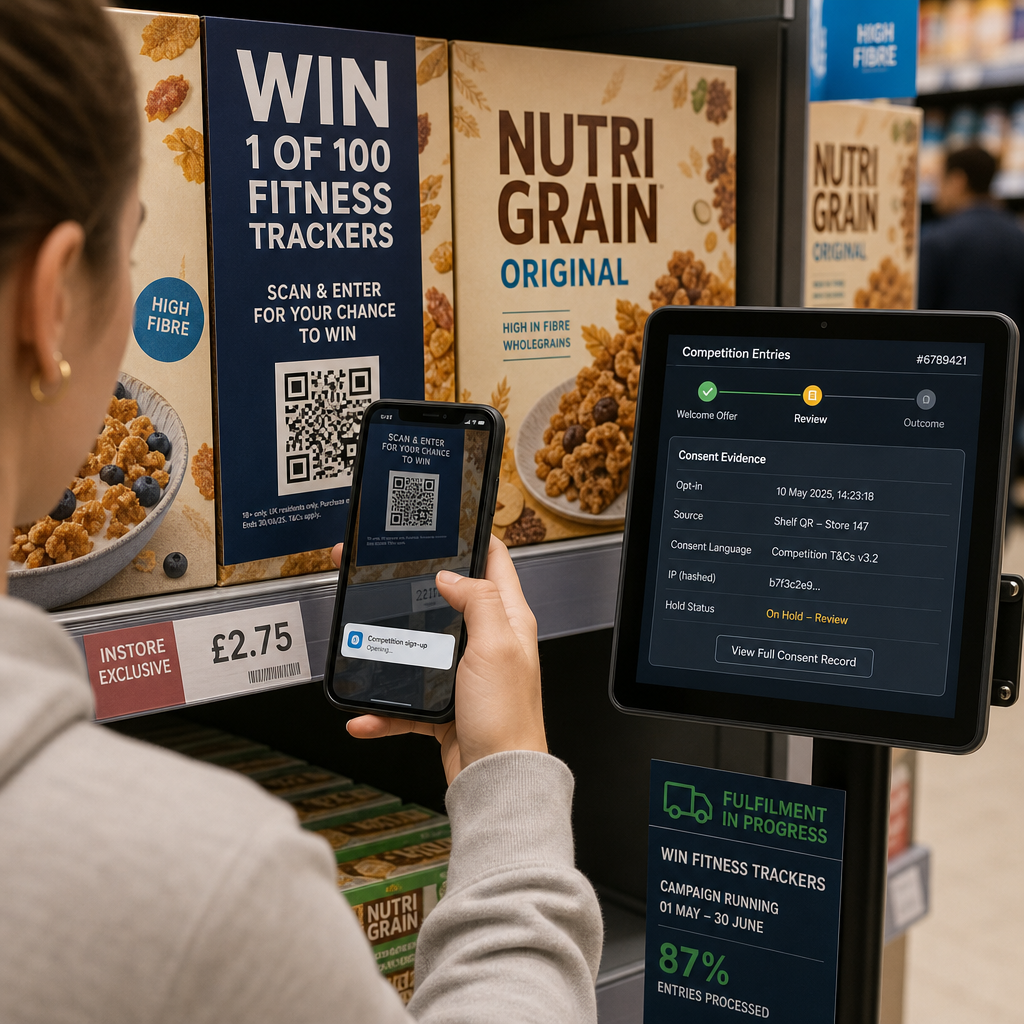
The GetPRO Campaigns precedent, a Tesco and Co-op style promotion, reports a 43% uplift in email sign-ups. It does not prove that every new record had the same reachability or consent quality. That is where EVE fits. Instead of a blunt valid or invalid check, EVE grades pass, challenge, hold, review or stop in real time and keeps the reasoning visible. The practical question: can you protect deliverability without blocking good users or turning routine decisions into manual work?
The operating context
Incentive-led capture changes the risk shape. Commercially, the upside arrives first: more sign-ups, cheaper acquisition. Operationally, the cost arrives later when welcome messages hit addresses entered too quickly, by someone other than the intended user, or only to unlock an offer. That delay over-credits a clean-looking spike.
Treat the 43% uplift as evidence of higher capture volume, not equal demand. No supplied source pack breaks out genuine, low-intent, or risky records. The safer reading: when volume jumps, route-state matters more. Which records pass immediately, which are challenged through an email confirmation loop, and which are held before the welcome flow?
The live choice is not growth versus caution. It is governed automated judgement with thresholds and exception handling versus silent acceptance, mailbox-quality drift, and avoidable manual handling.
What the signal actually tells us
A sign-up lift is not a pure demand signal. It can reflect real intent, lower friction from immediate value exchange, and low-commitment behaviour: disposable inboxes, typo-heavy entries, aliased addresses, or repeat attempts.
If sign-up volume rises and early welcome engagement stays proportionate, the promotion brings in reachable users. If bounce behaviour, complaints, or non-confirmation patterns worsen faster than engagement, the surge carries toxic data alongside genuine demand.
Static regex or allow-list checks answer a narrower question. EVE is designed for route judgement at form submit. Holograph positions it around sub-50ms response time, with intelligent caching and optional client-side execution, and supports 30+ proprietary detection methods including keyboard walks, entropy analysis, alias unmasking, and behavioural fingerprinting. The point is not sophistication. It is fitting judgement inside the time window at capture.
Stronger controls can cut into the sign-ups the campaign paid to generate. That trade-off is real. The answer is not hard blocking. It is to stop treating every doubtful record as if it deserves the same route.
Where the trade-off becomes visible
The decision is less about whether to run email campaign validation and more about where to place judgement. A workable sequence uses graded outcomes, not a single gate.
At form submit, EVE routes obvious risk without visible friction. Records with malformed syntax, suspicious domain patterns, or stronger behavioural risk signals are challenged, held, or stopped before they pollute the welcome flow. Ambiguous records move into a confirmation loop. Low-risk records pass.
That route map is more useful than the zero-friction versus hard-blocking argument. Zero friction preserves capture volume but lets toxic data into onboarding. Aggressive blocking protects list quality but raises false-positive costs. A pass, challenge, and hold model gives teams room to protect deliverability while keeping good users moving.
Override discipline matters here. If commercial pressure leads teams to loosen rules mid-flight, the adjustment must be visible, time-limited, and auditable. EVE keeps reasoning attached to the route decision, which matters when CRM, legal, and acquisition teams need to understand why a record passed or did not.
What to test before scaling
The first 24 to 48 hours after a spike are not for a full redesign. They are for checking whether route logic holds under pressure.
Compare four measures: raw sign-up growth, incidence of risky patterns, first-send bounce behaviour, and early engagement by source or form variant. Look for divergence, not averages. If one source delivers the same volume with weaker reachability, it needs different thresholds. If a form change lifts completion but raises the share of challenged or held records, the gain is less clean than it looks.
Then check exception handling. Who can force a pass, on what grounds, and for how long? Promotions generate informal workarounds that survive longer than the campaign. Set temporary tolerances, review them after 24 hours, and remove them quickly if downstream signals turn.
No universal threshold fits every retailer, publisher, or loyalty programme. The supplied proof does not support one. It does support visible route logic, measured exception handling, and a clear comparison between capture growth and welcome-flow quality.
What to monitor next
After the first 48 hours, the emphasis shifts from triage to pattern recognition. Watch bounce mix, complaints, confirmation completion, duplicate behaviour, and the gap between captured consent and reachable addresses. If those measures settle, the capture route is doing its job. If volume stays high while those indicators drift, the promotion still pulls in low-intent or manipulated sign-ups that the front end does not separate well enough.
Keep the comparison thread across channels. A social spike, an on-site offer, and a paid partnership can all show up as list growth while carrying different risk signatures.
The audit prompt is plain. Before the next incentive-led push, can your team explain which records pass, which are challenged, which are held, who can override the rule, and what the commercial cost is if that judgement is wrong? If not, fix the route before the first welcome email, not after. Book a frictionless validation walkthrough with our solutions team to map your real-time options, or explore the wider Holograph solutions portfolio.