Full article

Which proof artefact closes receipt disputes fastest in POPSCAN? The one easiest to verify against rules, not the richest in detail.
Dispute handling determines if a proof of purchase workflow builds trust or drains resources. POPSCAN organises evidence sequences to resolve claims swiftly and strengthen fraud prevention.
Decision context
Receipt disputes cluster around campaigns with varied formats. The first artefact submitted rarely resolves cases fastest.
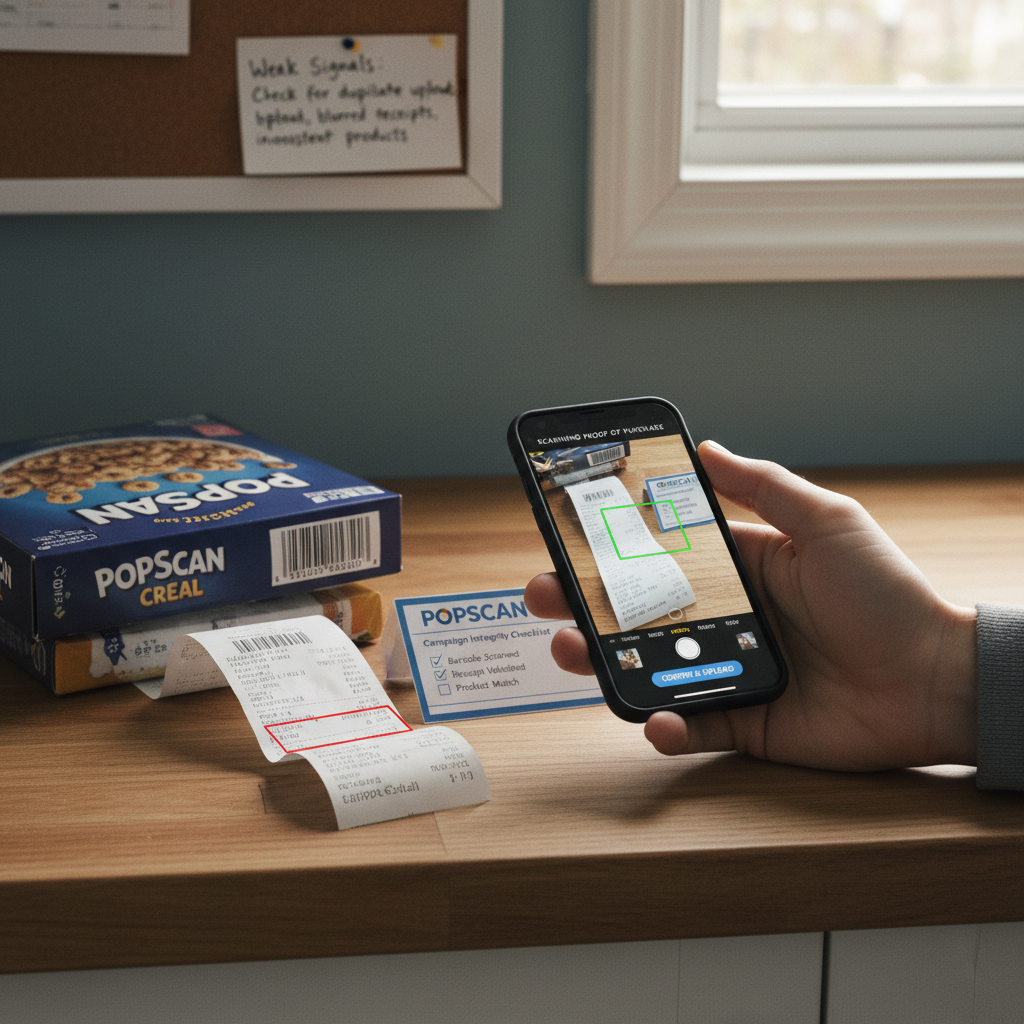
Three contenders exist: raw receipt images, structured receipt data, and linked tokens like voucher IDs. Structured data proves fastest in practice, favouring rule-based verification over manual review.
| Artefact type | Strength | Constraint | Typical impact on dispute speed |
|---|---|---|---|
| Raw receipt image | Original visual context | Variable quality, manual reading effort | Good for edge cases, slower at scale |
| Structured receipt data | Fast rule matching and comparison | Depends on extraction quality | Usually fastest for standard disputes |
| Linked token or voucher event | Strong audit trail | Only works if created earlier in the journey | Very fast when available, limited coverage |
Options and trade-offs
Using receipt images as primary proof provides context but slows down due to variable quality and manual checks.
Starting with structured extraction, supported by images, lets POPSCAN check fields against rules and open images only for discrepancies. This speeds standard claims and ensures consistency.
Relying on linked digital artefacts like voucher events is fast but depends on upstream design.
Selective structure is key. POPSCAN enforces stronger evidence only when dispute triggers occur, such as duplicate accounts or rule mismatches.
The fastest artefact is typically a validated structured claim record, backed by the receipt image and any linked token. Structured fields allow quick rule comparison without human interpretation.
In a product mismatch dispute, structured data can compare SKU and date rules immediately. If a date is faint on the image, the structured record narrows review to one field.
Speed comes from reducing open questions. Structured artefacts isolate eligibility fields, while duplicate detection and account checks further cut review burden.
Some categories have awkward receipts, requiring an escalation lane for ambiguous claims.
Risk and mitigation
Risk: overfitting to easy cases. Mitigation: layered evidence with thresholds. Standard disputes use extracted fields; medium-risk add duplicate checks; high-risk require manual verification or secure tokens.
Auditability is stronger with structured data, as decisions map to rules. Original images serve as supporting evidence.
Recommended path
Make validated structured claim records the lead artefact, keep receipt images attached, and extend token checks where possible.
Operational decisions: define minimum field sets, classify dispute types, connect duplicate detection, and design promotions with stronger proof objects to enhance digital voucher security.
Implement before major promotions to reduce manual reviews and refine thresholds with data.
Balance evidence strictness with clear customer communications to avoid alienating legitimate claimants.
Identify which artefact closes cases fastest to improve your proof of purchase workflow. POPSCAN assists in testing sequences, tightening fraud controls, and maintaining claimant flow. A demo shows how this layered approach can cut support queues.
If this is on your roadmap, POPSCAN can help you run a controlled pilot, measure the outcome, and scale only when the evidence is clear.