Full article

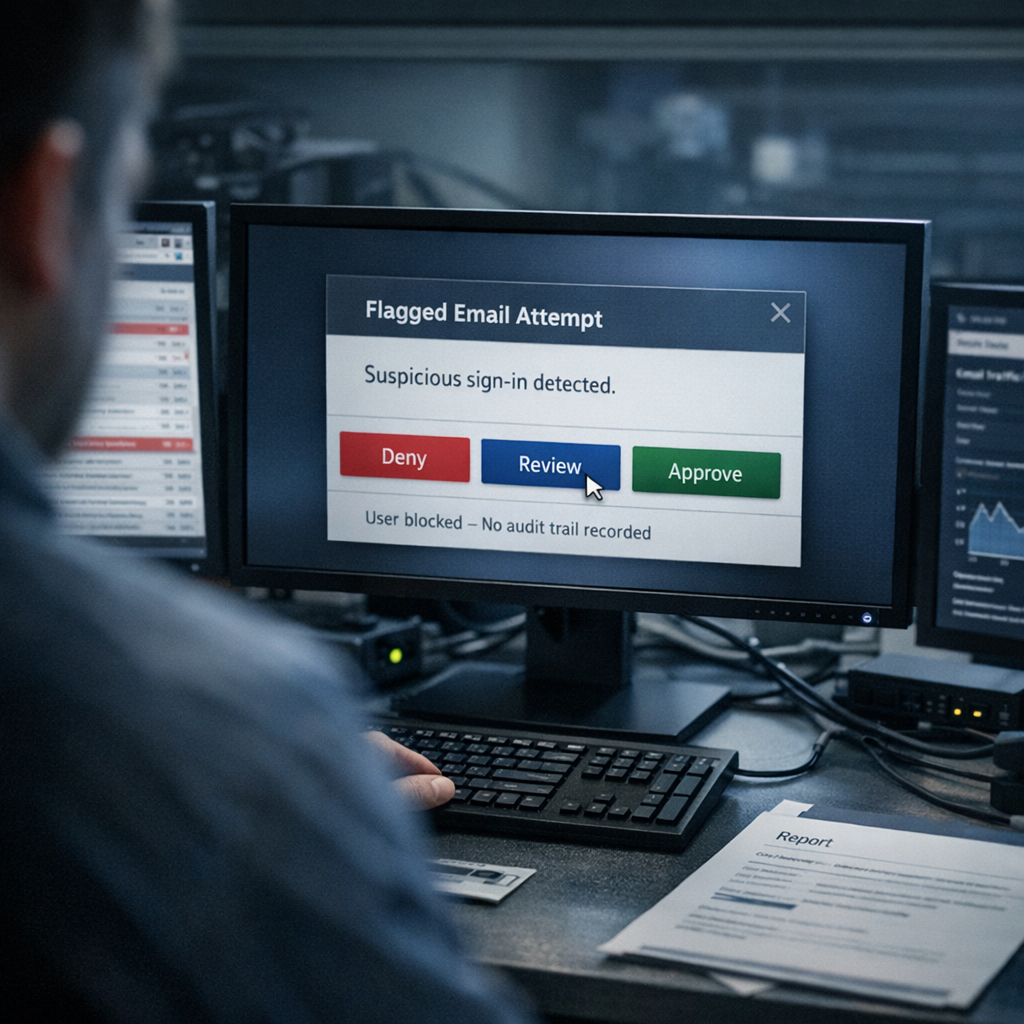
Silent rejection cleans lists fast but hides the evidence teams need to tune thresholds. This contradiction sharpens for UK lifecycle teams as deliverability, consent, and acquisition pressures mount. The first lesson is that EVE's visible review offers governed control where commercial return justifies the step.
Teams face a choice: invisible rejection or governed review. Use visible review selectively, aligning with commercial value to avoid hidden false blocks and demand loss.
Decision context
UK CRM teams judge ambiguous addresses. Silent rejection offers speed and simplicity; visible review provides traceability and tunable thresholds. In acquisition, forms must complete; CRM safeguards inbox placement; compliance demands auditable records. EVE, a validation engine with over 30 detection methods such as keyboard walks and entropy analysis, returns judgement in under 50ms. Visible reasoning treats uncertainty as an operational signal.
Options and trade-offs
Silent rejection removes toxic data quickly, preventing bounce pressure in high-volume promotions. It loses operational visibility, masking whether blocks are fraud, errors or both, and can hide demand loss.
A tiered model works best: pass clear entries, suppress clear fails, and surface the middle band for governed inspection. This balances speed with judgement.
| Approach | Main benefit | Main constraint | Best fit |
|---|---|---|---|
| Silent reject | Fastest path to cleaner lists | Poor visibility into false blocks and pattern shifts | Low-value, high-volume capture |
| Visible review | Better threshold tuning and auditability | More process design required | High-value onboarding and retention triggers |
| Hybrid pass, hold, suppress | Balances speed with judgement | Needs policy discipline | Most mature lifecycle teams |
In practice, a hybrid model aligns with lifecycle work. Use stricter suppression for acquisition, hold bands for onboarding, and richer review for retention, based on journey value.
Risk and mitigation
Silent rejection risks false confidence, excluding good users without complaint paths and leading to quiet revenue loss. Visible review risks operational drag if the hold band is too wide. Mitigate with disciplined threshold design and reason visibility tied to action, such as confirmation loops or overrides.
Technical authentication like DMARC protects domain trust but does not stop toxic data entering CRM. Fraud signal monitoring and technical compliance are complementary.
Recommended path
Adopt a staged hybrid: silent reject for toxic records in low-value acquisition, visible review for ambiguous cases in high-value onboarding and retention. Start by mapping block reasons at high-risk capture points like promotions or first-account creation, then create a narrow hold band before welcome series or conversion triggers.
Commercial return is highest where blocking a legitimate address costs more than an extra review, typically in purchase-linked or loyalty journeys. If override rates rise faster than good outcomes, tighten the hold band or clarify ownership.
Visible review, used properly, is stricter with evidence and more forgiving without it, aiding email risk monitoring in the UK and sender performance. To pressure-test thresholds, book a frictionless validation walkthrough with our solutions team.