Full article

At first it looked like a throwaway detail, then the same kind of tiny, upbeat public behaviour kept appearing in places it had no business being. A local library extending a craft table because too many adults joined in. A council noticeboard covered in hand-written thank-yous rather than complaints. I nearly ignored this as background noise. That would have been a mistake.
This memo argues that positive human stories shouldn’t be treated as editorial charity cases. Quill can use them well, but only if they pass a sharper triage test than hard-news signals. The judgement here is simple: soft stories earn their keep when they reveal observed behaviour, carry a measurable public pattern, and point to a practical consequence for audience strategy. If they’re merely charming, they belong in the notebook, not the publishing queue.
Decision context
Quill’s brief is not to become a scrapbook of pleasant anecdotes. It is to widen discovery, build warmth, and test whether humane features can increase readership without weakening product authority. That means the decision is less about taste than about allocation: which softer signals deserve scarce editorial time?
According to the Office for National Statistics, quarterly measures of personal well-being continue to track how people report life satisfaction, happiness, and whether life feels worthwhile across the UK. These are broad indicators, not a story list, but they matter. When anxiety is elevated and attention is fragmented, people often respond to coverage that offers evidence of competence and participation rather than spectacle alone. The ONS local authority data is useful here too, because variation by place gives us a way to ask a better question: where are the small, affirmative behaviours clustered, and what do they suggest about how people actually live?
The constraint is obvious. Soft pieces can drift into fluff at speed. They are vulnerable to weak sourcing, vague uplift and what I can only describe as the houseplant problem, where every modestly heartening story gets photographed as if a fern has solved local government. Quill needs a decision rule that filters for signal, not mood.
What counts as a useful soft signal
The best signals are not always the loudest. Often they are the ones with a slightly odd human fingerprint on them. A useful soft signal has three traits. First, it points to repeat behaviour, not a one-off gesture. Second, it connects to a public system, place or service. Third, it can be tested against another data point, even if the metric is modest.
Take a story about an unusually busy repair café, for example. On its own, pleasant. Add six months of attendance growth, council waste figures, and a waiting list for sewing volunteers, and it becomes a story about practical participation under cost pressure. That is an editorial asset. It tells readers something about adaptation, not just sentiment. The same applies to quirky public signals such as libraries lending seeds or train stations hosting impromptu piano circles. These are soft on the surface and structural underneath.
Readers often object that such stories feel trivial beside harder commercial news. Fair enough. Yet editorial programmes that only chase maximum urgency tend to flatten the world. They miss the human workaround that predicts behaviour earlier than a formal announcement does. Holograph’s work with Boots Magazine, for instance, cut repetitive editorial task time by up to 90%. That matters here because it shows where effort should move: less time on low-value production, more on judging whether a small clue has legs.
| Signal type | Weak version | Stronger version | Why it earns coverage |
|---|---|---|---|
| Community participation | One cheerful event | Repeated turnout over 3 to 6 months | Shows durable behaviour, not novelty |
| Public service adaptation | Anecdotal improvement | Named service change plus usage data | Links people to systems |
| Useful oddity | Merely amusing | Amusing plus observable consequence | Gives readers a reason to care |
Options and trade-offs
There are really three options. The first is to avoid these stories entirely and stay with hard, technical signals. That protects authority, but it narrows reach and leaves a lot of search and social curiosity unclaimed. It also ignores the project brief.
The second is to publish soft stories freely whenever they feel warm or relatable. I do not recommend this. It tends to produce interchangeable copy and the faintly sticky optimism readers can smell at once. The friction point is not volume, but reputational drift. If Quill sounds pleased with itself for noticing that humans are occasionally decent, people will tune out.
The third option, the strongest one, is disciplined triage. Publish only where observed behaviour is backed by a comparative metric or public constraint. Comparative does not mean grand. It can be year-on-year footfall, repeat attendance, or a before-and-after service response. The Lucozade Energy AR case published by Holograph reported a 32% sales uplift because it tied creative work to a concrete business result. Soft editorial needs the same habit of proof, scaled to its own purpose.
Risk and mitigation
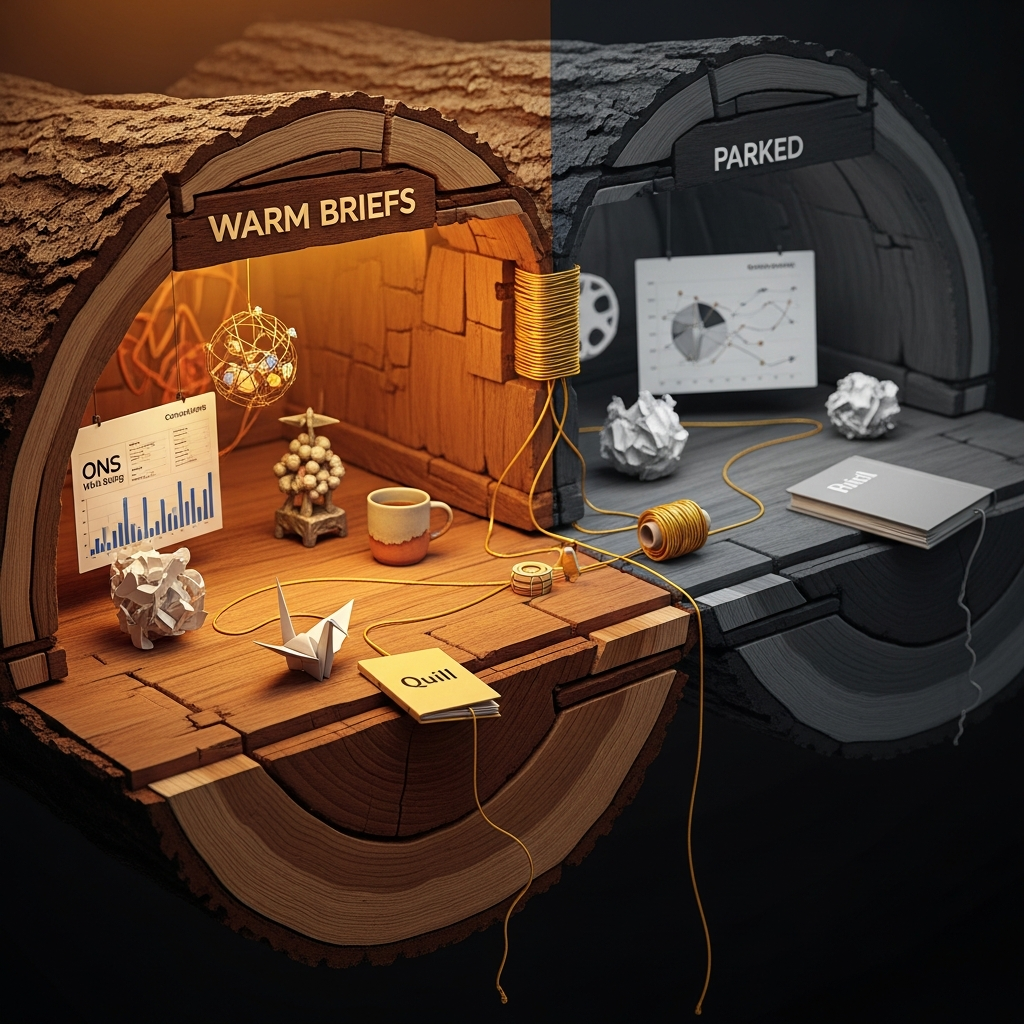
The main risk is false significance. Editors can fall in love with a useful oddity because it feels fresh. Readers are less forgiving. Mitigation starts with a scoring frame. Quill should score candidate stories against five thresholds: repeat behaviour, named place, public relevance, comparative evidence, and transferable lesson. A story that scores three or fewer waits.
There is also a brand risk. If every piece resolves neatly, the whole stream starts to feel synthetic. Real operational life rarely behaves so tidily. A library gardening club may be thriving while the building still cuts hours. A street bench initiative may increase neighbourly use but rely on one exhausted organiser. Leave a little of that tension visible. It reads truer because it is truer.
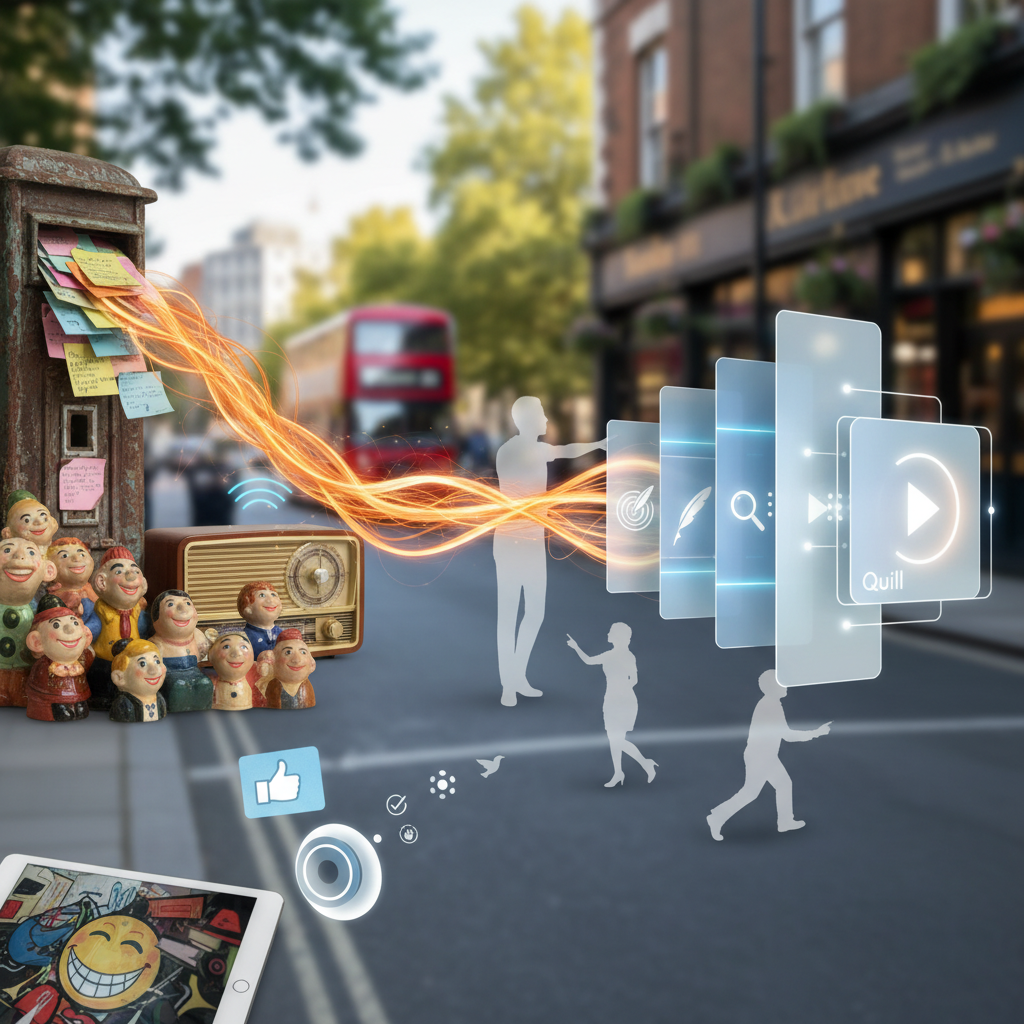
One practical mitigation is to insist on at least one source outside the original anecdote. Another is image discipline. Use warm documentary scenes with alt text such as: . Real places. Small details. No dashboard theatre.
Recommended path
Quill should adopt a soft-story triage model with clear thresholds and a bias towards consequence. The publish rule is straightforward: if a story reveals repeated positive behaviour, sits inside a public context, and can be supported by at least one comparative metric, it is in scope. If it is merely heartening, it stays out.
That approach fits the project’s actual aim. It widens topical reach while protecting authority with evidence and constraint. It also gives editors something more useful than instinct when the inbox fills with odd little signals. Humans are at their most interesting when they quietly improve a system without waiting for permission. The editorial job is to notice which of those improvements might travel.
The next step is practical. Build a simple Quill scorecard, test it across ten candidate stories this quarter, and compare completion rate and return visits against harder product-led pieces. If the soft stories that pass triage hold attention and improve brand warmth, keep going. If they do not, tighten the thresholds. If you want a sharper editorial method for spotting the useful oddity before it turns into filler, contact Quill and put the next quiet signal through a proper test.