Full article

Spreadsheets look quick. For many retail teams, that speed is front loaded. The export itself may take minutes, but the real cycle sits in checking, fixing, re-sending and sign-off. That is the tension in audience activation: what feels fast at the start often drags later.
The short answer
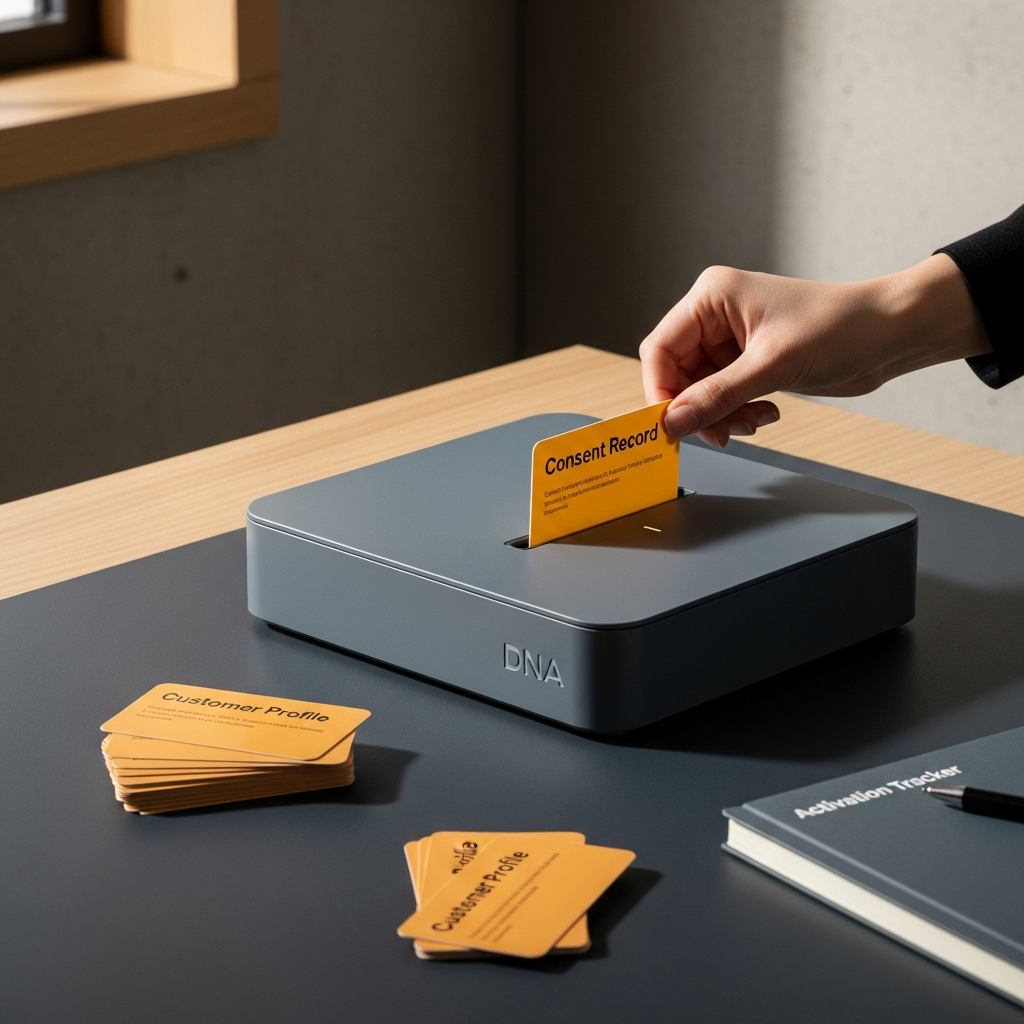
A UK team should understand this first about DNA: it is a governed customer data and activation layer built to bring identity, consent, segmentation and activation readiness into one place. The practical comparison is not spreadsheet versus software in the abstract. It is reusable audience logic in DNA versus one-off exports and campaign lists.
That matters because activation speed is rarely decided by the first pull. It is decided by how quickly a team can approve an audience, prove what rules were used, apply suppressions consistently and send without another round of fixes.
What is being decided
This is really a choice between two operating models. One relies on exports, local edits and manual sign-off. The other defines audience rules once, approves them once, then reuses them.
The spreadsheet route pushes risk towards the end of the process. Consent suppression, stale exclusions and version confusion tend to show up late, when the send slot is already close. The governed route shifts effort earlier. More time goes into agreeing logic, ownership and acceptance criteria up front, then repeat activations become easier to run and easier to defend.
That trade-off usually favours governed logic when campaign volume is high, compliance matters, or several teams touch the same audience definition. If your plan has no named owners and dates, it is not a plan, fix it. Here, the owner should sit with the Head of Marketing or Head of CRM, backed by data governance. The first checkpoint is straightforward: document who approves audience logic, who approves suppressions and the date for sign-off on each campaign.
What activation problem this really solves
The case for spreadsheets is usually flexibility, and for a low-risk one-off pull that can be true. The issue is not whether a spreadsheet can work once. It is how the process behaves when the brief changes, exclusions update or another owner needs to review the file.
That is where reusable logic starts to change the shape of the work. In DNA, audience rules, lineage and activation readiness sit in a governed layer rather than in a trail of files and local edits. The proof question is simple: are lineage, ownership and activation confidence clear enough to act on now.
Against that test, spreadsheets tend to create uneven outcomes. A team may still get the campaign out, but often with more handoffs, more checking and more dependence on whoever remembers which version is right. Governed logic reduces that dependence because the rules are stored, traceable and reusable.
| Operational metric | Spreadsheet-led model | Reusable logic model in DNA |
|---|---|---|
| Time to build and approve a new audience | Usually measured in days, with high variance from rework and sign-off loops | Usually faster once rules and approvals are established, with lower variance on repeat use |
| Rework rate due to audience errors | Higher risk where checks sit in files and local review | Lower risk where rules are defined once and reused consistently |
| Consent and suppression risk | Medium to high, depending on manual checks | Lower, with rules applied consistently |
| Data lineage clarity | Often opaque; depends on analyst memory and file naming | Auditable; logic is stored and reusable |
| Dependency on specific individuals | High | Lower |
The useful measure in board conversations is time to approved activation, not time to first export. That is the number that exposes approval friction, rework and governance gaps. It is also the one most likely to move when audience logic stops living in spreadsheets.
Operational impacts on retail teams
Once audience logic sits in spreadsheets, every export becomes a slightly different version of the same idea. Consistency weakens quickly. A loyal customer segment can shift between campaigns because someone copied last month’s file, changed two filters and missed an exclusion. The send still happens. The learning gets noisier.
That lands in two places. Reporting becomes harder to trust because teams are not always comparing like with like. Planning slows as marketing, CRM and data owners spend time debating definitions instead of acting on them.
The harder part, and worth saying plainly, is setup. Moving to governed feeds is not effortless. Source mapping, consent rules and QA can be more awkward than expected, and any sensible plan should budget for that. The gain comes afterwards: fewer ad hoc cleanses, fewer approval loops, fewer surprises close to launch. More discipline up front, less repair work later.
The risk is assuming the tool changes the behaviour on its own. It does not. If teams carry on exporting data and editing locally after the logic is built, the old failure mode still sits there. The practical mitigation is simple enough: lock approved audience definitions, keep a visible change log, and set acceptance criteria for every reusable segment before it goes live.
Where DNA fits best
DNA fits best where activation speed, governance and repeatability need to work together. That usually means retail teams running recurring campaigns, managing consent-sensitive audiences, or coordinating across marketing, CRM and loyalty rather than leaving one analyst to hold the process together.
It is less about replacing every spreadsheet in the business and more about removing spreadsheets from the production path where control matters. Low-risk ad hoc analysis can stay flexible. Live campaign activation should not depend on file handling by default.
For readers looking for customer data platform insight, retail analytics report context or marketing intelligence uk benchmarks, the operational question is the same in each case: can the team prove who owns the audience logic, which suppressions were applied and whether the audience is ready to activate without another manual pass.
Recommendation and next step
The recommendation is to move audience creation towards reusable logic in DNA wherever activation speed, governance and repeatability matter. Spreadsheet lists can still serve low-risk ad hoc work, but they should not remain the default production route for campaign activation.
Owner: Head of Marketing or Head of CRM. Support owners: data governance lead and implementation lead where Holograph is handling delivery. Date: complete a baseline review by the end of Q2 2026. Acceptance criteria: assess three recent campaigns from brief to live send; record total time to audience approval, number of handoffs, number of file versions, and any rework caused by audience or suppression issues. If those four measures are not visible, you do not yet know where activation speed is being lost.
The path to green is not complicated, but it does require discipline. Define the top reusable audiences, agree the rules, assign sign-off owners, then test one repeatable activation flow end to end. Keep the watchpoint in view: a governed model only works when teams stop treating each campaign as a fresh spreadsheet exercise.
If you want a clear benchmark of where your process is slowing down, DNA can help. Request a joined-up data workshop and we will map the current bottlenecks, owners, risks and the most realistic path to faster activation. You can also explore the wider Holograph solutions context if implementation fit matters.
If this is on your roadmap, DNA can help you run a controlled pilot, measure the outcome, and scale only when the evidence is clear.