Full article

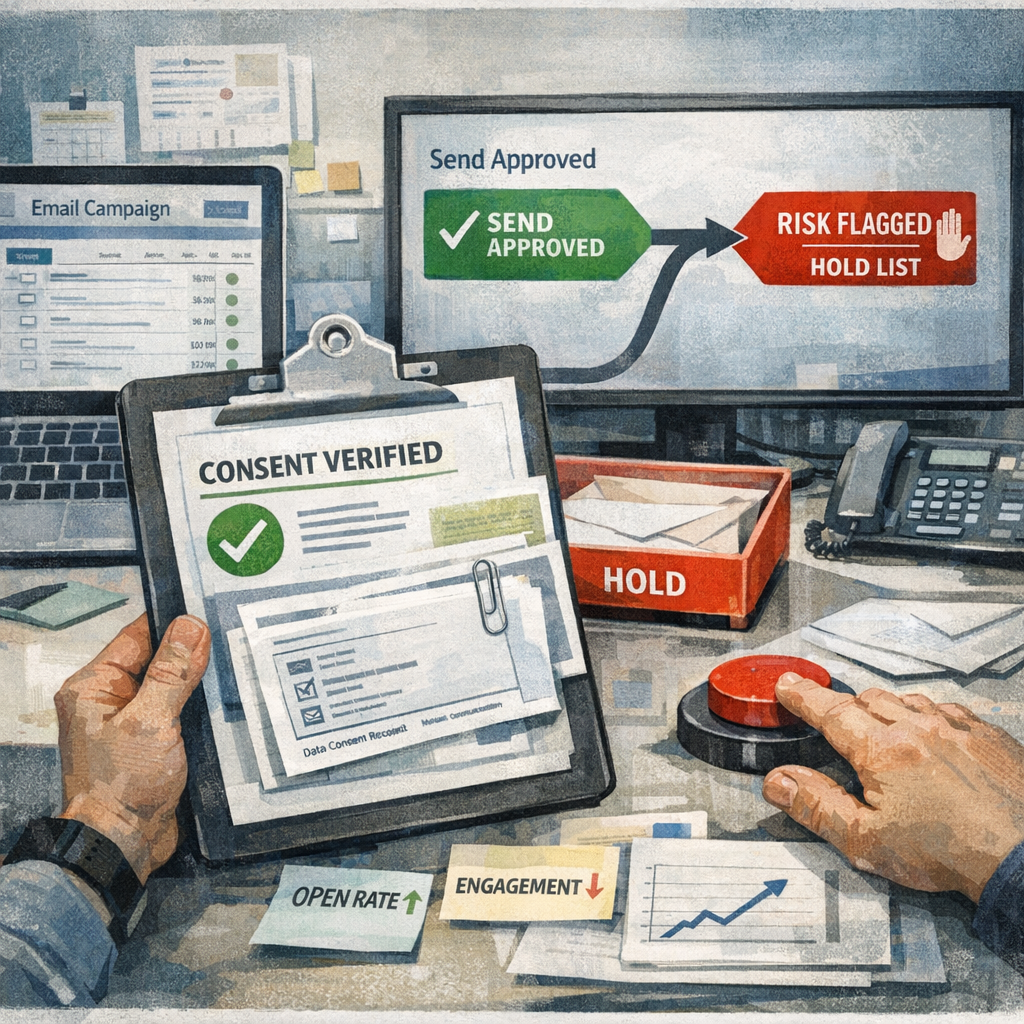
The short answer: proof-of-purchase answers whether the claim evidence stands up. Mailbox trust answers whether the address should enter CRM now, later, or not at all. Treat those as one control and you can approve a genuine purchase while still admitting a risky or low-confidence address into onboarding. That is the contradiction this checklist needs to resolve.
EVE is useful because it does not force every sign-up into a crude valid or invalid outcome. It applies email judgement at sign-up and returns an explainable route such as pass, hold or stop. That gives retail and rewards teams a way to protect acquisition quality and deliverability controls without turning uncertainty into a blanket rejection.
The real comparison is not advanced fraud prevention versus basic form checks. It is governed routing, with thresholds, overrides and logged reasons, versus silent rejects, mailbox-quality drift and queues nobody owns. One is operable. The other tends to come apart after launch.
What you are solving
Proof-of-purchase checks establish whether the claim evidence is acceptable. They do not decide whether the email address should move straight into onboarding, slow for confirmation, or stop. In retail rewards flows, that distinction matters because the downstream damage lands in CRM, not in the receipt check.
When those controls collapse into a single decision, the problem can sit there unnoticed. Acquisition can still look healthy while confirmation completion slips, soft bounces climb, or complaint rates start edging up. That is not only an abuse problem. It is a routing problem, and it is usually cheaper to fix at sign-up than after poor records have spread through the programme.
The aim is not to reject more people. It is to split sign-ups into workable states using deliverability controls that separate low-risk, reviewable and clearly unsafe records. If the only outcomes available are yes or no, the control is doing too little work.
Where EVE fits best
EVE fits where a valid purchase signal is necessary but not sufficient, and the team still needs a defensible decision on the mailbox. In that setup, proof-of-purchase and the email judgement engine run side by side. The receipt check handles transaction evidence. EVE grades the email and returns an explainable route state with the reason visible to the team.
That is the practical shift. Static regex rules or allow-lists can catch obvious formatting issues, but they do little with uncertain cases. Real-time judgement gives you route states with consequences attached. Pass means proceed. Hold means a controlled next step. Stop means the case has crossed a threshold agreed before launch.
- Valid receipt plus low-risk email: pass the sign-up, issue the reward or entitlement, and move the record into CRM onboarding.
- Valid receipt plus medium-risk email: hold the record away from the main list and trigger confirmation or another controlled step. Slow it down, do not throw it away.
- Invalid receipt plus any email: stop the claim and return a clear message explaining what failed.
- Valid receipt plus high-risk email: stop or challenge the sign-up based on the threshold, the evidence and the campaign economics agreed before launch.
A hard reject looks neat on a flow chart. In practice, it often shifts effort elsewhere: customer service contacts, exception requests and data clean-up that should never have been needed. A small hold route, with clear ownership, is usually the stricter option.
Explainability is what keeps that usable. Each route should log the decision reason, the threshold applied and the next action. If the team cannot say why a record was held, the control is not explainable. It is only opaque.
Decision points before launch
If your plan has no named owners and dates, it is not a plan. Sort that before launch. The controls below are the minimum worth agreeing in writing.
| Control area | Decision to make | Owner | Date or checkpoint | Acceptance criteria |
|---|---|---|---|---|
| Threshold settings | Define pass, hold and stop boundaries for this campaign, not a generic average | CRM Lead with Data Lead | Signed off before launch; reviewed at 24 hours, 72 hours, then weekly | Route volumes are visible and threshold changes are version logged |
| Hold route treatment | Decide whether hold triggers confirmation, delayed entitlement, or manual review | Marketing Operations | Workflow approved before build completes | No held record is left without a next action or expiry rule |
| Override policy | Set who can override, what evidence is required, and how exceptions are recorded | Data Governance owner | Approved before launch window opens | Every override has a reason code, timestamp and named approver |
| Monitoring | Agree the live measures that can trigger threshold review | Programme Lead | Dashboard ready before go-live; first check on day two | Pass, hold, stop, confirmation completion, soft bounce and complaint measures are visible by source |
Two decisions usually determine whether this stands up. Thresholds should fit the campaign, not a recycled default. A low-friction loyalty programme and a prize-led campaign do not attract the same abuse incentive. Then there is the hold route. It needs an owner, or it becomes a graveyard.
What risk or deliverability issue needs controlling
The immediate problem is not whether an email address exists in the abstract. It is what happens next if you trust it too early. A poor mailbox decision can drag down confirmation completion, lift soft bounces, increase complaints and make list-quality drift harder to spot while the campaign is already live.
That is why the more useful comparison is automated email risk routing versus blunt fraud blocking. Blunt blocking removes uncertainty by rejecting it. Controlled routing deals with uncertainty by assigning a state, a consequence and an owner. For most rewards flows, that is the better operational fit.
It also gives teams something they can check. Pass, hold and stop volumes can be reviewed against proof-of-purchase validity, confirmation completion, soft bounces, complaints and override rates. Those are operational signals, not abstractions. They show whether the thresholds are doing useful work or simply creating noise.
Common failure modes
Failure mode one: thresholds are too aggressive on day one. Teams tighten early and catch genuine customers whose mailbox pattern falls outside the expected norm. The signal is plain enough: hold or stop volumes rise while proof-of-purchase acceptance remains strong. Mitigation: start with a measured hold band, review outcomes after the first 24 to 48 hours, and tighten only where the evidence supports it.
Failure mode two: the hold queue has no owner. This is an operational own goal. Records are held, customers get no clear next step, and the queue stops functioning as a control. It becomes delay. Mitigation: assign one owner, define an SLA or automation path, and set an expiry rule. If you cannot resource a review queue, do not pretend you have one. Use confirmation or challenge steps instead.
Failure mode three: no feedback loop into the rules. A pattern appears, perhaps legitimate addresses are being held after launch, but nobody adjusts the thresholds or route logic. Mitigation: run a short weekly review with CRM, Ops and Data, and keep a change log covering the adjustment, owner, date, reason and expected effect. Without that traceability, tuning slides into guesswork.
Failure mode four: mailbox risk is treated as the whole story. It is only one side of the decision. A risky email with valid proof-of-purchase may justify a challenge or delayed onboarding rather than an automatic stop. The control works when purchase evidence and mailbox evidence are handled together, then routed on purpose.
Action checklist for the next campaign
- Write dual acceptance criteria. Separate what counts as acceptable proof-of-purchase from what counts as pass, hold or stop mailbox risk. Owner: CRM Lead and Fraud or Risk owner. Date: before build sign-off.
- Map every route. Define what the customer sees for pass, hold, challenge and stop, including entitlement timing and contact rules. Acceptance criteria: no route ends in a silent failure.
- Set live measures. Track route volumes, confirmation completion, soft bounce rate, complaint rate and override volume from day one. Owner: Programme Lead. Checkpoint: first review on day two, then weekly.
- Document exceptions. Keep an override log with named approver, reason code and date. Acceptance criteria: every manual decision is auditable.
- Keep a change log. When thresholds move, record what changed, why, who approved it and what signal triggered the update. If the team cannot explain the last threshold change in one minute, governance is already slipping.
The audit prompt before you go live
Ask one blunt question before launch: what happens to a legitimate customer with a valid receipt and a slightly uncertain mailbox? If the answer is a silent block, you may be close to go-live, but you are not ready.
EVE gives teams a more workable route than binary checks by applying automated email risk routing with explainable decisioning, controlled exceptions and measurable outcomes. The product pages set out how EVE handles real-time sign-up decisions and where it sits alongside wider Holograph solutions: EVE and Solutions. If you want to pressure-test your thresholds, owners and path to green before the campaign goes live, contact EVE and we will walk through the control points with you. Cheers.
If this is on your roadmap, EVE can help you run a controlled pilot, measure the outcome, and scale only when the evidence is clear.