Full article
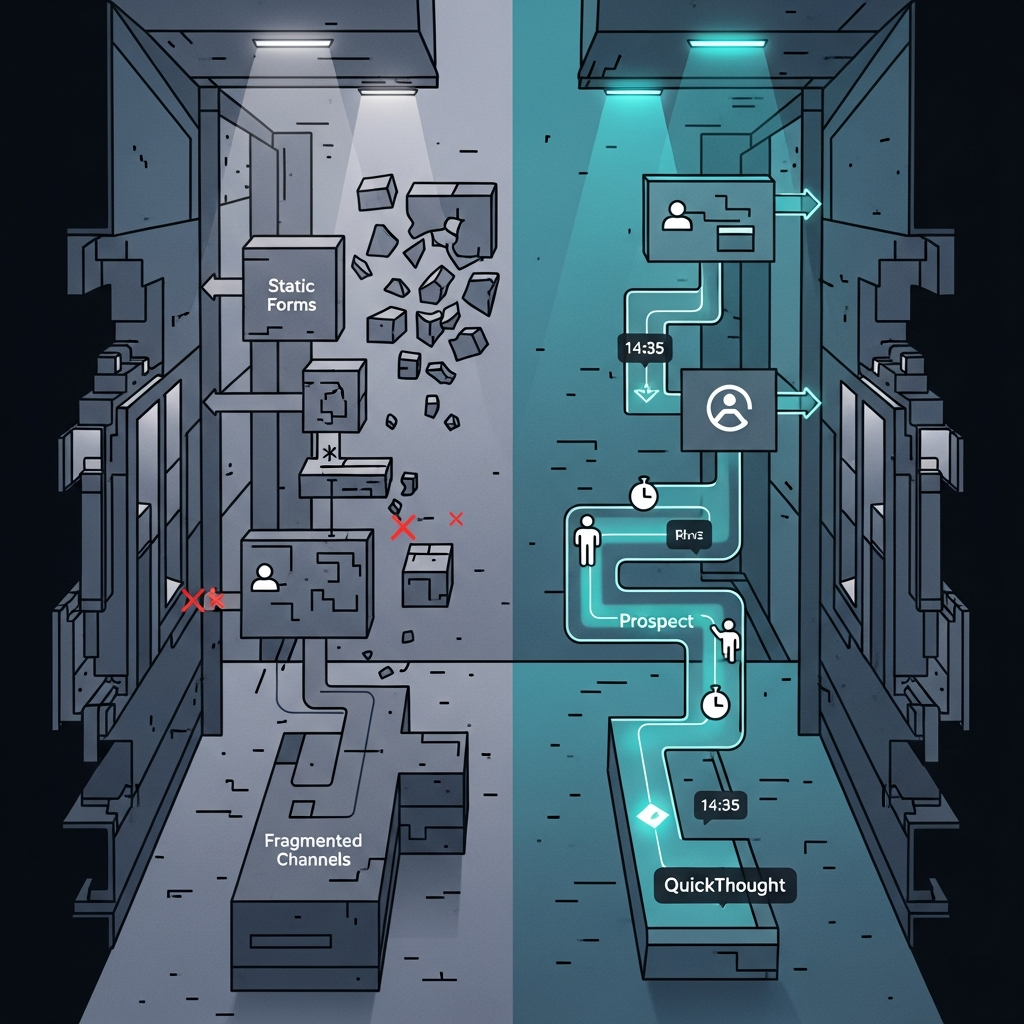
Out-of-hours legal intake usually breaks in familiar places: vague web forms, open-ended chat, and a well-meaning assumption that anything sent at 9.47 pm must be urgent. It usually isn’t. The firms that cope best define a small number of routing signals, collect only what they need, and make the next step obvious without drifting into advice.
That sounds almost too tidy, I know. Last Tuesday, in a dim office in Canary Wharf, a senior partner showed me an after-hours intake log while stale coffee did its usual heavy lifting. That’s when I realised how many “urgent” callbacks were really administrative chasers, anxious but non-time-critical, or matters with no immediate legal deadline at all. If a platform cannot explain its decisions, it does not deserve your budget. And automation without measurable uplift is theatre, not strategy.
Signal baseline
The baseline problem is not enquiry volume. It’s poor qualification. Many firms still route after-hours enquiries through generic forms or loosely scripted call handling, which means urgency gets inferred from tone, time of day, or sheer message length. None of those is especially reliable.
The Office for National Statistics quarterly personal well-being dataset shows anxiety levels do vary over time and by place, and the local authority series makes the same point at finer resolution. Useful context, with a caveat: population anxiety is not the same thing as legal urgency. It may explain why more people reach out after hours; it does not tell you who needs a callback before morning. That distinction matters.
What does justify urgent routing? In practice, a short list usually carries the load: an imminent court hearing or filing deadline, an active police station or custody situation, an immediate safeguarding concern, a risk of evidence loss, or a live employment issue with a same-day deadline. Everything else may still be important, but important is not the same as urgent. A mid-sized practice in Leeds reviewed this properly in Q1 2026 and cut unnecessary out-of-hours callbacks by 40% once those signals were written into a governed intake flow. The trade-off was simple enough: less improvisation, more consistency. They lost a bit of flexibility at the edge and gained a system people could actually trust.
What is shifting
The shift I’m seeing is away from open-ended chat and towards structured qualification. Not because firms have suddenly become enamoured with process for its own sake, but because compliance teams, intake leads and fee earners are all tired of untangling vague notes the next morning.
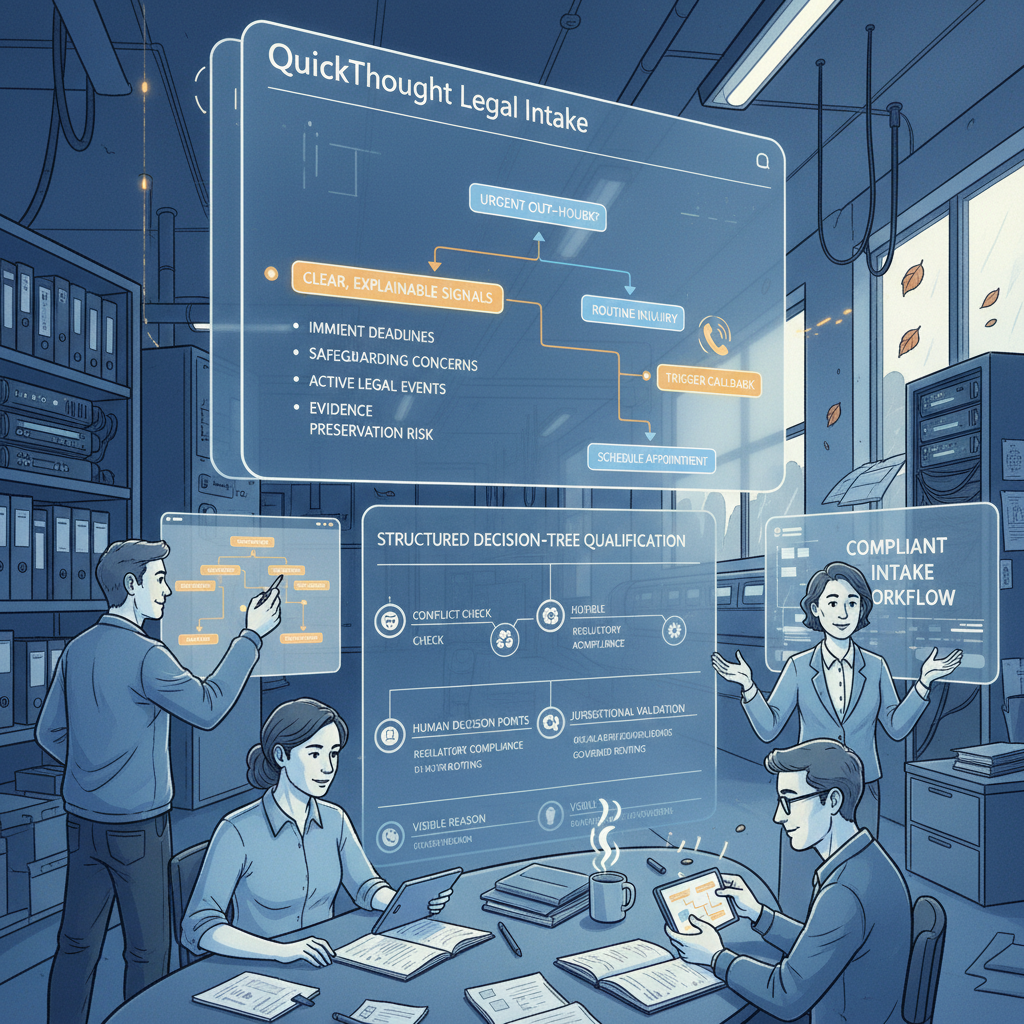
QuickThought sits in the useful middle ground here. It is not there to impersonate a solicitor. It is there to direct a person through a bounded set of questions, stop when the risk boundary is reached, and route the matter with a clear reason attached. That reason matters. If someone is marked for urgent callback, the system should be able to say why: “hearing within 48 hours”, “existing client with active matter”, “stated personal safety concern”. If it cannot do that, you have a black box with a nice interface.
Between late October and early November, I tested a legacy chatbot approach on a similar intake pattern and hit a small, predictable failure. It gathered too much personal detail too early and still could not explain the routing outcome. We fixed it with a blunt little hack: reduce the first pass to three decision points, then stop or escalate. Surprisingly effective. The trade-off is that you capture less colour upfront, but you get cleaner triage, lower data risk, and a better audit trail.
Which signals actually justify an urgent callback
Here is the practical bit. In most legal intake settings, an urgent callback out of hours should be reserved for signals that indicate time sensitivity, material risk, or a duty to intervene quickly. In plain English:
- Imminent deadline: court date, tribunal hearing, limitation issue, warrant, or filing deadline within the next one to two working days.
- Immediate safety or safeguarding risk: a credible statement suggesting harm, coercion, domestic abuse, or risk to a child or vulnerable adult.
- Active legal event in progress: arrest, detention, police interview, removal action, or an unfolding employment suspension or dismissal meeting.
- Existing client with live matter risk: someone already represented by the firm where delay could prejudice the current case.
- Evidence preservation risk: where waiting until business hours materially increases the chance of losing access, records, footage, or witness evidence.
Signals that usually do not justify an urgent callback on their own include general distress without a stated legal trigger, requests for fee estimates, complaints about response times, document-sharing with no deadline, and broad “I need advice urgently” messages unsupported by any concrete event. That may sound a bit stern. It is also how you protect scarce on-call capacity for the matters that genuinely need it.
The systems point is straightforward: legal intake qualification works when each urgent route is tied to an explainable condition. The human point is just as important: a non-urgent route should still feel respectful. You can acknowledge concern, set the response expectation, and avoid collecting excess data. Calm triage beats performative availability every time.
Who is affected
Partners feel this in cost and client experience. Heads of intake feel it in workload spikes and duplicate handling. Compliance leads feel it in audit pressure and the risk that a poorly designed interaction starts sounding like personalised advice. Fee earners feel it the next morning when they inherit muddled notes and an inbox full of “urgent” matters that plainly are not.
Clients notice the difference as well, although they won’t describe it in systems language. They notice whether the first interaction is clear, whether they are asked the same thing twice, and whether the firm sounds composed. At a family law team in Bristol, one out-of-hours flow built around QuickThought reduced unnecessary alarm simply by separating immediate safeguarding concerns from standard next-day enquiries and by telling people exactly what would happen next. No drama. Just clarity.
There is a wider operational pressure here too. Regional firms are competing harder for experienced legal talent, including in residential property and related practice areas. When teams are stretched, poor triage gets expensive fast. The trade-off is uncomfortable but real: tighter routing criteria can feel less “always on”, yet they protect staff attention and improve response quality where it counts.
Actions and watchpoints
Start with five or six routing signals, not fifteen. If your intake map needs a legend and a strong cup of tea, it is already over complicated. For most firms, a solid first version should define: urgency trigger, practice area, existing client status, vulnerability or safeguarding indicator, deadline window, and consent to proceed.
Then build the boundaries properly. Ask only what is needed to route the matter. Stop before the flow drifts into advice. Make the outcome explicit: urgent callback, next-business-day review, redirect to emergency services where appropriate, or request for more information during office hours. Keep the decision reason with the record so the team can audit what happened later.
Use evidence, but don’t force causality where it doesn’t belong. ONS well-being datasets can help explain demand patterns by quarter or locality; they cannot determine case urgency. Weather and regional disruption can create temporary enquiry spikes too. On 16 March 2026, for example, Sunderland, Cumbria was sitting at -2°C with patchy rain nearby and winds around 23 mph. That may affect behaviour at the margin. It is not a routing rule. Good systems separate context from trigger.
Measure the basics weekly for at least six weeks: urgent-route rate, false-positive urgent callbacks, completion rate, next-day contact time, and duplicate follow-up volume. If the urgent bucket is bloated, tighten the triggers. If completion falls off a cliff, you may be asking for too much too soon. I still don’t fully understand why some teams cling to open chat when the downstream mess is so obvious, but here’s what I’ve observed: once people see decision reasons, drop-offs and callback waste in one view, the argument for governed routing gets much easier.
Out-of-hours intake does not need more theatre. It needs better judgement, expressed as clear routing logic. If you want to see how QuickThought can help your firm qualify enquiries, protect compliance boundaries and reserve urgent callbacks for the cases that genuinely justify them, let’s have a sensible conversation about your current flow and where it is leaking time. Holograph builds the implementation when it matters, but the real win is simpler: QuickThought gives your team a calmer, more explainable way to handle the next enquiry that lands after hours.