Full article

Which proof of purchase workflow offers the safest path for UK promotions? Off-platform entry, on-pack codes, and receipt checks each validate purchase differently. Evidence from POPSCAN supports a layered model: off-platform entry for data control, unique on-pack codes as primary verification, and receipt checks for exceptions.
Decision context
Market pressures demand low-friction engagement alongside tight fraud controls. Promotions lose profitability when manual validation costs escalate. UK CAP guidance requires transparent mechanics; vague proof models introduce operational and regulatory risks.
Options and trade-offs
Compare the three primary mechanics on operational resilience.
| Mechanic | Main strength | Main constraint | Best fit |
|---|---|---|---|
| Off-platform entry form | Control over data capture, eligibility logic, and audit trails | Does not prove purchase; high entry volume can mask low participation quality | Campaigns needing structured entry data and clear consent |
| On-pack unique codes | Strong purchase-linked verification at scale, standardises validation, reduces manual review | Operational rigidity; dependent on supply chain discipline, packaging timelines | Large retail or FMCG promotions where stock control allows |
| Receipt checking | Flexible proof across retailers without packaging changes | Higher review complexity; receipt variability leads to manual exceptions and delayed fulfilment | Multi-retailer campaigns or cases where on-pack codes are infeasible |
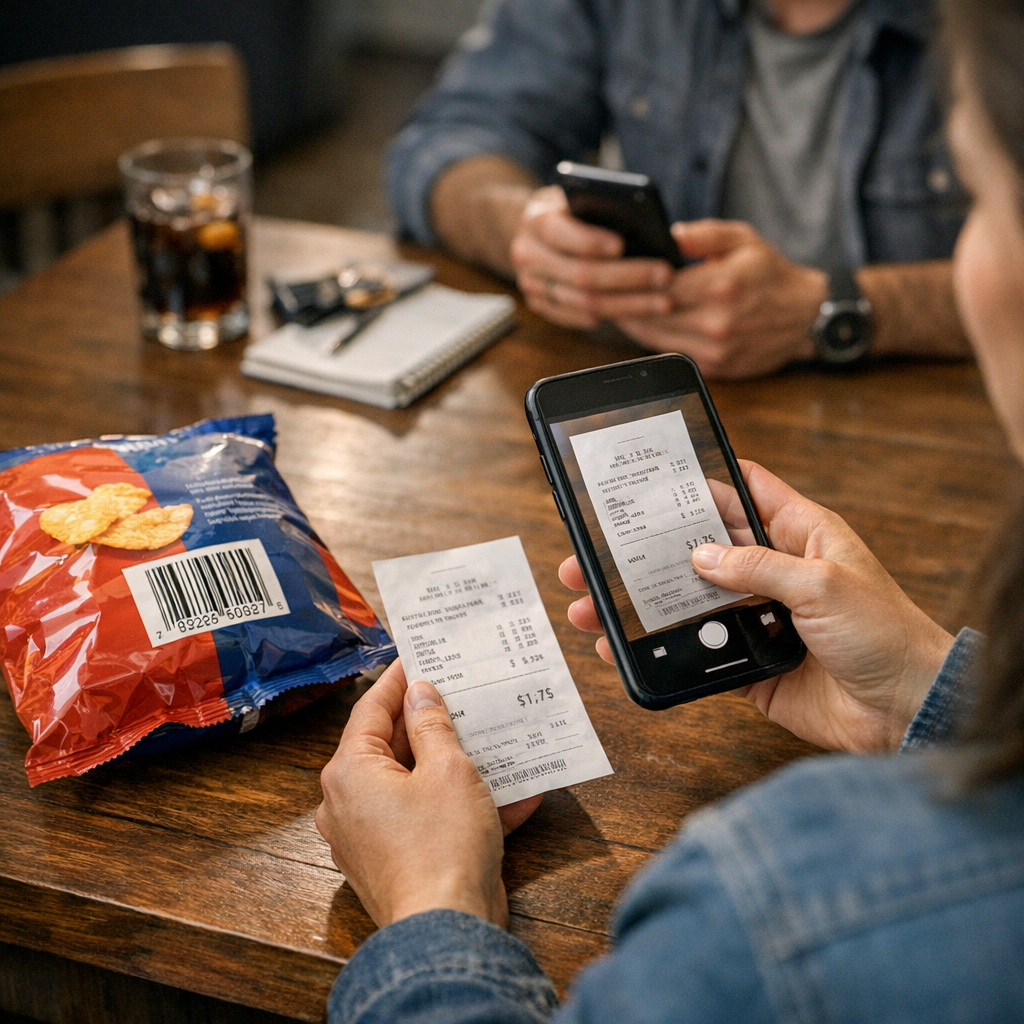
For proof of purchase workflow design, on-pack codes provide the cleanest validation path. Receipt checks introduce operational friction, as tools like Amazon Textract show, till receipts lack consistent structure.
Risk and mitigation
Redemption volume alone misleads if fraud and support costs are hidden. Measure commercial health with paired metrics.
| Metric pair | What it reveals | Why it matters commercially |
|---|---|---|
| First-pass validation rate vs manual review rate | Efficiency of the mechanic at self-verifying claims | High manual review erodes margin through operational overhead and delays fulfilment |
| Duplicate submission rate vs valid unique claimant rate | Whether growth comes from genuine participants or noise | Separates real engagement from fraudulent activity that inflates numbers without value |
| Time-to-approve vs reward redemption rate | Proportionality and efficiency of fraud checks | Slow approvals frustrate customers, suppressing legitimate use and generating negative sentiment |
| Blocked claim rate vs upheld dispute rate | Accuracy of fraud rules, balancing looseness and restrictiveness | High dispute rates indicate false positives, damaging trust with legitimate claimants |
Mitigation involves designing workflows around these metric pairs. For on-pack codes, manage the code lifecycle tightly. For receipt checks, set automated thresholds for acceptable proof, escalating only outliers.
Recommended path
For most UK consumer promotions, a hybrid approach is safest: off-platform entry as the controlled front end, unique on-pack codes as primary proof where feasible, and receipt checks for exceptions. This mix balances participation quality with operational resilience. If on-pack codes are infeasible, use off-platform entry with receipt upload and establish validation thresholds from the start. Build the proof of purchase workflow around measurable metrics to scale without cost escalation. POPSCAN's layered validation, which treats receipt, pack, and barcode as one purchase-proof set, separates valid claims from noise in real-time. To see how this works in practice, contact for a guided walkthrough tailored to your campaign goals.
If this is on your roadmap, Holograph can help you run a controlled pilot, measure the outcome, and scale only when the evidence is clear.