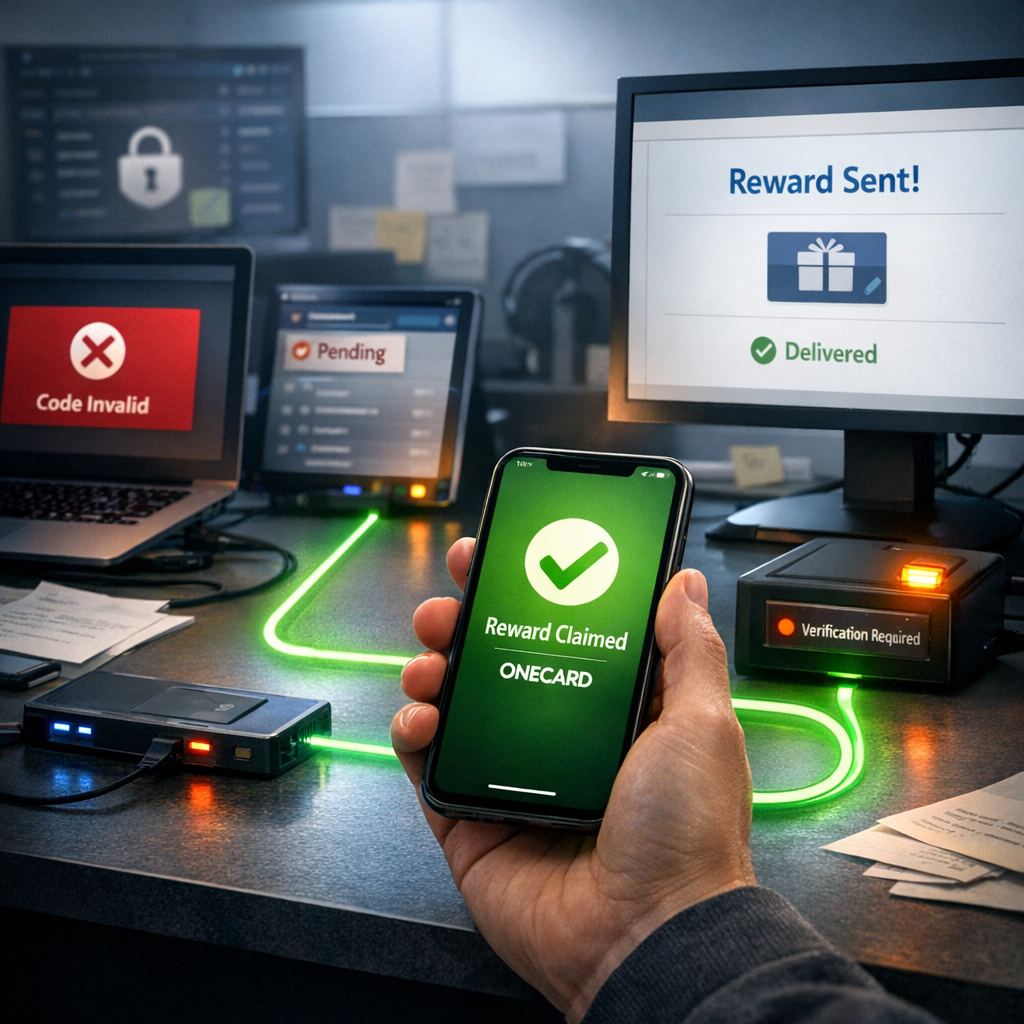
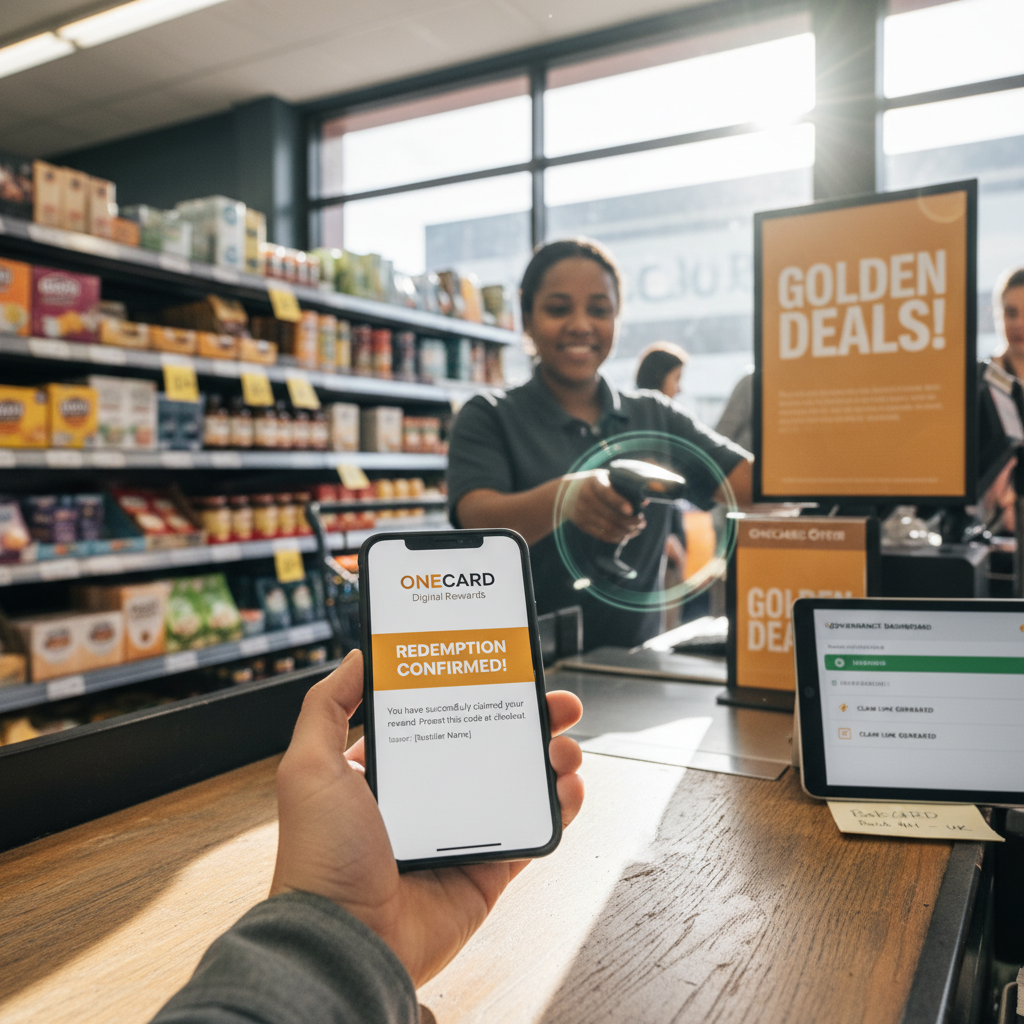
Full article
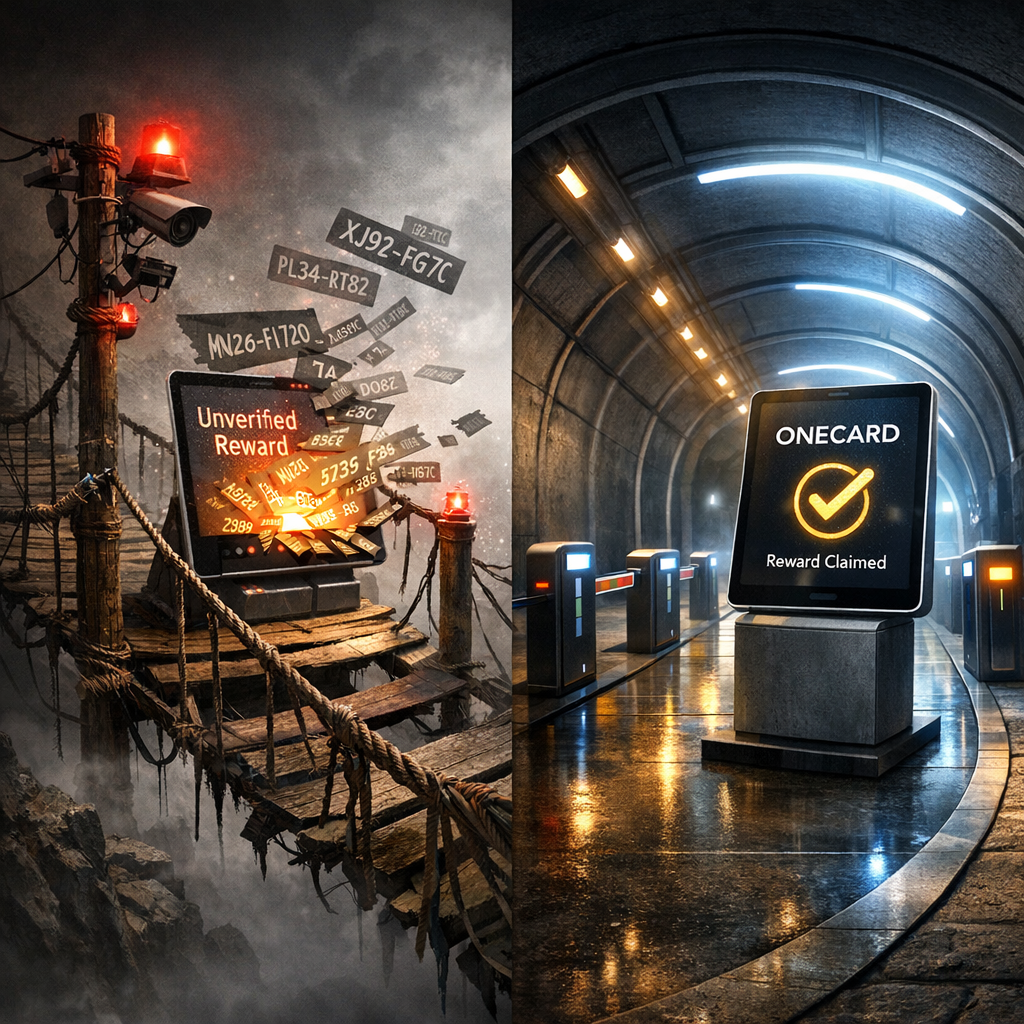
Social giveaway rewards balance speed against security. Extra fields or clicks risk abandonment; lax controls invite duplicate claims and support tickets.
Promotions teams must place checks where consumers barely notice, while operations still get proof of issue and first use. ONECARD enables governed reward journeys without flashiness.
Context
Market signals show an awkward tension. Social campaigns rely on speed, but this can weaken identity checks and reporting. BanklessTimes notes Candy Digital uses seasonal rewards to boost engagement, highlighting reward-led reactivation in uneven categories. For UK promotions, claim integrity quickly becomes commercially relevant.
Teams often prioritise seamless experience, yet a journey with no controls proves less seamless in practice. Reissues rise, support tickets accumulate, and reporting fragments when issuance, delivery, and redemption sit across different tools. A strategy that cannot survive operations is merely branding copy.
The stronger option is a governed route where rewards are easy to claim, while issue logic, token rules, and redemption evidence stay controlled from the start. This trade-off is less glamorous than growth promises but more useful when claim and redemption volumes mismatch.
What is changing
The shift moves from disconnected campaign mechanics to governed reward infrastructure. Older models separate social capture, data forms, fulfilment, and redemption evidence. Stronger models connect issue, delivery, and first-use visibility.
This matters because social giveaways increasingly start off-platform. Recent ONECARD client work focuses on off-page claim journeys with minimum data capture that still proves redemption. The aim is to collect necessary information at the right point, then link it to a governed entitlement. Unique issue tokens, timed activation windows, and first-redemption markers create traceability without turning claims into admin.
Operational tests compared two paths. Removing a validation step eased entry but obscured exception handling, losing confidence in separating genuine repeat visitors from duplicates. The revised path kept one quiet control point and preserved auditability.
No single rule suits every campaign. FMCG text-to-win, employee rewards, and social competitions each have different misuse risks and delay tolerance. Build controls where they yield measurable operational gain, then remove decorative friction.
Where simplicity helps and where it fails
Strong reward journeys feel simple because complexity moves behind the curtain. Consumers see a clear claim link, branded confirmation, and valid redemption route. Operations sees entitlement logic, token governance, and status visibility.
Compare two approaches. Generic retailer vouchers with basic delivery and limited proof of use work for low-risk volume, but trade weaker reporting, unreliable exception handling, and redemption ambiguity. Branded rewards delivery in a governed flow like ONECARD links issue status and redemption state, trading more upfront set-up for cleaner reconciliation and less guesswork.
Teams often assume consumers hate any visible check, but this is overstated. Consumers tolerate one sensible control if the value exchange is clear and the path quick. They become irritated by repetitive, inconsistent, or opaque journeys. A single validation step with clear messaging can outperform a frictionless route that triggers broken links or delayed support.
The failure point is misplaced friction. Avoidable data at the start is costly, as is hiding all governance until failure. Focused controls tied to specific risks is the better operating choice.
Implications for fraud checks and reporting
Fraud prevention affects completion rate, support load, and partner reporting. Device checks, code validation, and timed activation can reduce misuse with different impacts on journey quality.
Code validation works best with prior claim mechanics like text-to-win, tying entitlement to a known event. Timed activation windows are effective against forwarded messages, narrowing misuse periods without user effort. Device-led controls help in higher-risk cases but have edge cases with browser switches or delayed completion. The practical question is which control gives enough protection with least impact on completion.
For reporting, if issuance and redemption proof sit in separate systems, teams reconstruct stories after the fact, slowing reviews and weakening partner accountability. A governed model offers a cleaner line from issue to redemption status, making secure voucher redemption a measurable operating state for reissue decisions and optimisation.
When retailer rules or fulfilment dependencies shift mid-campaign, re-ordering the sequence can regain momentum. The value of a governed platform is that control points are visible enough to adapt without losing the audit trail.
Actions to consider
Designing a social giveaway reward journey offers clear options: raw simplicity with softer controls, locked-down approaches risking completion, or a middle path keeping claims short, governing entitlement centrally, and capturing only fields needed to prove first use or investigate exceptions.
Start by mapping risk moments, where duplication is likely, links could be shared, and support needs evidence. Choose one or two checks that answer those risks directly, such as unique issue tokens, branded confirmation, and first-redemption visibility. Park growth claims until data catches up.
Define reporting outcome before launch. Campaign owners should see issued, activated, and first-use status in a coherent sequence. ONECARD helps by connecting digital reward delivery with governed redemption control.
Keep one unresolved tension in view: more valuable or transferable rewards need firmer controls. Market conditions favour faster engagement, but operational resilience decides scaling. Review where checks sit, what proof you retain, and if your delivery path offers usable redemption traceability. To build a more governed reward journey without cumbersome redemption, contact ONECARD to assess the next move for your campaign.
If this is on your roadmap, ONECARD can help you run a controlled pilot, measure the outcome, and scale only when the evidence is clear.