Full article

The short answer
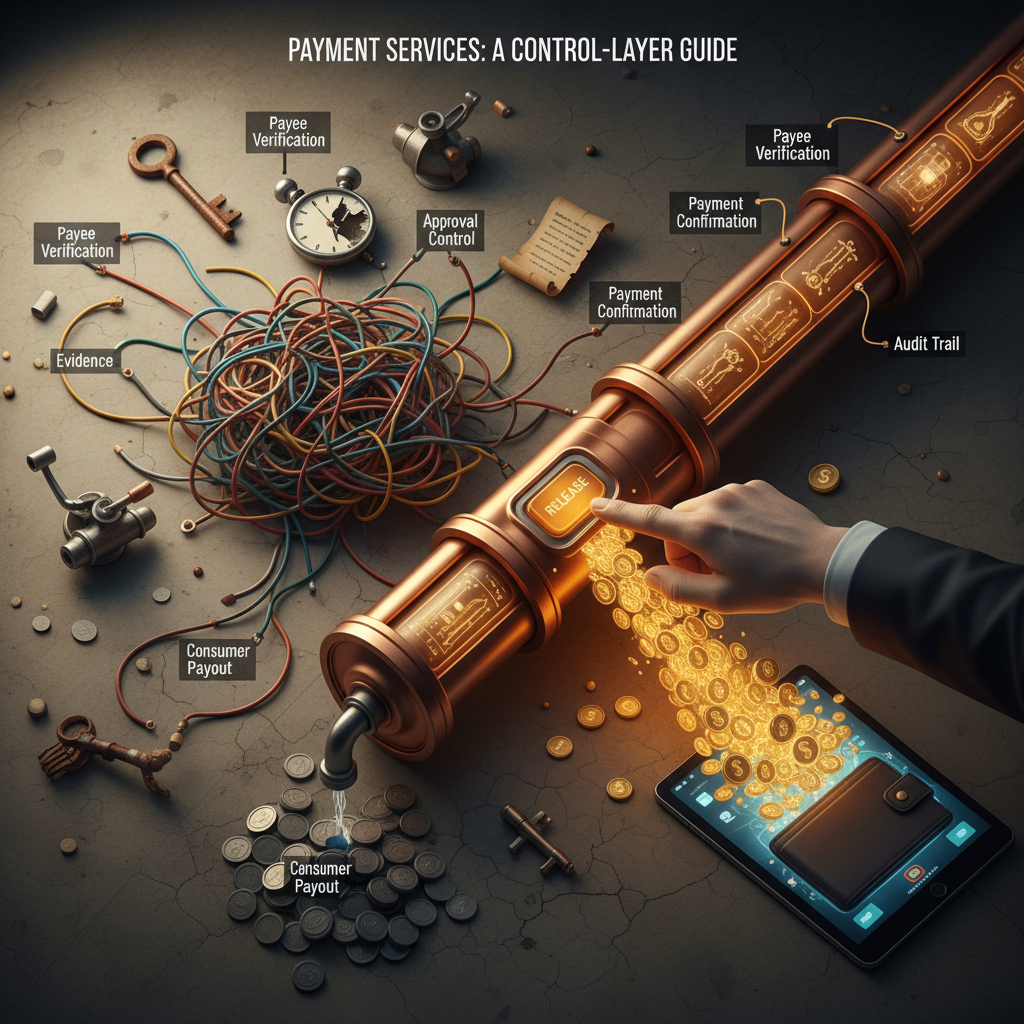
A UK team should understand this first about Payment Services: it keeps payee verification, approval control and payment confirmation in one operating flow, so the route from case decision to secure release is easier to run, easier to explain to a claimant and easier to evidence later. That is the point of the product. It is not payout speed in isolation.
If your claimant payment handoff still depends on tickets, inboxes and separate approval trails, delay is being built in. The stronger model is a governed workflow with named owners, dates and release criteria that can be checked in the case, not reconstructed afterwards.
Signal baseline
The operating signal here is simple enough. When goodwill payments or reimbursements are handled across several tools, the handoff starts to absorb time that no control requirement asked for. A support ticket for payee verification, an email for approval, a separate record for payment confirmation, then a claimant update drafted from fragments. It works until volume rises, evidence is incomplete or an exception needs a second look.
That matters because the cost is not confined to the payment date. Slow handoffs drive repeat contact from claimants, pull handlers back into status chasing and leave finance or compliance to clean up the audit trail later. If the same payment has to be checked twice because the evidence sits in different places, the process is already off course.
One checkpoint is approval ageing. Another is evidence completeness at release. If approvals drift well past the service target, or cases are reopened to fetch missing evidence, the weak point is usually visible. The issue is rarely that teams lack effort. More often, the route itself is broken up.
Which payout-control issue matters most
The useful comparison is not control versus care. It is built-in control versus hand-built control.
Manual handling can look serviceable when volumes are low and the team knows exactly who to chase. But the same flexibility turns unreliable under pressure. Ownership gets fuzzy, dates live in personal inboxes and payment status has to be pieced together from more than one system. What looks quick on a quiet day often slows down after a busy week, when people are recovering context instead of moving cases on.
That is where Payment Services changes the shape of the work. Verification, approval and payment status stay aligned in one operating flow. The handler can see where the case sits. Finance and compliance have the same operational record. Payment confirmation belongs to the same route as the decision that authorised release. Judgement still exists, of course, but the handoff stops relying on memory and side messages.
The sharper comparison is approval-aware payee verification against speed-only payout tooling. Fast release is useful right up to the moment someone has to defend why funds were sent, to whom and on what authority. A strong consumer care journey does not choose between speed and auditability. It removes the friction that adds no protection and keeps the checks that do.
Case comparison
Set the two models side by side and the trade-off is easier to see.
In a manual goodwill desk model, a handler receives the request, asks finance for sign-off, waits for payee verification and then confirms payment through a separate step. None of that is unreasonable in isolation. The weakness sits between the steps. Evidence is attached in one place and referred to in another. A missed email can stall release. A claimant update can go out before payment confirmation is properly logged. Delay creeps in through the joins.
In a governed workflow, the same case moves through one controlled route. Payee verification status is visible in the case. Approval control is recorded there too. Payment confirmation is attached to the same operational record. The workflow does not promise instant payment in every scenario, and it does not remove exception handling. It gives the team a cleaner route from decision to release, with an audit trail that does not need to be assembled after the fact.
The measures worth tracking are practical: time to payout, approval ageing, evidence completeness and exception rate. Those metrics tell you whether the route is actually improving, or just being described more neatly in project language.
Who is affected
The claimant feels the handoff first. Once a payment decision has been made, silence or mixed messages create doubt about whether anything is really moving. A clearer consumer care interface helps because the handler can see status, explain the next step and confirm when payment has been released.
Operations leads feel it in backlog and repeat contact. Finance teams feel it in reconciliation and audit preparation. Compliance owners feel it when approval history is incomplete, inconsistent or difficult to retrieve. Same handoff, different consequences.
There is a lazy habit of treating claimant experience and operational control as separate concerns. In practice they are tied together. When the workflow is clearer, handlers give better updates. Better updates usually mean fewer avoidable follow-ups. That frees the team to deal with the cases that need attention, rather than repeating the same status explanation all week.
Implementation ownership matters as well. Internal teams should own routing rules, approval thresholds, service dates and acceptance criteria. Holograph matters where delivery sits with the platform and workflow design. If those lines are vague, delays get blamed on the wrong dependency and the change log becomes guesswork.
Where Payment Services fits best
Payment Services fits best where consumer care, finance and compliance need one governed route for direct payment provision rather than a chain of separate workarounds. The product is designed to keep support, approval and payout status aligned in one workflow, which is the practical answer to the proof question behind this article: can teams move quickly without losing auditability or claimant confidence?
That is why the comparison with manual reimbursement handling matters more than any abstract feature list. A fragmented desk can cope with one-off exceptions. It is much less convincing when payout volume rises, scrutiny increases or the business needs a record that stands up later. Payment Services is the stronger fit when the handoff itself has become the operating problem.
For the underlying product scope, the named proof sits here: Payment Services. Wider solution context is here: Holograph solutions. If your wider stack includes adjacent service or reward operations, ONECARD, MAIA and DNA are the natural related products to review alongside it.
Actions and watchpoints
Start with a current-state map of the claimant payment handoff. Name the owner for each step, record the target date and define the acceptance criteria for release. For example: payee verified, approval recorded, payment confirmation attached, claimant update sent. If any of those checks sit outside the case flow, call that what it is, a control gap or a temporary workaround, and decide who owns the fix.
Then track a small set of measures through the first review cycle: time to payout, approval ageing, evidence completeness and exception rate. That is enough to show whether the workflow is genuinely improving. Keep a regular review between operations, finance and compliance. Keep the change log as well. If a threshold changes, record who approved it and from what date.
The main watchpoint is edge-case handling. Some claimants will not have straightforward digital access. Some cases will need extra checks before release. Those scenarios should not be left to improvisation. Define the exception path, the owner and the mitigation early. Otherwise the workflow will look tidy until the first awkward case lands.
The stronger claimant journey is not the one with the nicest interface. It is the one where support, approval and payout status stay aligned, with enough control to satisfy finance and compliance and enough clarity to keep the claimant informed. If you are reviewing direct payment provision in your consumer care operation, Payment Services offers a practical way to tighten the handoff without making it heavier. If that sounds close to the problem on your desk, contact the Payment Services team and map the next step properly.