Full article
Created by Marc Woodhead · Edited by Quill Admin · Reviewed by Marc Woodhead
How UK law firms can automate legal enquiry triage while maintaining compliance
Last Thursday, near Chancery Lane, I read an intake transcript. It was an ordinary employment matter: a nervous client, a handover that happened too early, and without the right checks. Five minutes later, the firm had a preventable compliance problem, with a fee earner reviewing notes that should never have reached them in that state.
This is a common pattern. Firms try to automate for speed first, then add compliance afterwards. It is the wrong order. Legal intake works better when a scripted decision path covering consent, eligibility, conflicts and escalation comes first, followed by the routing logic that makes the process faster. If a platform cannot explain its decisions, it does not deserve your budget.
What changed
The pressure is not from one dramatic rule change, but from the accumulation of expectations around client care and data handling. For UK legal intake teams, SRA standards, FCA Consumer Duty and UK GDPR all point in the same direction: firms need to show how first contact is handled, not just say they take it seriously.
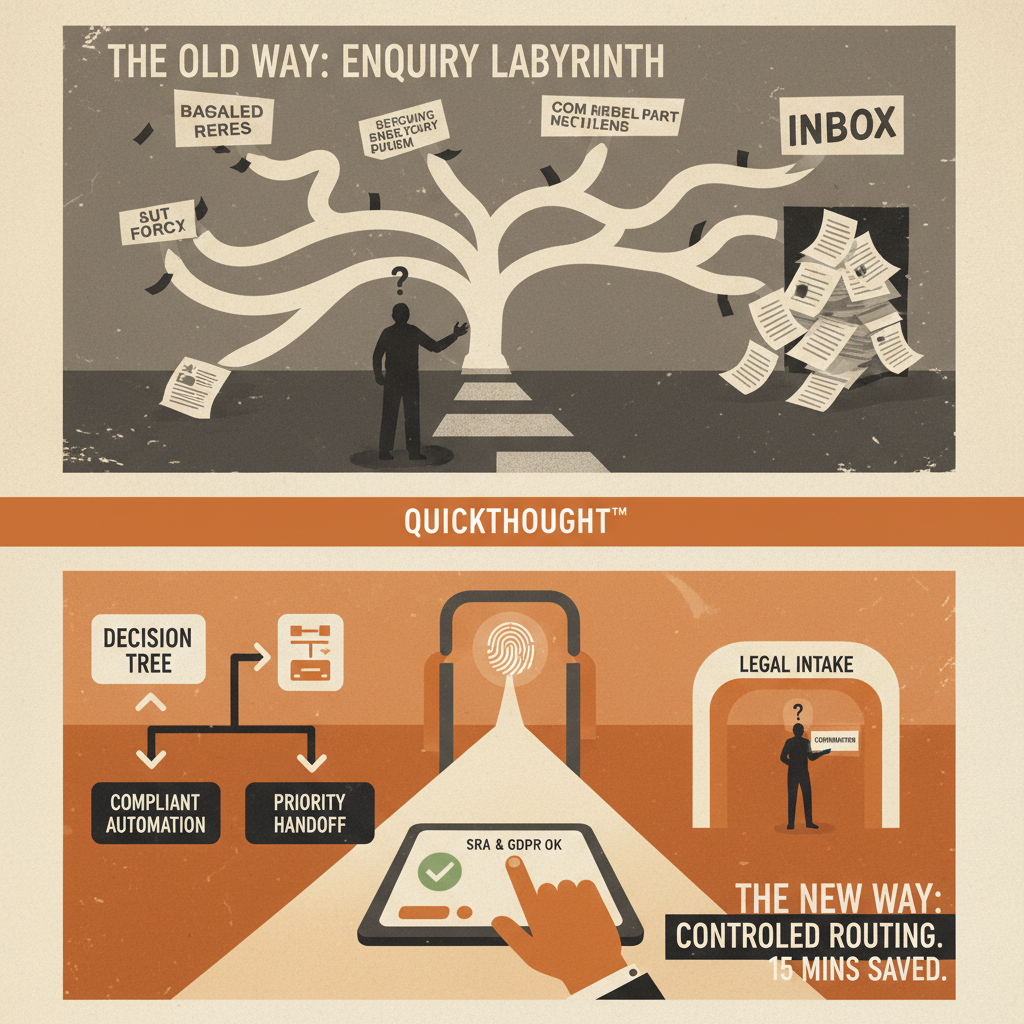
This has practical consequences. Free-text notes from hurried calls are difficult to audit. Unscripted web forms invite oversharing and miss conflict signals. By contrast, a decision-tree web chat asks the same core questions every time, captures consent correctly, and routes edge cases to a human. The trade-off is clear: you lose some conversational flexibility, but gain consistency, evidence and far less rework.
We saw this in a pilot between December 2025 and March 2026. One firm introduced a scripted intake flow and reduced unqualified enquiries by 40%, cutting average initial call time by 15 minutes per matter. The first version still failed in one important way: it did not surface a conflict check early enough for a property enquiry, forcing a manual correction. This was not a reason to abandon automation. It proved that compliant intake lives or dies on the design of its checkpoints.
There is a wider human signal. The Office for National Statistics’ quarterly well-being estimates are not a legal operations manual. Still, when background anxiety is elevated, slow, opaque intake processes land worse. People do not enjoy repeating sensitive details because the first capture was overcomplicated. Pretending that is a good client experience strategy is a mistake.
Why it matters
Legal enquiry triage is not an admin task. It is where firms collect facts, spot vulnerability, and create a defensible record. Get it wrong and the damage is wasted fee earner time, weak consent evidence, and longer matter opening times. One operations director showed me a routing log that caught a duplicate enquiry before it reached a lawyer, saving roughly three hours of review time because the system asked consistent questions. Automation without measurable uplift is theatre, not strategy.
The compliance case is just as strong. A documented path helps evidence SRA expectations and FCA Consumer Duty. It also supports UK GDPR by clarifying what is collected and why. None of this is helped by a vague website form that invites a claimant to paste half their life story into a single text box.
Some firms cling to manual intake, assuming a human call is safer because it feels nuanced. In reality, unscripted calls produce variation. Warnings are missed and eligibility questions are phrased differently. Notes become interpretation, not evidence. Manual review still matters for edge cases, but it should sit above a reliable intake layer, not replace it.
There is a clear trade-off. A rigid script can frustrate users if it asks too much too soon. A loose script creates compliance gaps. The sweet spot is a guided intake form handling high-frequency scenarios, then offering a human handover for fact-heavy, urgent or sensitive issues.
What to do now
Start with your live enquiry types, not with software features. Pull three months of intake data and sort matters by volume, qualification rate and rework. In most firms, a small number of categories create most of the noise: employment, property, personal injury, and consumer claims. Build scripts for those first. Designing for your messiest niche case on day one creates a journey nobody enjoys.
For each pathway, define four things before building. First, the minimum facts needed to decide if the matter is in scope. Second, the compliance checks that must happen before a fee earner sees it, like conflict triggers or jurisdiction filters. Third, the consent and privacy wording for UK GDPR. Fourth, the handover rule for cases that need a person. This is less glamorous than discussing innovation, but it works.
A practical pattern for compliant intake automation looks like this:
- identify the matter type in the first one or two steps;
- ask only the information needed for triage, not full legal advice intake;
- capture privacy and contact permissions in plain English;
- screen for conflicts or connected-party issues before detailed narrative capture;
- route urgent, vulnerable or unusual cases to a trained human reviewer;
- store a transcript and decision log that an auditor can follow without guesswork.
One pilot improved conversion by 25% by replacing a long contact form with a shorter guided form that had clear eligibility checkpoints. Another reduced abandonment by 30% when the team cut duplicate questions. Shorter scripts convert better, but only if they still collect enough structured information for safe routing.
Language matters. Call it a decision-tree web chat or a guided intake form, but it must be scripted, reviewable and predictable. QuickThought is useful here because its paths are AI-free and decision-led. In regulated environments, a system that stays inside the rails is a strength, not a limitation.
Watchpoints
Watch for three failure modes. The first is collecting too much too early. Asking for pages of narrative before confirming the matter type increases privacy risk and user drop-off. The second is burying key disclosures in a footer or leaving them for a callback. The third is treating the script as finished once it launches. It will not be.
Review the pathways quarterly against live enquiry outcomes. Track average response time, qualification rate, abandonment rate, conflict flags and the proportion of matters escalated to human review. If you cannot see these numbers by pathway, you are operating on instinct. Instinct is useful for partners; it is less useful for audit trails.
Keep an eye on vulnerability handling. The ONS well-being data is useful context, reminding us that distress and anxiety are not edge conditions. Intake teams will meet people who are confused, upset or under pressure. Your scripted paths should recognise signals of urgency or reduced understanding and offer a safer handover. This is not sentimentality; it is competent operations.
One last judgement: firms often spend too long debating whether automation feels personal enough, while clients wait days for a response. A clear, compliant and prompt first interaction is more respectful than an over-promised “personal” process held together by memory and call notes.
If your intake journey still relies on free-text forms, unscripted calls and crossed fingers, it is time to tighten it up. QuickThought can help your operations team review pathways, test compliance checkpoints and design a cleaner handover model. If you want a practical look at where your current process creates risk, book a QuickThought compliance workshop and we will go through the evidence with you.