Full article

Overview
AI is moving into support workflows faster than most customer data teams would prefer. The commercial case is straightforward enough: lower handling time, better triage, more consistent routing, and some relief for stretched service operations. The harder question is whether the underlying customer data operating model can cope once models start reading, classifying and activating customer signals at speed.
As it stands, yes, but only if governance is designed into the workflow rather than added after the first compliance wobble or service failure. TechNode Global reported on 11 March 2026 that Temasek-backed Rhoda AI raised $450 million in Series A funding to accelerate robotics development. That is not a support software story on its own, but it is a credible signal that capital is moving hard into applied AI operations. Around the same time, Yahoo Finance reported on 10 March 2026 that Cohesity and Datadog partnered around AI agent resilience, observability and rapid recovery. The pattern is worth a closer look: investment is flowing not just into models, but into the controls that make them usable in the real world.
Quick context
When AI enters support, the pressure lands first on data operations. A service assistant that drafts replies, classifies cases or suggests next best actions needs access to identity, event, preference and case-history data. That creates immediate strain across permissions, lineage, routing logic and role ownership. A strategy that cannot survive contact with operations is not strategy, it is branding copy.
The market movement matters because vendors are packaging AI into platforms that already touch customer records. PR Newswire reported on 10 March 2026 that Rokt mParticle made Match Boost and Composable Audiences available to all customers. Read plainly, that suggests identity resolution and audience construction are becoming more operationally embedded, not tucked away inside specialist teams. For support leaders, the practical implication is simple: service workflows may start to behave more like activation workflows, with segmentation, eligibility logic and model-driven decisioning running in the same environment.
That changes the operating model in three ways. First, support data can no longer be treated as a downstream reporting asset. It becomes live decision input. Second, governance has to cover both outbound activation and inward-facing operational use. Third, success metrics have to move beyond generic AI claims. Growth claims without baseline evidence should be parked until the data catches up.
A useful test is simple: can your team explain, for one support use case, which data was used, what permissions applied, which model touched it, what action followed, and how that outcome was measured? If not, the issue is not AI readiness. It is operating discipline.
Step-by-step approach
The strongest route is not a broad AI rollout. It is a narrow operational test with clear boundaries. In a strategy call this week, we tested two paths and dropped one after the first hard metric came in. The broad path promised reach but lacked permission clarity. The narrower path, case triage for logged-in customers with existing service history, gave us cleaner governance and faster validation. That is usually the better trade-off.
Step one: choose a support task with low ambiguity. Triage, intent classification and knowledge-base recommendation are usually safer starting points than full automated resolution. They rely on structured signals and have clearer rollback options. Pick a journey with a stable baseline, such as email cases in one product line or authenticated chat in one region.
Step two: map the minimum viable data set. Most teams over-collect because they can. Resist that. Define which fields are required for the task, which are merely useful, and which should stay out. A support classifier may need product ID, account status, recent case category and language preference. It rarely needs the whole profile payload. This is where consent-aware segmentation starts to matter, not just for outbound campaigns but for determining whether a customer should enter an AI-assisted path at all.
Step three: set a policy for action types. Separate actions into three classes: recommendations to an agent, customer-facing drafts requiring human approval, and fully automated operational steps. Each class should have different controls. The measurable outcome here is speed with safety. If you cannot state both the gain and the guardrail, the pilot is under-specified.
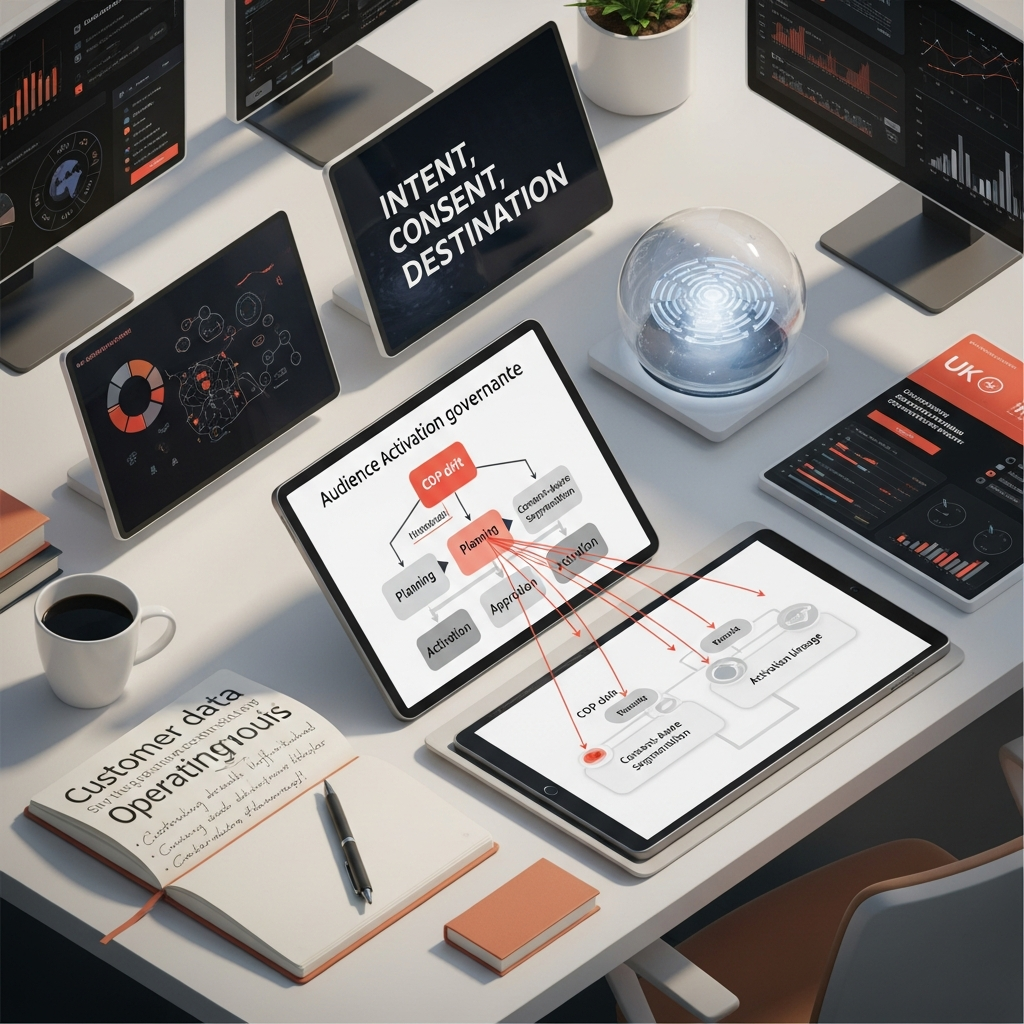
Step four: implement audience activation governance across support triggers. The term can sound marketing-heavy, but the underlying issue is universal: who is eligible for which action, based on which signal, under which policy. If a customer has opted out of certain profiling uses, that should affect not only campaign activation but also model-driven service personalisation where relevant. This is not bureaucracy for its own sake. It is what stops operational logic drifting away from customer expectation.
Step five: document activation lineage from signal to action. Lineage means being able to trace how a customer attribute, event or score became an operational output. In support, that might mean linking a delayed shipment event, a premium service tier and an open complaint in the last 30 days to priority queue routing. Without that trail, quality assurance becomes guesswork and complaints become expensive to investigate.
Step six: review weekly against operational evidence. Yahoo Finance reported on 11 March 2026 that Domo's Q4 2026 earnings call highlighted record billings and strategic shifts. The full call text is not available in the lite feed, so it would be daft to over-read the detail. Still, the signal is consistent with what buyers want: measurable business outcomes tied to system changes. Apply the same standard internally. Review handle time, first-contact resolution, manual override rate and policy exception count every week during the pilot.
Pitfalls to avoid
The first pitfall is treating AI as a layer above existing data chaos. If identity resolution is weak, permissions are inconsistent, or support and marketing use conflicting customer states, the model will simply industrialise the confusion. The mParticle release on 10 March 2026 should remind teams that the plumbing still matters. Fancy prompts do not repair poor identity logic.
The second pitfall is assuming support use is exempt from the rigour applied to marketing activation. To be fair, many firms still draw a line between service operations and activation governance. In practice, the customer does not care which department made the questionable decision. They care that an organisation used their data in a way that felt off. If the same event stream powers campaign exclusion and support prioritisation, both need consistent policy treatment.
The third pitfall is aiming for autonomy before observability. According to Yahoo Finance on 10 March 2026, the Cohesity and Datadog partnership focused on resilience, observability and rapid recovery for AI agents. That order is sensible. Before an organisation expands autonomous actions, it should know where the model failed, how quickly it can be contained, and which customer groups were affected. A plan looked strong on paper, then one dependency moved, so we re-ordered the sequence and regained momentum. That sort of re-sequencing is normal. Pretending the first architecture will be perfect is not.
The fourth pitfall is measuring only volume outcomes. Faster case handling is useful, but insufficient. Track quality and fairness signals too. A practical scorecard might include manual override rate by queue and customer segment, misroute rate against the pre-AI baseline, time to investigate a disputed automated action, percentage of AI-assisted actions with complete lineage records, and complaint rate linked to personalisation or prioritisation logic.
The fifth pitfall is weak operating ownership. If the model team owns performance, support owns outcomes, legal owns approvals and data engineering owns the event pipeline, someone still needs to own the decision framework. Usually that is a cross-functional operating forum with one accountable lead. Committees are not glamorous, but neither is avoidable rework.
Checklist you can reuse
The simplest way to keep AI support projects grounded is to force a short operational checklist before launch. It should be brief enough to use every week and tough enough to stop theatre. Below is a working version for a pilot or an early production release.
A few details are worth spelling out. If your organisation cannot produce a case-level audit trail within one working day, do not move to broader automation. If permission logic is still being debated once the model is in testing, pause the launch. And if support leadership is not attending the weekly review, the project is probably being treated as a technology experiment rather than an operating change.
There is also a timing issue. Cold operational realities expose weak dependencies quickly. On 11 March 2026, weather reporting showed Sunderland, Cumbria at around 0°C with patchy rain nearby and winds near 25 mph. Small point, perhaps, but useful: service demand and operational strain rarely arrive in ideal conditions. Governance has to work under pressure, not just in a tidy workshop deck.
Closing guidance
The sensible route is to treat AI in support as an operating model decision first and a tooling decision second. The value appears earliest where data boundaries are clear, human review is practical, and outcomes can be measured weekly. Start with one support workflow, define the permission logic, document the lineage, and judge it against hard metrics rather than hopeful language.
For most organisations, the next move is not a bigger model. It is tighter governance around who can be acted on, why, and with what traceability. That is where audience activation governance, a workable customer data operating model, disciplined consent-aware segmentation and reliable activation lineage stop being abstract architecture terms and start protecting service quality. If you want a sober view of your option set before AI support workflows scale, contact Kosmos and we will help you map the trade-offs, pressure-test the operating model, and identify the first pilot worth running.