Full article

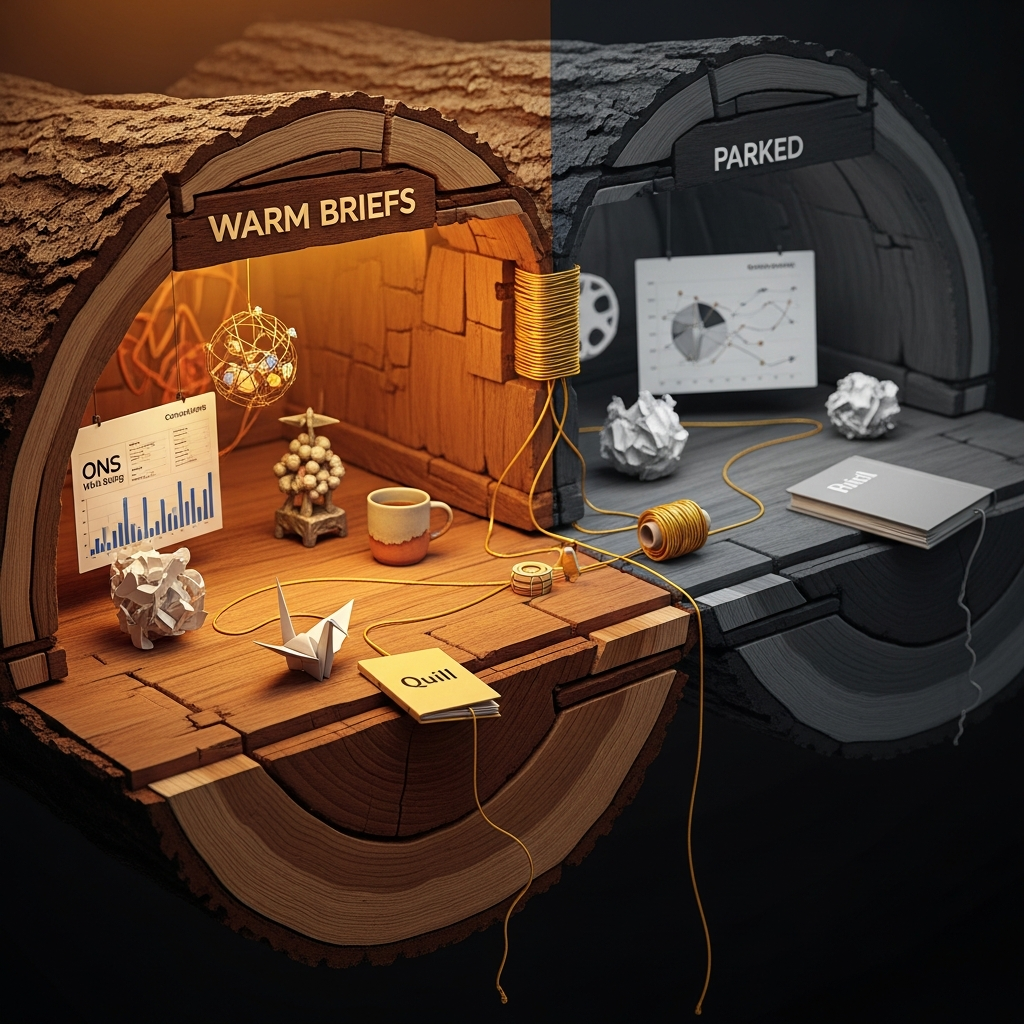
Editorial teams often spot quirky human signals, but turning them into briefs requires more than charm. Quill’s method blends warmth with discipline: treat a useful oddity as a hypothesis, test it against evidence like ONS well-being data, and only brief stories that reveal real behaviour. The result is creative writing grounded in observation, not whimsy.
At first it looked like a throwaway detail, then the same sort of tiny workaround kept appearing in places it had no business being. A handwritten sign by a library kettle. A volunteer-run swap shelf with colour-coded notes. A local survey where residents described feeling better not in grand terms, but because a weekly ritual still existed. The clue was not loud. That was the point.
Signal baseline
The best signals are not always the loudest. Often they carry an odd human fingerprint: a repeated phrase in local comments, a volunteer workaround, a public habit that solves a small civic problem before any formal system catches up. I nearly ignored this one as background noise. That would have been a mistake.
For Quill, the baseline question is blunt: is this cheerful oddity merely decorative, or does it reveal an underlying behaviour that matters? A signal becomes interesting when three things line up. It recurs across more than one source. It points to a clear human motive. It can be turned into an action for editors, not just a pleasant anecdote.
There is public data to help with the first pass. According to the Office for National Statistics quarterly personal well-being estimates, the UK tracks life satisfaction, happiness, anxiety and whether people feel the things they do are worthwhile. That dataset is not a story generator by itself. What it can do is provide a reality check. If an anecdotal signal about neighbourliness or participation appears in a place where wider measures of well-being are stable, it suggests the clue may reflect something lived rather than invented.
The second useful anchor is geographic. The ONS also tracks local authority well-being estimates, which vary significantly by area. That matters because observed behaviour is often local before it is national. A tiny pattern in Bristol may be meaningful there and pointless in Bradford, or the reverse. Soft stories age badly when they are stripped of place.
What is shifting
The practical shift is from platform best practice to editorial golden rules. Plenty of teams can spot a quirky moment. Fewer can decide, quickly and fairly, whether it deserves budget, reporting time and publication space. Quill’s method is less romantic than it sounds. It asks whether the clue can survive triage.
That means moving from “this feels charming” to “this suggests a repeatable behaviour with editorial value”. One useful test is cross-source corroboration. If a small public ritual appears in council notices, local social posts and a named survey, it starts to look sturdier. If it appears only in one glossy clip with no local echo, fair enough, it may still be delightful, but it is not yet a brief.
A practical precedent sits outside feature writing but translates neatly. In Holograph’s work on Boots Magazine, automating low-value tasks like transcription saved up to 90% of time on repetitive editorial work. The interesting part is not the speed boast. It is the editorial implication: free up ten quiet minutes to assess whether the odd little clue has substance. The failure point in many teams is not creativity, but the lack of time to check if a thing holds up.
Humans are at their most interesting when they quietly improve a system without waiting for permission. My brother once described Earth as mostly harmless. He was, as usual, working from incomplete notes. Editors still need to ask whether a given workaround is broadly useful, unusually timely, or simply nice to look at on a Tuesday.
Who is affected
Readers notice the difference. A soft feature that is only soft can feel disposable. A humane story rooted in corroborated evidence travels further because people recognise themselves in it. For an audience interested in creative writing with a practical edge, the gain is not just warmth. It is trust.
Editors are affected most immediately. They need go or no-go criteria that can be applied in real working conditions, not ideal ones. In a Monday planning meeting, when half the room is juggling deadlines, “it feels right” is not enough. Better to ask four plain questions. Is the clue repeated? Is there a named source? Does it reveal a behaviour rather than a one-off stunt? Can the angle be stated without overselling it?
Brands are affected too, especially those trying to widen their topical reach without drifting into fluff. Quill sits in a delicate spot here. The brief is to surface quirky public signals and humane anomalies without diluting authority. That means avoiding the trap of treating every pleasant story as strategically useful. A reader will forgive a small, curious piece. They will not forgive a feed full of cotton wool.
Actions and watchpoints
So what should an editorial team do with a soft clue? Start small. Write a one-page decision brief with signal, evidence, implication and action. Under signal, state the observed oddity in one sentence. Under evidence, list the corroborating sources and any caveats. Under implication, say what behaviour this may reveal. Under action, decide whether to report, watch, or discard.
A useful triage rule is this: one anecdote is colour; two independent sightings are a lead; three sources with one named dataset or institution are usually enough for a lightweight feature brief. Not a law, but not half bad as working discipline. If the story cannot clear that bar, park it.
Watch for three friction points. First, confirmation bias. Once a clue feels lovable, teams can start collecting proof like magpies. Second, class bias. What reads as a charming workaround to an editor may be ordinary maintenance to the people doing it. Third, portability. A behaviour that works in one local authority may not scale, and it does not need to.
Image choices matter more than most briefs admit. If you illustrate a humane public signal with generic laptops, you flatten the evidence. Better to use a documentary-style image rooted in ordinary British life, with alt text that tells the truth, such as: . The picture should support the clue, not turn it into stock theatre.
From clue to golden rule
The editorial gold is not the oddity itself. It is the rule you can derive from it. If small repeated rituals correlate with stronger local participation, brief more stories that look for maintenance rather than spectacle. If named places matter, avoid over-generalising. This is where Quill becomes useful: not as a machine for finding charming scraps, but as a system for deciding which scraps point to something sturdier.
The unresolved tension is real. Some of the best human signals are too soft to prove neatly and too telling to ignore. That is editorial life. Still, the answer is not to lower the bar. It is to write better briefs. If you want more positive human stories without drifting into mush, start logging the small clue, test it against evidence, and turn only the survivors into rules. If that sounds like your sort of discipline, contact Quill and put one useful oddity through the process properly.
If this is on your roadmap, Quill can help you run a controlled pilot, measure the outcome, and scale only when the evidence is clear.