Full article

Created by Brenden O'Sullivan · Edited by Marc Woodhead · Reviewed by Marc Woodhead
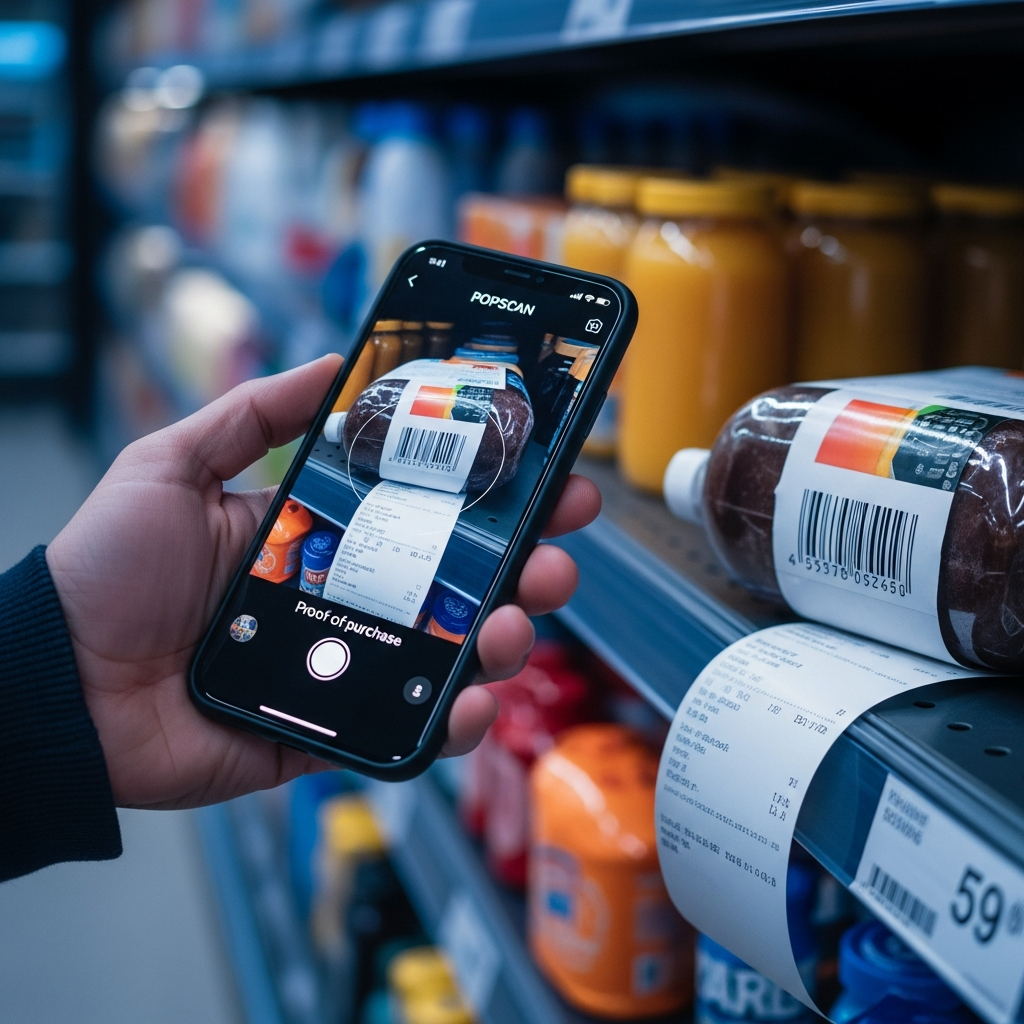
Which proof artefact clears an FMCG instant-win claim first: the receipt, the barcode, or both together? The fastest route is often not the simplest. A barcode captures quickly but alone says little. A receipt proves purchase, but format variation and image quality add friction. In practice, the fastest clearance comes from asking for more evidence upfront to cut manual checks later.
Operations dictates the effective strategy. For promotions teams, the decision centres on which evidence stack minimises disputes, ensures clean audits, and reduces rework. Proof of purchase verification works best as a workflow decision, not a creative mechanic.
Decision context
Instant wins compress the decision window. Claims arrive when consumer attention is high and operations has little pause. The evidence question shifts: it is about trusting the artefact quickly enough to maintain a smooth experience.
Market demands lower friction to sustain participation, yet cheap tools make weak evidence easier to produce. Barcode-led claiming appeals for customer cleanliness, but evidence favours a combined route to avoid shifting work downstream.
Retail estates are messy. Receipt formats vary by retailer, store, till system and promotional wording. Fast-growing estates increase variance. A claim flow assuming uniform receipts will test well but stumble live.
Promotion participation quality matters as much as volume. High entry counts lose value if shares need review, lack timestamps, or mismatch SKUs. According to the Office for National Statistics, personal well-being measures track both happiness and anxiety, acknowledging complexity. Promotions operations must similarly balance speed and confidence.
Options and trade-offs
The practical option set is usually threefold: barcode only, receipt only, or combined receipt-plus-barcode evidence. Each can work, but each fails in a different way.
| Option | What it proves quickly | Main constraint | Operational effect |
|---|---|---|---|
| Barcode only | Product identity | Weak proof of transaction and timing | Fast entry, higher need for secondary checks |
| Receipt only | Transaction event, retailer, date and time | Format variance, image quality, line-item ambiguity | Stronger initial proof, moderate review burden |
| Barcode plus receipt | Product identity linked to transaction context | Slightly more consumer effort at entry | Lower dispute rates, cleaner automated decisions |
Barcode and receipt controls become useful precisely because the artefacts complement one another. A barcode confirms what the product purports to be. A receipt confirms where and when the transaction happened, and whether the purchase fits the campaign window. Put together, they answer different parts of the eligibility question. Separately, they leave awkward gaps.
Barcode-only flows feel attractive in creative meetings because the action is obvious: scan the pack, get the result. Yet they invite two friction points. First, one barcode may relate to many identical units, so uniqueness is weak without transaction evidence. Second, shared packs or in-store photography can mimic a claim without a purchase.
Receipt-only flows solve more but create operational nuisance. Crumpled receipts, partial line items, and retailer shorthand complicate auto-clearance. Receipt-only routes often generate edge cases where image presence does not guarantee confident resolution, incurring review costs.
The critical distinction is what ‘cleared’ really means. If it means the fastest upload, barcode-only wins. If it means the fastest confident decision with least manual intervention, the combined route outperforms. A three-second scan that triggers a two-minute exception queue is not fast; it merely postpones delay. By contrast, a claim that captures receipt date, retailer, and qualifying line evidence may take seconds longer at entry but passes through the decision layer with less argument.
Fair-feeling promotions depend on auditable claim mechanics. The consumer should understand the route from entry to outcome without hidden steps. If there is a winner contact process, state the channel and timeframe clearly. If there are anti-scam guardrails, publish them. That protects trust and reduces customer support demand.
Well-designed participation mechanics can improve both uptake and control when the route is clear and credible.
Risk and mitigation
The main risk in instant wins is operational drag caused by ambiguous evidence. Ambiguity arrives in pairs: a valid purchase with poor image capture, or a neat image with weak purchase context. Both create queues, slow customer handling, and leave promotions managers balancing fairness and goodwill.
This is where campaign integrity design should be treated as an early commercial decision, not a legal footnote. The control set needs to be proportionate and traceable. At minimum, the workflow should retain the barcode read, receipt image, submission timestamp, retailer signal where available, and the decision trail showing why a claim was approved, held or rejected.
Flexibility is key when retailer conditions or promotion terms shift near launch. Mitigation lies in a rule set that can flex without becoming opaque. For example, if receipt OCR confidence drops for one retailer format, the workflow can require a clearer image or a second artefact rather than pushing cohorts into manual review.
Useful mitigations usually sit in four practical buckets:
- Require the minimum evidence set that links product identity to transaction context.
- Define exact match rules for qualifying SKUs, date windows and retailer exclusions.
- Retain an auditable decision log so disputed claims can be resolved without re-reading the entire case.
- Re-check platform and promotion policy before launch, especially where social capture or user-generated submissions are involved.
According to the Office for National Statistics, datasets are often reported at multiple levels because aggregate views can hide meaningful variance. Proof-of-purchase controls have a similar constraint. An average approval rate can conceal retailer-specific failure points. Without segmenting evidence, optimisation may target the wrong part of the funnel.
Recommended path
For most FMCG instant wins, the recommended path is a combined artefact workflow: scan or capture the product marker, capture the receipt, and let the rules decide quickly whether the claim looks genuine. That is not because every campaign needs the heaviest controls. It is because combined evidence usually gives the best balance between speed, confidence and recoverability when something goes wrong.
The comparison is plain. Barcode-only mechanics maximise convenience but leave transaction proof thin. Receipt-only mechanics improve purchase validation but suffer more from formatting variance and interpretive review. Combined evidence adds slight upfront friction and removes a larger amount of downstream friction.
The commercial implication is timing. If your campaign launches this quarter, value appears first in lower exception handling and faster dispute resolution. Over time, the same evidence model improves benchmarking across retailers, prize types and pack formats, making the next campaign easier to price and safer to scale. The unresolved tension is real: every extra field can shave participation at the margin. The job is to choose the version that costs less than it saves.
If you are reviewing an instant-win mechanic now, worth a closer look is the clearance path rather than the entry screen alone. Map which artefact answers product identity, which answers purchase timing, and which combinations create avoidable manual work. To see how Kosmos models these trade-offs and calibrates the right proof of purchase verification for your next campaign, explore the options in a practical workflow review with our team.
If this is on your roadmap, Holograph can help you run a controlled pilot, measure the outcome, and scale only when the evidence is clear.