Full article

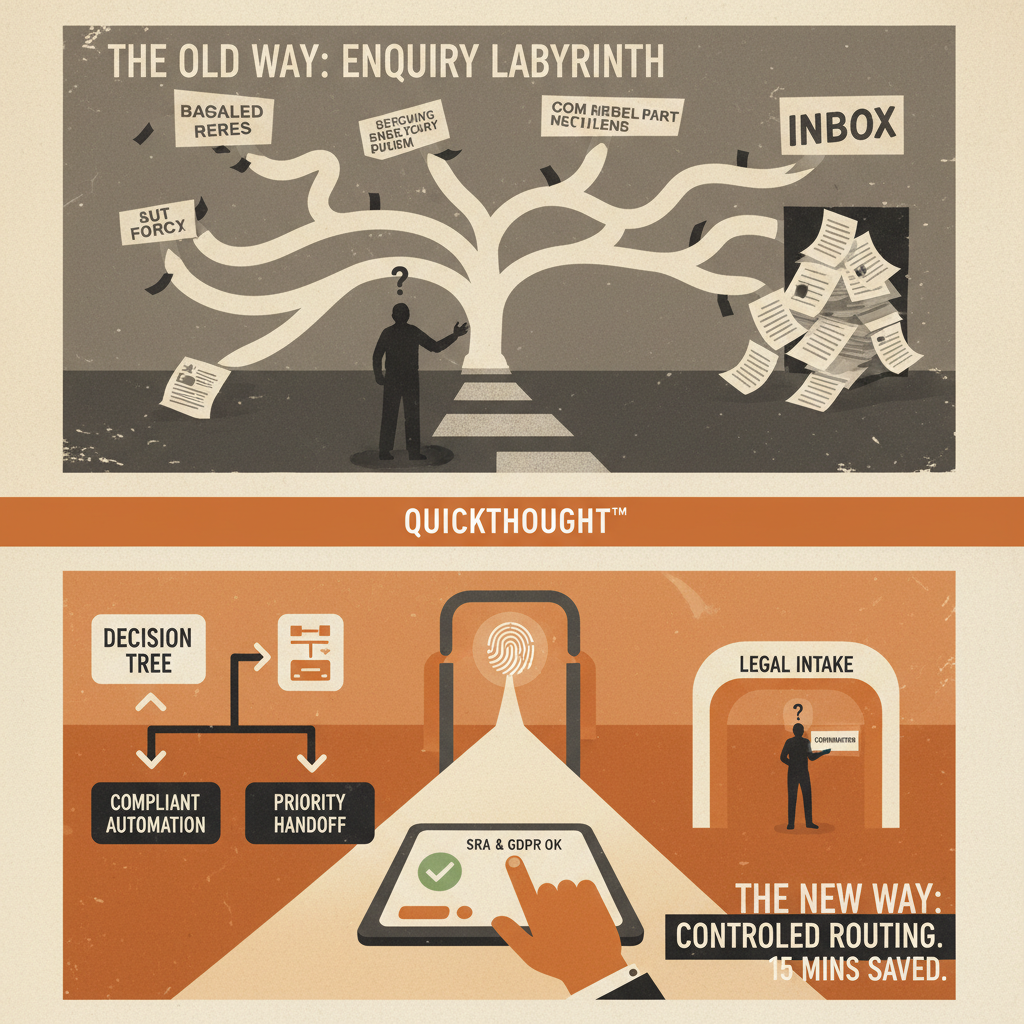
Where does legal intake qualification slow? Usually not where firms think. Queues break because privacy decisions misfire, sitting in the wrong place, triggering at the wrong moment, forcing staff to patch gaps by phone or email.
Choose: privacy as a blunt gate or integrated into routing logic. A front-loaded model simplifies approval but slows handoff, weakens audit trails and duplicates effort. QuickThought treats privacy as part of governed routing, not a pop-up ritual for compliance calm.
What is being decided
Privacy matters. The decision is where checks belong in the intake flow, and whether they help qualification or interrupt it.
Many firms place consent language at the start or end as an afterthought. Both create friction. Early placement asks for agreement before context; late placement leaves handoff with thin records. Neither works well.
Intake is operational, not decorative. A platform must explain its decisions to deserve budget. When routing, warning, pausing or passing an enquiry, teams should see which branch fired, which data point triggered it and which privacy step was presented. Otherwise, the system is theatre with a decent interface.
A comparative view of intake models
Set two models side by side.
Traditional intake uses a static form. Mandatory boxes sit near the top. Privacy wording is broad, written for blanket coverage not comprehension. Family, employment and claims enquiries hit the same gate before qualification begins. Result: slower completion, patchy context, follow-up calls to recover structured data.
Governed QuickThought models branch by enquiry type and routing need. Basic qualification happens first. Privacy prompts appear when the journey justifies them. This keeps users moving and leaves clearer records.
| Area | Static form model | QuickThought decision-tree model |
|---|---|---|
| Privacy wording | Presented as a generic gate | Shown in context, tied to the branch and purpose |
| Data capture | Often broad and front-loaded | Minimal first, then expanded only where justified |
| Routing quality | Depends on free text and manual interpretation | Driven by structured answers and branch logic |
| Audit evidence | Split across forms, inboxes and notes | Logged in one governed path with timestamps |
| Operational load | More chasing, rekeying and duplicate calls | Cleaner handoff with fewer avoidable interventions |
Static forms launch easier. Governed flows design harder. With volume, the simple option charges interest in staff time, queue delays and inconsistent evidence. Some teams cling to static versions, confusing familiar with safe. In intake design, those differ.
Where the intake queue actually slows
Queues stall on repeatable friction. A privacy checkbox that blocks progress before purpose is clear. A warning shown to every enquiry, urgent or routine. A handoff record with no consent event, so staff repeat explanations by phone.
Legal intake qualification drags when workflows treat compliance as separate from routing. Manual processes that trigger the same privacy warning for every enquiry, regardless of urgency, irritate users and create staff noise. The fix changes logic to show warnings only at genuine thresholds for sensitive capture. Small adjustment, useful result.
Privacy prompts tied to decision points clean handoff. Bolted on as universal gates thicken the queue. Feel it in three places: more incomplete submissions, more duplicated follow-up, more ambiguity about record scrutiny.
The operational impact of getting it right
Privacy placed properly inside logic yields practical gains. Handoff quality improves. Structured branch decisions create clearer next-step certainty for intake or legal teams. Instead of vague free-text notes, they receive a reasoned path: enquiry type, urgency signal, routing outcome and relevant privacy event attached.
Auditability improves because evidence sits with the decision. In regulated lead routing, reviewing why a path stopped, diverted or requested a callback should be visible without trawling three systems and a shared inbox. Compliance teams prefer this; operations teams save time. A rare organisational harmony.
Teams waste less effort recovering what the form should have handled. Static forms appear cheap but shift true cost into the queue with call-backs and manual reclassification. Automation without measurable uplift is theatre, not strategy.
Recommendation and next step
If this queue problem sounds familiar, start with a narrow review. Map the current journey from first enquiry to fee-earner handoff. Mark where privacy wording blocks progress or leaves records thin. Compare with a governed path built around minimal initial capture and contextual disclosures.
Pilot one high-volume practice area with uneven handoff quality. Use QuickThought to design decision-tree qualification, define fields needed for routing, and record which privacy prompt appears at each branch. Measure completion to handoff time, duplicate follow-up, and whether the receiving team gets enough structured context to act without rework. If numbers do not move, change the design. If they do, extend carefully.
To see this in a live intake flow, consider a conversation with QuickThought. Review where privacy settings slow handoff and design a governed route that calms users and aids the team. Compliance then stops being the queue's excuse and starts directing it properly.