Full article
When contact is lost abroad, the first question is often a practical one. Is there a will? Is there a Lasting Power of Attorney? Can anyone act now? Reports that contact with East Sussex’s Lindsay and Craig Foreman was cut off in Iran are the kind of signal that brings those enquiries forward. The useful response is not broad reassurance. It is a clear first route.
That route starts at intake. Get it right and the family reaches the right adviser with the right papers. Get it wrong and a wills appointment is asked to solve a consular, court or cross-border problem it cannot fix. The core distinction is simple: what can move inside a wills appointment now, and what needs outside process or specialist advice first?
The short answer
An East Sussex wills team can usually help with document checks, executor questions, Lasting Powers of Attorney, and preparation for later decisions if contact is restored or a death is formally confirmed. It cannot replace consular support, police processes, emergency court action or specialist cross-border advice.
That answer may feel blunt. It is still the answer that prevents a family losing time in the wrong meeting.
The pressure point is intake, not intent
Urgent enquiries rarely go wrong because the team lacks goodwill. They go wrong when the first call tries to carry every unknown at once. One relative wants to rewrite a will immediately. Another wants bank access sorted. Someone else thinks an old LPA covers everything. If the booking comes before the checks, the appointment becomes an argument about authority instead of a useful piece of legal work.
This is where EVE is a helpful comparison. It does not treat every record the same. It grades pass, challenge, hold, review or stop outcomes in real time and keeps the reasoning visible to the team. That matters because the real comparison is not automation versus care. It is governed judgement with thresholds and exception handling versus silent drift, avoidable manual handling or a flat yes to something that is not in scope.
The same logic holds at legal intake. Some urgent enquiries can move straight to appointment. Others need a hold for documents, a review on standing, or a referral before anyone starts discussing wills.
What a sensible intake method looks like
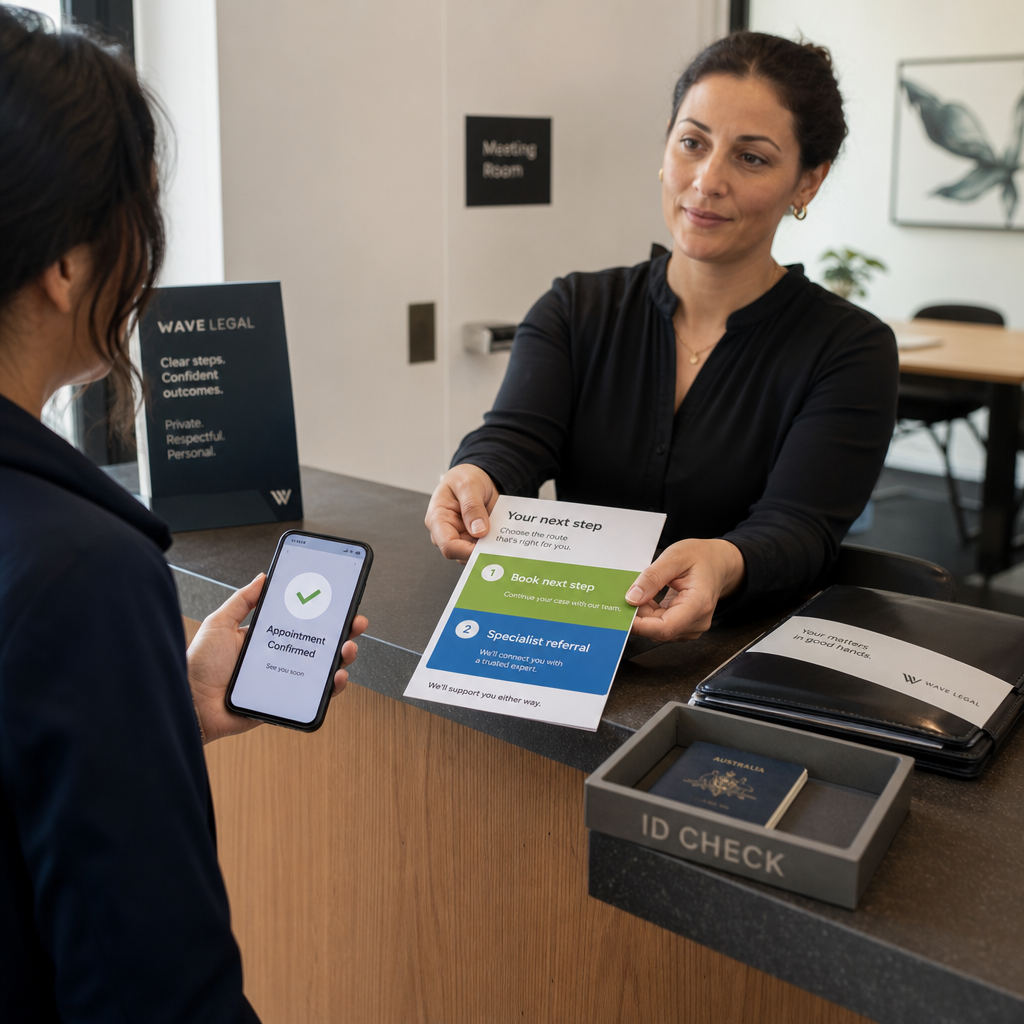
A workable method follows the family’s path rather than an internal script. In practice, five stages are enough: first contact, conflict and identity checks, document gathering, legal triage, and appointment booking or referral.
At first contact, the task is not to solve the whole matter. It is to pin down what is known, what is missing and what can be said safely that day. Usually that means asking:
- who the caller is and their relationship to the missing or affected person
- whether the person lives in East Sussex or holds assets here
- whether there is a known will, LPA, deputyship order or trust
- whether there are immediate welfare, banking or property concerns
- whether another process is already under way through the Foreign, Commonwealth & Development Office, police, hospital, coroner or court
Then comes the sorting decision. A local enquiry about updating a will after a crisis may go to a normal appointment. A matter involving loss of contact overseas, disputed authority, frozen accounts or uncertainty over death registration may need triage or referral first. That is not delay for its own sake. It is the difference between a wills conversation and a problem that belongs somewhere else.
| Intake point | Checkpoint | Operational aim |
|---|---|---|
| First contact | Relationship, location, urgency, existing documents | Establish what is known and what the firm can discuss safely |
| Conflict and identity checks | Names, addresses, parties involved, authority to instruct | Avoid acting where there is a conflict or no clear standing |
| Document gathering | Will, LPA, death certificate if available, property and account details | Reduce speculation and focus the appointment |
| Legal triage | Wills issue, capacity issue, missing person issue, probate issue, overseas issue | Separate firm work from consular, court or specialist advice |
| Booking or referral | Right adviser, timeframe, next document list | Keep the family moving without false reassurance |
Which judgement points matter most
The first is standing. Who is actually entitled to instruct, receive information or ask for changes? Families often speak collectively in a crisis. The legal right to act is usually narrower. A spouse, attorney, executor or next of kin may have a defined role that other relatives do not. Miss that point early and the appointment starts to slide into a dispute.
The second is scope. A wills appointment can deal with testamentary wishes, executor choice, guardianship provisions, property ownership and LPAs. It may also map likely probate steps. It should not be presented as a route to immediate overseas access, a missing person procedure or contested authority.
The third is evidence. Families often arrive with fragments: screenshots, partial account details, an unsigned draft will, or a belief that something was sorted years ago. Those fragments are useful, but they are not the same as verified documents. Keep that line clear and the file stays reliable.
The fourth is timing. Some matters justify a same-day or next-day will review. Others need staging: confirm authority, collect documents, then book drafting. Fast helps. Sequence helps more.
Where rework usually starts
It usually starts with a brief that sounds urgent and proves very little. “Family crisis abroad” explains the pressure. It does not yet identify the legal task.
That is where an operator-led checklist earns its place. EVE’s model is useful again here because it separates pass, challenge, hold, review and stop decisions rather than forcing every case down one route. The proof standard is familiar: protect outcomes without blocking good cases or turning routine judgement into unnecessary manual work. Intake needs the same discipline. Distressed callers do not all need the same answer.
Keep these checkpoints explicit:
- Confirm the caller’s relationship to the person concerned and whether they have authority to instruct.
- Ask whether there is an existing will, LPA, deputyship, marriage, divorce or property co-ownership issue that changes the advice.
- Separate immediate practical risks, such as an empty property, bill payments or account access, from longer-term estate planning.
- Check whether the matter involves a missing person, an unregistered death abroad, or assets in more than one country, because those points often require specialist advice.
- Record what documents have been seen and what has only been reported verbally.
- Set a clear next step: appointment, document chase, referral, or hold pending external confirmation.
The point is not script for script’s sake. It is a consistent route that keeps one hard call from becoming three avoidable ones.
A checklist worth keeping
If you need an intake checklist for East Sussex will appointments after a family crisis abroad, keep it close to the family’s real path and short enough that the team will still use it under pressure.
- Have we identified who is calling, their relationship to the person concerned, and whether they have standing to instruct?
- Have we separated what can move forward in a wills appointment now from what needs consular, court or specialist cross-border advice first?
- Do we know whether a will, LPA, deputyship order or trust already exists?
- Have we checked for property, business or bank issues that need facts gathering before advice?
- Are we clear whether the issue is a will update, probate query, missing person matter, capacity concern or document search?
- Have we logged what evidence is verified and what is still unconfirmed?
- Does the family leave the call with one clear next step and one named point of contact?
The practical judgement is usually the right one. Do not ask the first appointment to carry every unknown. Use intake to narrow the issue, route it properly and avoid false certainty. If you want to pressure-test that operating approach, book a same-day EVE risk walkthrough with Holograph. More on the wider solution sits here.