Full article
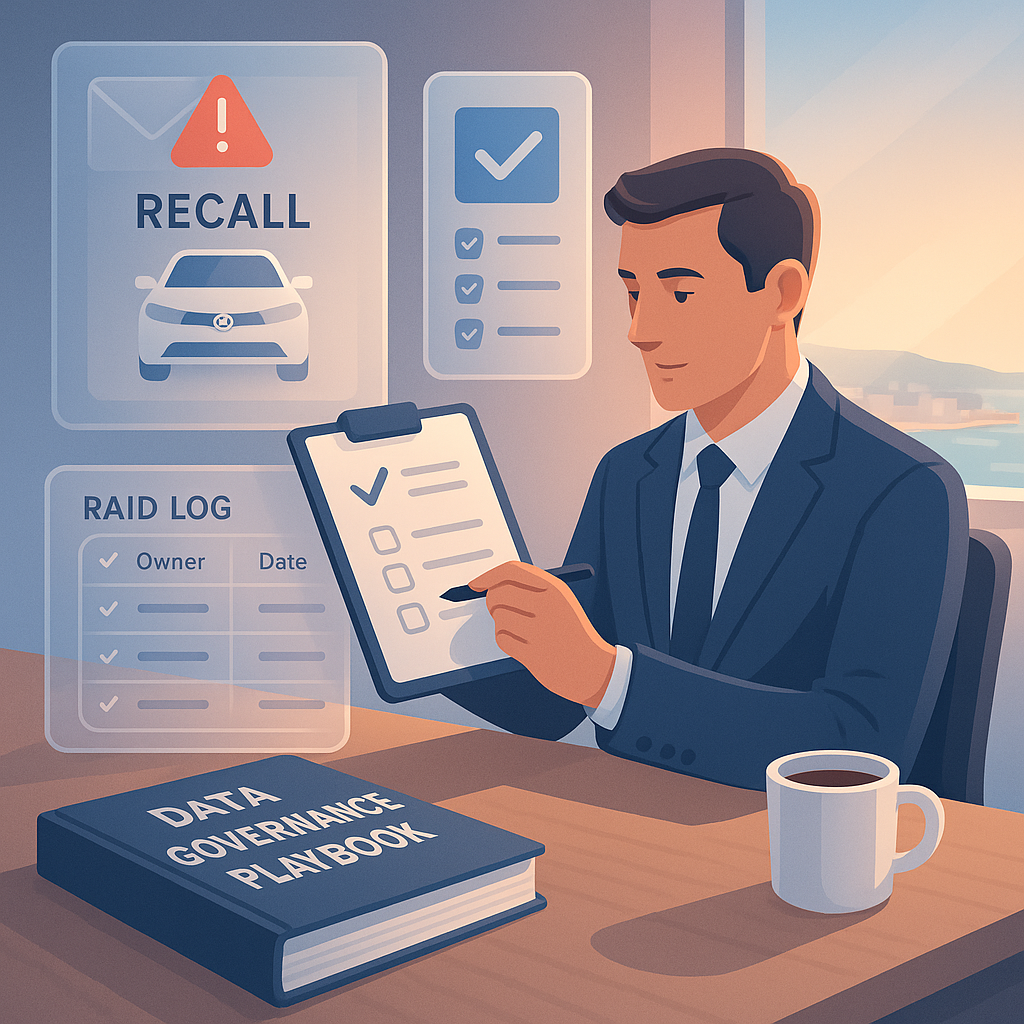
Key Takeaways
- High-profile product recalls are fundamentally data failures, highlighting the critical need for structured incident response beyond manufacturing.
- A data governance playbook transforms reactive crisis management into a proactive, evidence-led process with clear owners and actions.
- Effective governance relies on live, practical documents like risk registers and RAID logs, not static policies left on a shelf.
- The goal is to build organisational resilience, ensuring data incidents are managed calmly and consistently, protecting both customers and brand reputation.
What is a Data Governance Playbook?
Let’s be clear. A data governance playbook is not another 100-page policy document destined to gather dust on a shared drive. It is an actionable, operational guide that outlines the precise steps your organisation will take in response to a data-related incident. Think of it as the delivery plan for when things go wrong. It defines the people, processes, and technologies required to detect, assess, and resolve data issues in a structured and repeatable way.
A good playbook contains clear acceptance criteria for what constitutes an incident, defined roles and responsibilities, pre-approved communication templates, and clear escalation paths. It removes ambiguity when time is tight and stress levels are high. Just yesterday, after stand up, a data quality ticket was flagged as blocked by a sudden upstream API change. Because our playbook had a clear protocol for this, a quick call with the data owner got it sorted. The risk was logged, a new date was set, and we had a clear path to green without any drama or delay. That is the kind of calm, operational rhythm a playbook provides.
From Reactive Firefighting to Proactive Control
The difference between an organisation with a playbook and one without is stark. Without one, an incident triggers a chaotic scramble. Emails fly, meetings are called with no clear agenda, and different stakeholders receive conflicting information. The technical team might be focused on a fix, while legal is concerned with liability, and marketing is trying to manage public perception. This lack of coordination slows down the response, increases the risk of mistakes, and erodes trust.
With a well-rehearsed data governance playbook, the response is immediate and coordinated. The moment an incident is declared, everyone knows their role. The data steward begins the impact assessment, the communications lead prepares the initial holding statement using an approved template, and the technical owner starts the root cause analysis. The process is predictable and transparent, which gives leadership the confidence to make informed decisions. It shifts the entire posture of the organisation from one of fear and reaction to one of control and resilience.
Building Your First Data Governance Playbook: A Practical Guide
Creating a playbook doesn’t need to be a monumental task. It is an iterative process that starts with the most critical risks and expands over time. A pragmatic approach focuses on clarity and action, not exhaustive detail. Here is a straightforward, six-step process to get you started.
- Identify Critical Data Assets and Scenarios: Start by identifying the data that is most critical to your operations. This includes customer PII, financial records, and key operational datasets. Then, workshop 3-5 realistic incident scenarios, such as a data breach, a major data quality failure, or a critical system outage.
- Define Roles and Responsibilities (RACI): For each scenario, map out who is Responsible, Accountable, Consulted, and Informed. Key roles often include a Data Owner (business accountability), a Data Steward (operational management), and an Incident Lead (coordination). Be specific and name individuals where possible.
- Establish Triage and Severity Criteria: Define what constitutes a P1 (critical) versus a P4 (low) incident. Criteria should be based on measurable impacts like the number of customers affected, potential financial loss, or regulatory implications. This ensures that the response is proportional to the risk.
- Map Communication Protocols: This is a vital step for effective recall communications or any incident response. Determine who needs to be notified, by what channel (e.g., email, Slack, phone call), and at what frequency. Prepare simple, pre-approved templates for internal updates and external holding statements.
- Document Standard Operating Procedures (SOPs): For each scenario, outline the high-level steps for containment, investigation, and resolution. For example, an SOP for a data breach might include isolating the affected system, preserving logs for forensic analysis, and initiating the user notification process.
- Schedule and Conduct Regular Drills: A playbook is only effective if it is tested. Run tabletop exercises at least twice a year to walk through a scenario. This builds muscle memory and reveals gaps in the plan before a real crisis occurs. Update the playbook based on the lessons learned.
The Role of RAID Logs and Risk Registers
A playbook is a response mechanism, but true governance is about proactive risk management. This is where tools like RAID logs and risk registers become indispensable. A RAID log (Risks, Assumptions, Issues, Dependencies) is a living document used to track anything that could derail your data operations. It is not just for one-off projects; it should be a central part of your team’s weekly rhythm, ensuring that potential problems are surfaced and assigned an owner before they escalate.
Similarly, a risk register is a formal repository for cataloguing and prioritising potential data-related threats. Each entry should detail the risk, its potential impact, its likelihood, and the proposed mitigation strategy. But a list is not enough. Your risk register is useless if it is just a collection of worries. Each risk needs a mitigation plan, an owner, and a review date. If your plan has no named owners and dates, it is not a plan, fix it. This accountability is the engine of effective governance, turning a passive document into an active management tool.
Faq
How is a data governance playbook different from a data strategy?
A data strategy sets the long-term vision and goals for how an organisation will use data to achieve its objectives. It is the “why” and “what”. A data governance playbook is the operational “how” for a specific set of circumstances, namely data incidents. It is a tactical, actionable guide for response, whereas the strategy is a high-level plan for value creation.
Who should own the data governance playbook?
The playbook should be sponsored by the Chief Data Officer or equivalent, with clear ownership shared between data governance leads, security, and the operational teams who execute the steps. Name accountable individuals, not just job titles, so escalations are never ambiguous.
How often should we rehearse the playbook?
Run tabletop or live-fire exercises at least twice a year. After each drill, capture timings, blockers, and recommendations, then update the playbook and RAID log so improvements land in the day-to-day rhythm.
Next Step: Bring DNA Connect Into the Room
High-profile recalls prove that governance gaps surface fast when pressure arrives. DNA Connect helps enterprise data teams map those gaps, sharpen their playbooks, and run the drills before the regulator or press does it for you.
Book a DNA Connect governance workshop this week. We will review your current playbook, stress-test a live scenario, and leave you with a clear action plan, named owners, and dates you can take straight into stand up.