Full article
Overview
Gas supply disruption reporting is useful because it strips performance back to first principles. Can a team spot the issue early, route work quickly, coordinate dependencies, and prove what happened when the pressure goes up? In practice, that is the difference between a response and a story about a response.
For UK operations leaders, the opportunity is fairly clear. Recent energy-sector reporting from bodies such as Ofgem, the Department for Energy Security and Net Zero, and National Gas has kept returning to the same operational themes: visibility, contingency design, scenario planning and disciplined communication. That makes it worth a closer look as a campaign case study UK teams can learn from, especially where delivery credibility shapes commercial positioning.
Context
Gas supply disruption is not only an energy issue. It is a compressed version of a broader operational problem facing organisations in logistics, customer service, field delivery, facilities management and regulated communications. When supply tightens or demand shifts suddenly, leadership tends to ask the same three questions: what do we know, what are we doing, and what evidence supports the next move?
The UK has had repeated reminders that resilience is operational, not theoretical. Since the market volatility that followed Russia’s invasion of Ukraine in 2022, public discussion from DESNZ, Ofgem and National Gas has focused on storage, import flexibility, balancing and demand scenarios. The useful lesson is not the technical detail alone. It is the discipline of reporting against scenarios and constraints rather than optimistic assumptions.
There is a cultural point here as well. Energy reporting usually separates signal from noise. It tracks concrete indicators such as linepack, storage levels, imports, balancing actions and customer impact. Other sectors often gather broad status updates, then discover too late that none of them proves execution. A strategy that cannot survive contact with operations is not strategy, it is branding copy.
What is changing
Three shifts stand out. First, the threshold for proof has risen. Boards, regulators and clients now expect more than a continuity plan sitting quietly in a folder. Ofgem’s resilience and consumer protection work has reinforced the point that controls need to work in practice, especially where vulnerable customers could be affected. Good intentions do not count as evidence.
Second, organisations are moving from static planning to live activation design. Across UK resilience guidance, the emphasis has shifted towards trigger points, rehearsals, escalation paths and multi-party coordination. The value now sits in the activation logic: who decides, on what data, at which threshold, within what timeframe.
Third, reporting itself has become part of delivery performance. During a disruption, updates shape customer behaviour, partner confidence and internal decision quality. If an external update goes out before the internal facts are stable, the team often spends the next six hours correcting its own work. To be fair, many organisations only learn that once.
The caveat is worth stating. A gas network is not a retail fleet, a SaaS support desk or a field-service operation. Risk tolerances and service economics differ. Even so, the underlying operating principle transfers well: speed only helps when the evidence is strong enough to support the decision.
What the reporting gets right
Gas disruption reporting tends to outperform the average incident report in four areas.
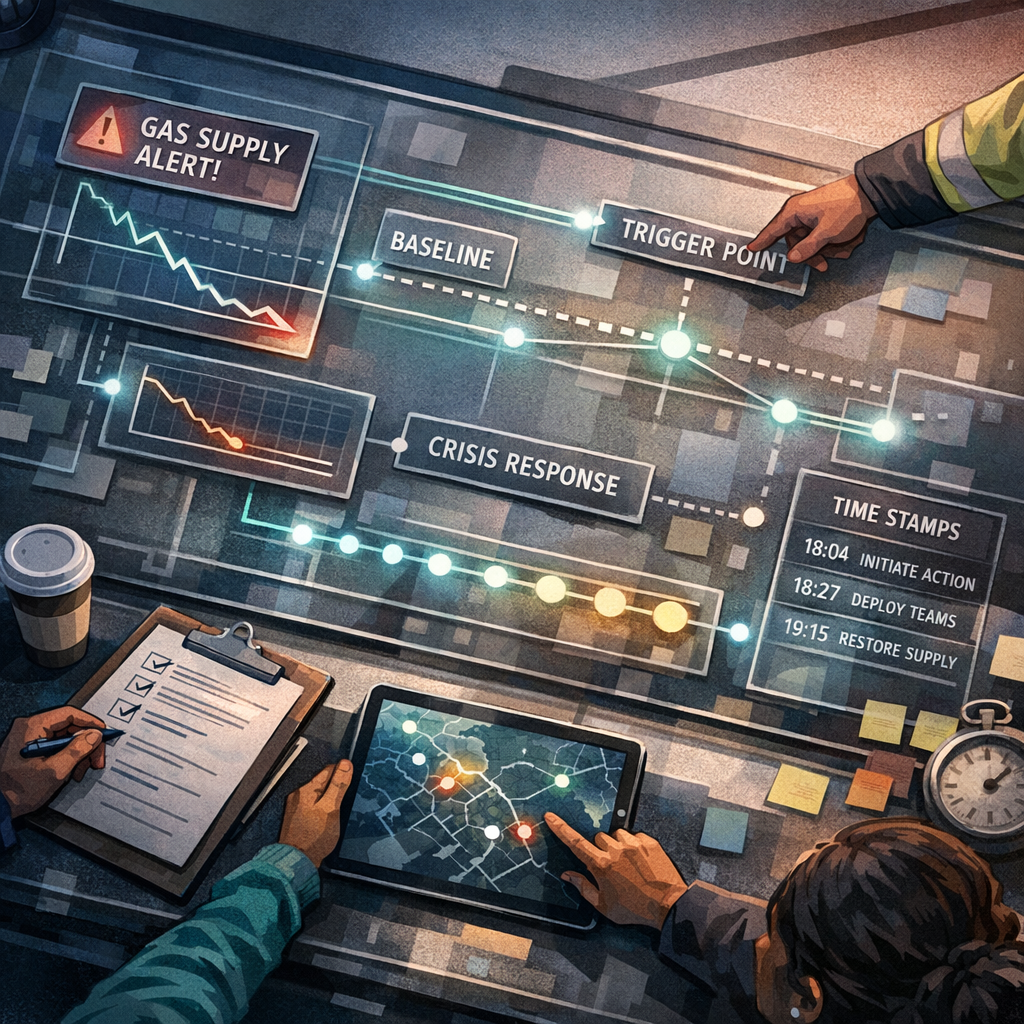
First, it starts with a baseline. Teams know what normal looks like, so they can identify deviation early. Without a baseline, dashboards become theatre. The same rule applies elsewhere: growth claims without baseline evidence should be parked until the data catches up.
Second, it uses timestamped escalation. Better reports show when an alert was raised, when balancing action began, when supplier coordination started and when customer messaging was issued. That sequence creates a usable record rather than a vague narrative assembled afterwards.
Third, it recognises dependencies. Field operations, data feeds, maintenance windows, supplier actions and customer communications all interact. In a strategy call this week, we tested two paths and dropped one after the first hard metric came in. That is the discipline worth borrowing. When one dependency moves, the sequence should change with it.
Fourth, stronger reporting uses caveated confidence. Government winter briefings and network outlooks tend to distinguish between confirmed conditions, likely scenarios and contingent risks, often with weather and import assumptions made explicit. That is good operational writing. It gives decision-makers room to act without pretending uncertainty has vanished.
Implications for UK operations teams
The commercial implication is straightforward. Teams that can prove response quality tend to earn trust faster from clients, regulators, senior leadership and front-line staff. Teams that cannot often compensate with meetings, message revisions and general reassurance. That is expensive in any week. In a disruption, it is worse.
For service businesses, the practical lesson is to redesign incident management around evidence capture rather than post-event storytelling. If support, fulfilment, field service and account management all log issues differently, there is no reliable picture when pressure rises. The result is familiar: duplicated work, contradictory updates and no clean view of impact by segment, customer tier or geography.
For commercial and marketing teams, there is a quieter opportunity. A well-run response can become a credible campaign case study UK buyers will actually trust, provided the claims stay modest and the proof is visible. Buyers are increasingly looking for delivery credibility, not just proposition language. If you can show how alerts were triaged, which service levels were protected and what changed within seven days of the incident, you have evidence with transfer value.
There are trade-offs. More rigorous evidence capture can slow teams initially if the workflow is clumsy. Over-instrumentation can create noise as easily as clarity. The answer is not to track everything. It is to track the handful of measures that show whether the response held up: time to detection, time to decision, time to first customer update, service restoration interval, exception rate and issue recurrence over the following week.
Actions to consider
Start small and operational.
First, define the baseline. What does normal look like by channel, region, supplier, team and customer tier? UK resilience guidance from the Cabinet Office has consistently pointed towards explicit triggers and responsibilities. Build those into reporting so teams know when routine variation becomes a managed incident.
Second, create a timestamped response log that sits inside operations, not beside it. Record detection time, owner assignment, first confirmed diagnosis, first customer communication, workaround activation and resolution confirmation. The point is not admin for its own sake. It is reliable delivery evidence that survives scrutiny later.
Third, map dependencies before the next event. Which supplier, dataset, approval step or field team could block activation? Ofgem’s consumer protection stance is useful here because it keeps priority services and vulnerable customers in view. Even outside regulated sectors, segmenting response by customer need is commercially sensible. Not every delay carries the same cost.
Fourth, tie communications to operational thresholds. Drafting a holding statement is easy. Linking each version to a confirmed condition is where the value appears. Use clear states such as unconfirmed issue, confirmed disruption, workaround live and restoration underway.
Fifth, turn the aftermath into usable proof. Within seven days, review the sequence, quantify impact, identify one process fix and one data fix, then publish an internal note. If the evidence is strong enough, develop it into an external case study. The strongest ones are not glossy. They show the baseline, the interruption, the response, the measured outcome and the remaining gap.
Where value appears first
The earliest gains usually show up in three places. Leadership decision speed improves because fewer meetings are needed to establish the basics. Customer confidence improves because updates are more precise and less contradictory. Learning rate improves because post-incident reviews work from shared facts rather than memory.
As it stands, that is the practical lesson from gas supply disruption reporting. Market stress rewards organisations that can observe, decide, activate and evidence their response in one chain. The next move is not another polished deck. It is a reporting spine that holds up when operations get messy. If your team is reviewing response design, or wants to turn delivery performance into a credible external narrative, contact Kosmos and we will help you map the option set, the trade-offs and the evidence worth testing next.