Full article

Last Thursday, in a cramped meeting room at a regional law firm in Canterbury, the head of intake sighed as she scrolled through a spreadsheet full of web enquiries that nobody could use. The air smelt of stale coffee and mild despair. That’s when it clicked again: on regulated legal and advisory websites, the job is not to collect more enquiries. It is to qualify the right ones, route them cleanly and leave an audit trail that stands up when someone sensible asks, “Why did this person see that next step?â€Â
Consumer Duty sharpened that question from July 2023 onwards. For firms using QuickThought-style decision trees, the opportunity is simple enough: create governed journeys that help people explain their situation, stop short of advice, and hand structured facts into intake or case-management without the usual duplicate calls and messy re-keying. Useful automation, in other words. Not theatre.
Context
Consumer Duty came fully into force for open products and services in July 2023, with a clear expectation that firms deliver good outcomes and communicate in ways that are fair, clear and not misleading. That matters at the very first digital touchpoint. If a website implies certainty, asks for more data than it needs, or nudges a vulnerable user down the wrong path, the problem begins before a fee earner has even seen the enquiry.
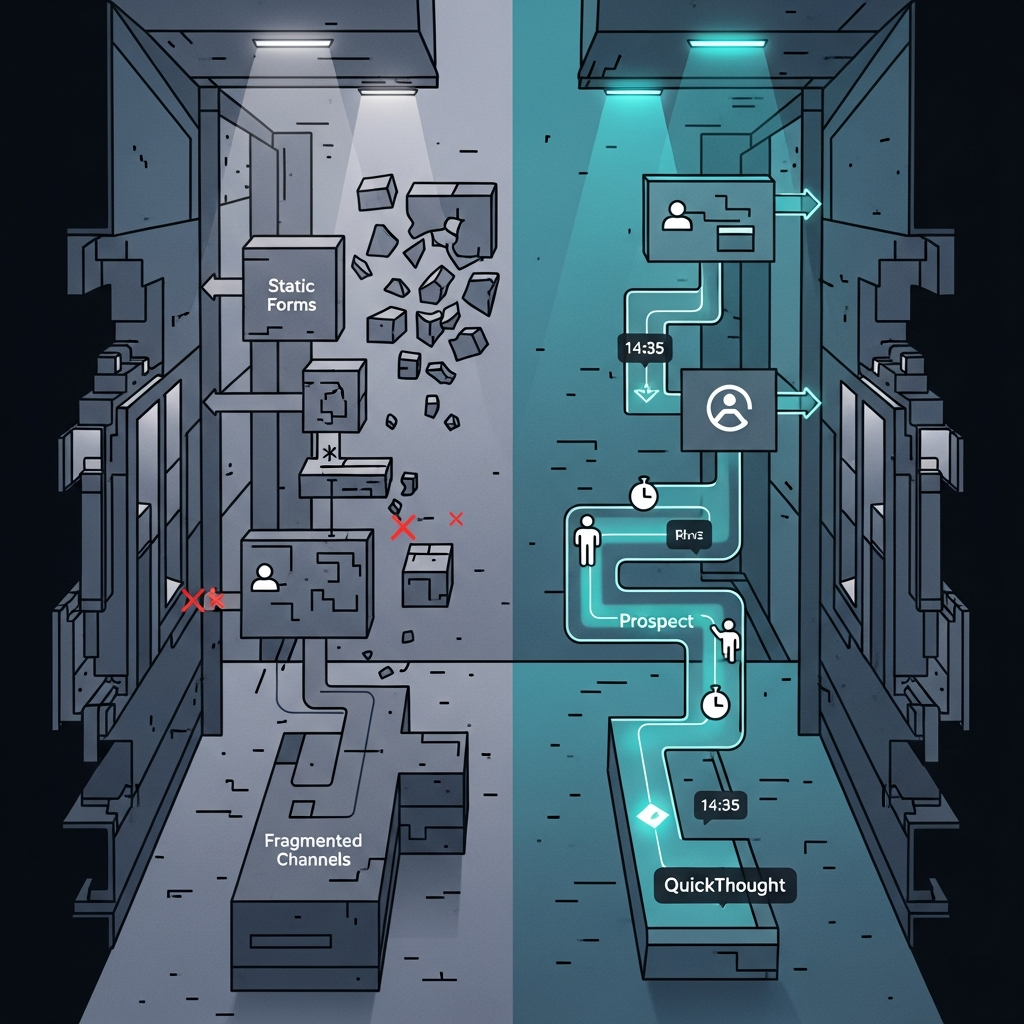
The wider public context matters too, though it needs handling carefully. The Office for National Statistics quarterly personal well-being series shows that measures such as anxiety and life satisfaction still move in ways that remind us people often arrive at advisory and legal websites under stress, not in a leisurely research mood. Simpler journeys reduce friction. Over complicated ones increase abandonment or bad inputs. Last month I reviewed a legal intake flow with a 40% drop-off rate because it asked for sensitive financial detail before establishing whether the matter was even in scope. That is not diligence. It is queue creation.
What is changing
The shift is away from open-ended chat and towards governed qualification. I’m sceptical of any platform that cannot tell you, in plain English, why it routed one enquiry to employment, another to family, and a third to a human callback. If a platform cannot explain its decisions, it does not deserve your budget.
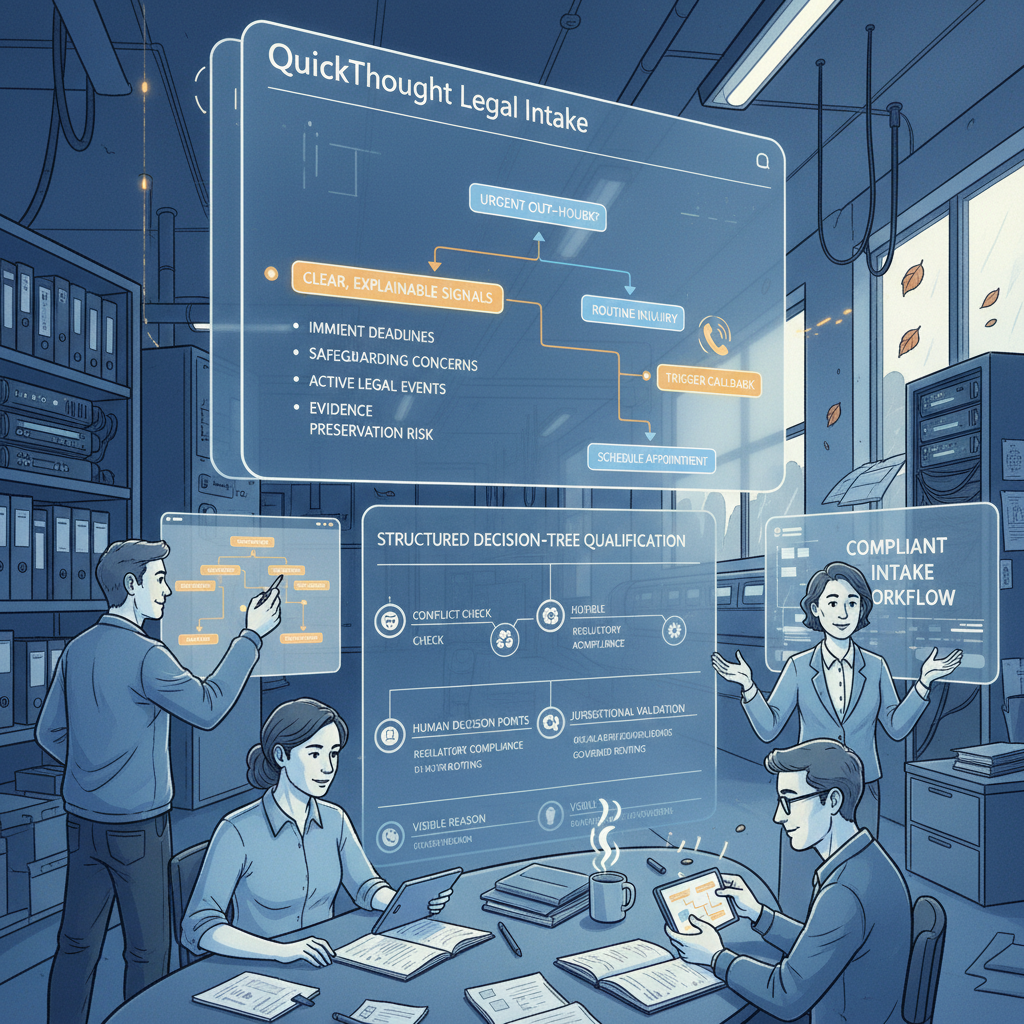
That is why structured decision-tree qualification is gaining ground. A QuickThought journey can ask bounded questions such as issue type, jurisdiction, and urgency, then branch accordingly. It does not need to improvise. In fact, it should not. The aim is to support legal intake qualification, not mimic a solicitor after two paragraphs of prompted text.
In early 2026, a compliance lead at a mid-sized firm in Leeds described the aftermath of a previous chatbot that implied stronger prospects than the facts justified. The result was not clever automation. It was complaint handling, manual clean-up and wasted team hours. The replacement model was far duller, which I mean as praise: the flow stopped on vulnerability signals, avoided probabilistic language and routed edge cases to a person. Less sparkle. Better control.
I still don’t fully understand why some teams remain attached to sprawling forms, but here’s what I’ve observed. When firms cut early-stage capture down to the few fields needed for triage, completion rates tend to improve. A family law practice trimmed an intake form from 15 fields to 5 and saw qualified completions rise by 50%. The trade-off was obvious: less narrative detail at the first touch, more reliance on a proper human follow-up. Fine. That is where nuance belongs anyway.
Where firms stray into advice
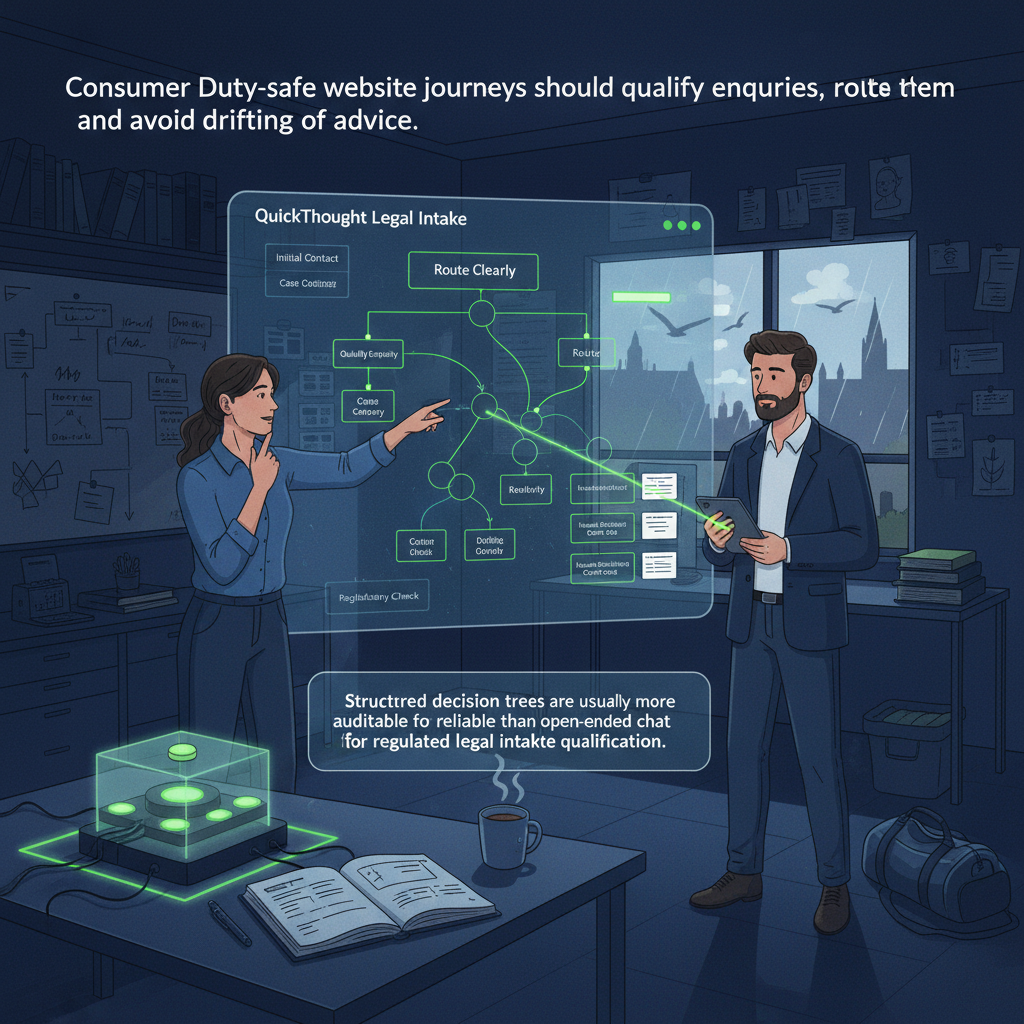
The risk point is usually not malice. It is sloppy product design. A journey starts by “helpingâ€Â, then drifts into interpreting facts, hinting at likely outcomes or sounding more certain than the process really allows. On a regulated website, that drift can create Consumer Duty problems and, depending on the service, wider compliance trouble as well.
The safer pattern is tighter and more useful. Ask questions that establish eligibility, urgency, and routing. Stop before judgement. For example, a housing disrepair flow might ask whether the issue involves damp, mould, or repair delays. It can then route to the right team or callback queue without suggesting legal merit. Likewise, if someone mentions financial distress or mental health concerns, the journey should switch mode and offer a human route rather than pressing for more detail.
The concrete trade-off here is between conversational smoothness and auditability. A free-form chat can feel warmer for thirty seconds, but it is harder to govern and harder to evidence later. A bounded decision tree can feel slightly less chatty, yet every branch has a reason. In regulated operations, that matters more than synthetic charm.
Implications for operations and evidence
Once you view this as an operating model rather than a widget, the priorities become clearer. The hand-off into case-management needs structured fields, decision reasons and routing outcomes, not a wall of transcript text. If the website captured “employment dispute†and “wants callback after 5 p.m.â€Â, those fields should pass straight into the matter-opening workflow.
One Surrey firm piloted an out-of-hours screening flow in January 2026 that captured issue type and callback preference, then pushed the result into its internal system by API. Within a month, duplicate calls were down 25%. That is a modest number, but a believable one, and I trust believable numbers far more than glossy claims about transformation. Privacy-preserving architectures are not a fashionable garnish. They are simply easier to defend.
How to design a QuickThought journey properly
Start with the real intake decisions, not the interface. Which enquiry types are genuinely in scope? Which signals require immediate human review? Which matters should stop because the website cannot safely qualify them? If the answers are vague, the journey will be vague as well.
For most firms, the first layer of legal intake qualification should cover practice area, geography, urgency, and whether the person is seeking information or a next-step conversation. Then define the stop rules. If a user signals vulnerability or a matter that carries obvious sensitivity, stop asking clever questions and route to a person.
Between 6 p.m. and 8 a.m., I tried a stripped-back out-of-hours intake pattern on a similar decision-tree build and one small failure kept appearing: users were abandoning when asked for too much free text. We fixed it with a simple hack: replace the open box with two guided selections and a callback slot. Completion recovered because the path became obvious.
There is a discipline to this. Score the journey against suitability fundamentals before publishing it. If a branch cannot be explained, measured or defended, cut it. Automation without measurable uplift is theatre, not strategy.
What this means for firms using QuickThought
QuickThought is at its best when the brief is not “give us a chatbotâ€Â, but “help us design a governed intake system that qualifies cleanly and hands off properlyâ€Â. That is the difference between a noisy front-end toy and a working operational layer. QuickThought journeys can support compliant website engagement by structuring decisions in real time, limiting unnecessary data capture and passing useful, auditable context into the next system without pretending to offer legal advice.
Cheers , if you want a practical look at where your current journey is leaking quality or overstepping the mark, have a conversation with Holograph and we’ll work through it properly.
If this is on your roadmap, Holograph can help you run a controlled pilot, measure the outcome, and scale only when the evidence is clear.