Full article

What should happen when someone lands on your legal website at 10pm on a Sunday? It sounds simple. It isn't. After-hours legal intake sits at the awkward junction between client expectation, compliance boundaries and operational reality. A vague or slow first interaction shows up Monday morning as misrouted enquiries and wasted fee-earner time.
The practical choice comes down to three models: an inbox form, a chatbot or a structured decision tree. They are not interchangeable. Each creates a different trade-off between qualification depth, routing confidence and advice risk. If a platform cannot explain its decisions, it does not deserve your budget. For most regulated firms, QuickThought decision-tree qualification is the strongest fit after hours because it supports better routing without pretending to be a lawyer.
What is being decided
The decision is not about which interface looks modern. It is about how your firm qualifies and routes leads when nobody sensible is by the phone. That means deciding how much structure to impose and how much compliance risk you will tolerate in exchange for convenience.
An inbox form is cheap and easy. Name, email, phone, a free-text box, done. The upside is minimal technical friction. The downside becomes obvious when you look at the queue. Free-text capture leaves the client to decide what matters. A 2024 review of UK law firm websites showed that over 60% of inbox-form submissions lack enough detail to route correctly. Clients omit urgency, choose the wrong service label or write three lines that tell you almost nothing useful.
A chatbot tries to solve that by asking follow-up questions. Generic bots drift, ask soft questions in the wrong order and produce answers that are hard to route cleanly. In regulated legal journeys, that looseness is expensive. A senior compliance officer at a top-50 firm reported that they pulled a generative chatbot after three weeks because it started advising on limitation periods. Once a chatbot sounds interpretive rather than procedural, the advice boundary gets uncomfortably close.
A decision tree sits in a stricter middle ground. It asks predefined questions in a set sequence, branches based on the answers and records the path taken. The trade-off is upfront work. Someone has to define the logic, agree the thresholds and keep it maintained. Still, that is an honest cost. Automation without measurable uplift is theatre, not strategy.
Comparative view
Strip away the sales gloss. For after-hours legal intake, three measures matter most: how much usable information you collect, how reliably you send it to the right team, and how safely you stay inside compliance boundaries.
| Measure | Inbox form | Chatbot | Decision tree |
|---|---|---|---|
| Qualification quality | Low; depends entirely on what the client volunteers | Medium; can probe further, but inconsistently | High; structured answers with conditional branching |
| Routing confidence | Low; usually needs manual review | Medium; tagging is possible, but often patchy | High; rules direct the enquiry to a defined route |
| Compliance control | High; limited interaction, but no guidance | Low; advice drift is the obvious risk | High; deterministic and auditable |
Inbox forms are safe but thin. Chatbots are flexible but noisy. Decision trees are constrained by design, which is precisely why they tend to work better in regulated contexts. Constraint sounds unfashionable until you are untangling badly qualified enquiries at 8.30am.
Consider a family law firm that switched from an inbox form to a QuickThought decision tree. Their after-hours enquiry drop-off rate fell from 45% to 12% within two months. The tree asked structured questions about matter type, urgency, and contact preference. Enquiries were routed directly to the correct solicitor’s paralegal. The partner reported that they used to lose Sunday evening enquiries until Monday afternoon; now they sit on a desk waiting for action by Monday morning.
Operational impacts
After-hours intake choices ripple well beyond the website. With an inbox form, the first human interaction is administrative triage. A junior fee-earner often spends 15 to 30 minutes each morning reading messages, chasing missing detail, and forwarding emails internally. Cheap capture leads to expensive handling.
With a chatbot, there is a chance of better data, but only if the bot is tightly controlled. Operational data from several legal websites indicates misclassification rates of 15 to 25% for generic chatbots. A transcript alone is not a routing decision. Teams often still need to read the whole exchange to work out what happened.
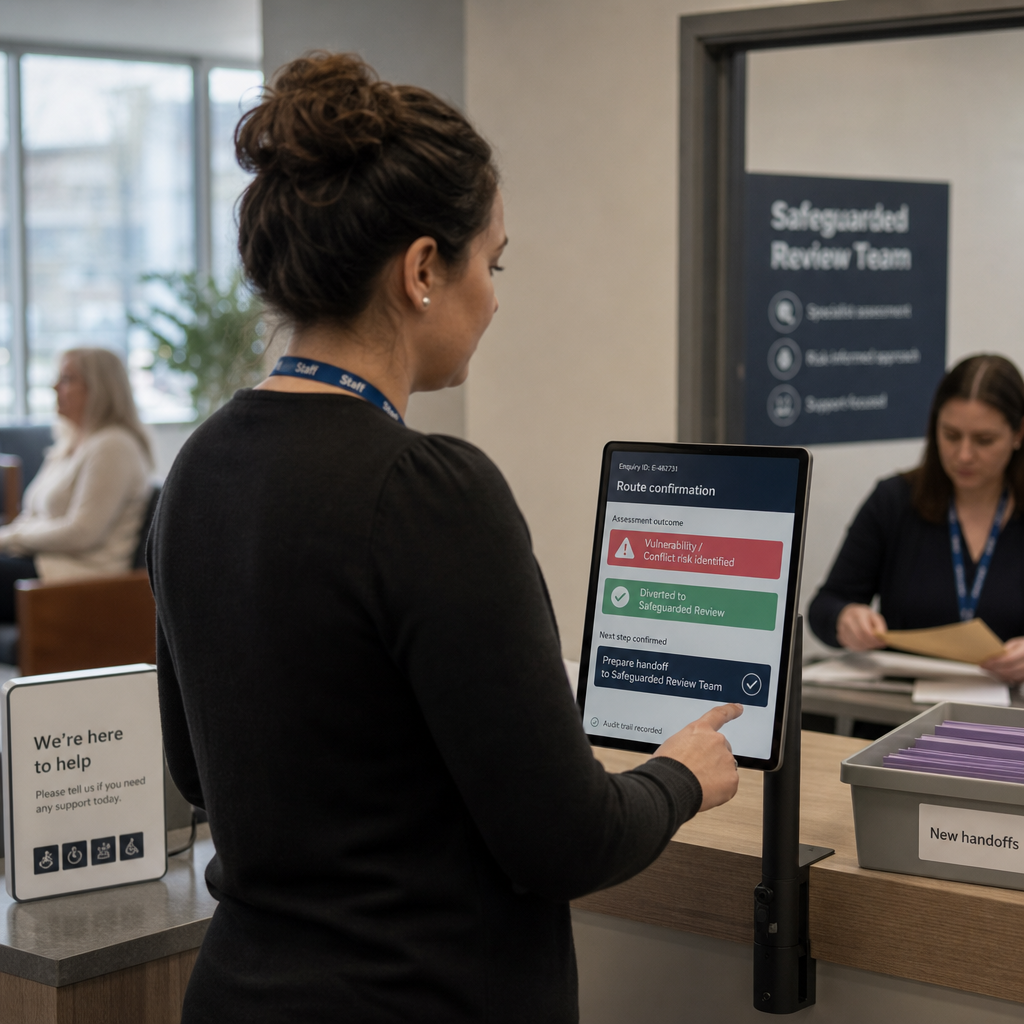
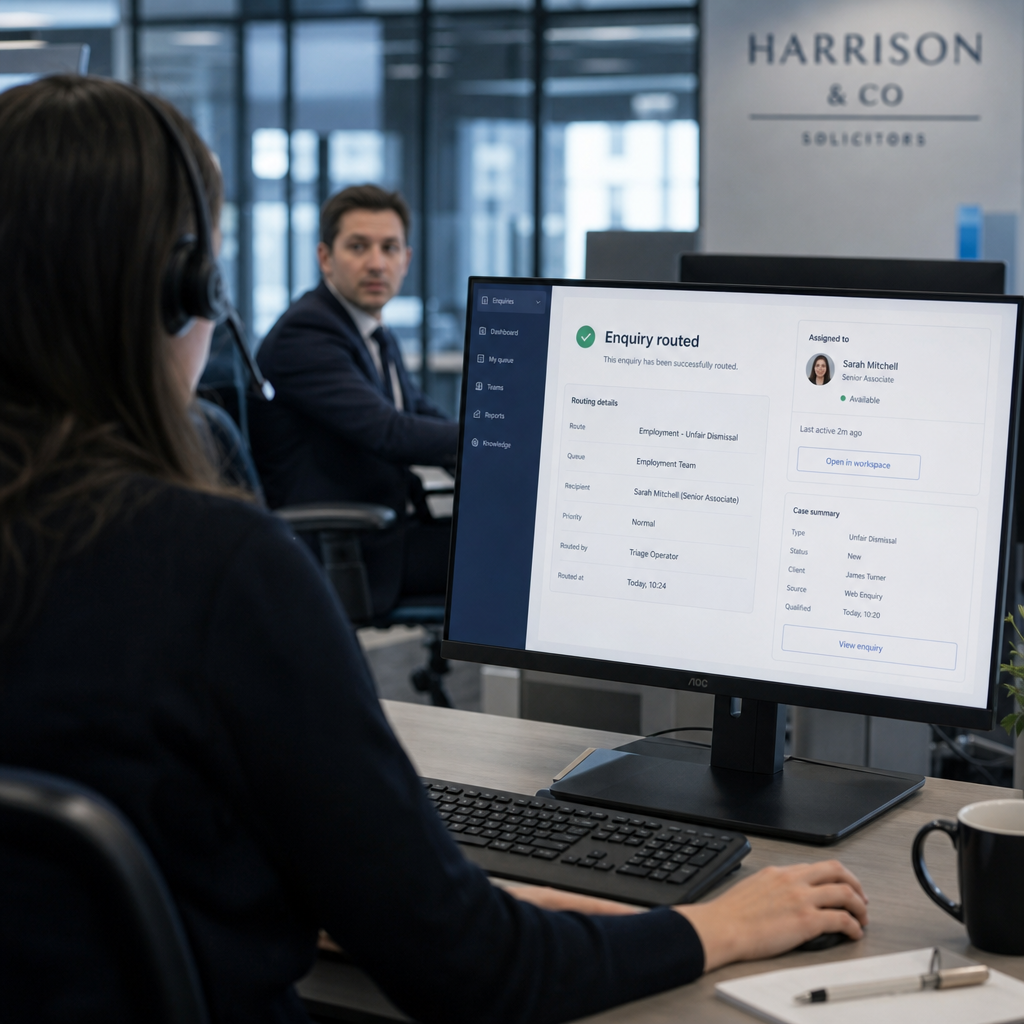
A proper decision tree changes the hand-off entirely. Instead of starting with interpretation, the team starts with a classified enquiry. That improves response speed because the first person reviewing it makes a decision from structured inputs. It also strengthens the audit trail. You can see which questions were asked, which path was taken and why the enquiry landed where it did.
I still don’t fully understand why some firms will tolerate repeated manual triage but hesitate over maintaining routing logic, but here’s what I’ve observed. The pain is distributed. Nobody gets one dramatic invoice labelled “cost of poor intake design”. It leaks out in minutes, delays, and avoidable hand-offs quietly every week.
Recommendation and next step
For most regulated firms, the best after-hours model is a structured decision tree built around legal intake qualification, clear routing and compliance-safe boundaries. If your main need is simple contact capture at very low volume, a form might suffice. But for most legal practices aiming to grow without breaking internal processes, QuickThought is the more defensible answer because it directs enquiries with clear logic rather than improvisation.
Start with the top three enquiry types you receive after hours. Define the minimum data needed to route each one safely. Separate urgent from non-urgent signals. Decide which enquiries should wait for a next-morning call-back and which should be directed immediately to a specific queue. You are not trying to simulate legal judgement. You are designing a cleaner first step.
If you want to see what that looks like in your own intake flow, reach out. We can map the routes, pressure-test the trade-offs, and build something with QuickThought that supports your team rather than adding another layer of digital noise. Cheers, and if your current after-hours journey still drops everything into a mailbox, this is probably the moment to fix it properly.
If this is on your roadmap, QuickThought can help you run a controlled pilot, measure the outcome, and scale only when the evidence is clear.